Japan Marrow Donor Program, Tokyo, Japan; Division of Epidemiology and Prevention, Aichi Cancer Center Research Institute, Nagoya, Japan.
Biol Blood Marrow Transplant. 2013 Aug;19(8):1197-203. doi: 10.1016/j.bbmt.2013.05.020. Epub 2013 Jun 6.
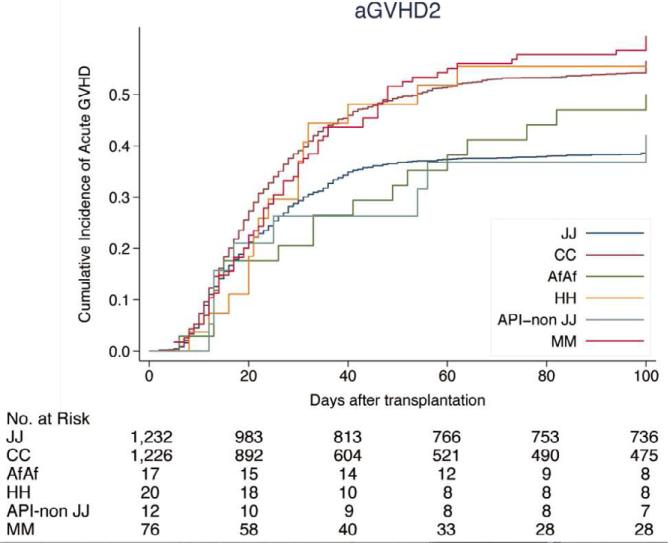
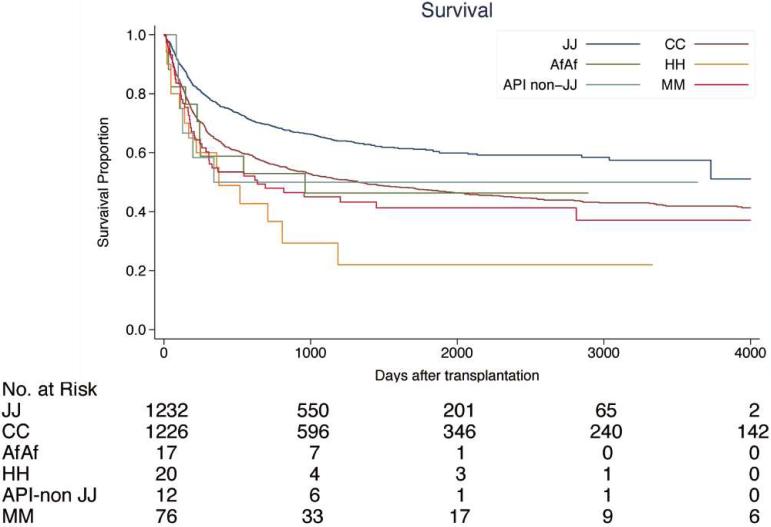
The significance of patient and donor ethnicity on risk of acute graft-versus-host disease (GVHD) and disease relapse after unrelated donor hematopoietic cell transplantation (HCT) is not known. A total of 4335 patient-donor pairs from the International Histocompatibility Working Group in HCT met the following 3 criteria: (1) HLA-A, -B, -C, -DRB1, and -DQB1 allele matched donor, (2) diagnosis of leukemia, and (3) non-T cell depleted GVHD prophylaxis. Posttransplantation risks of acute GVHD and leukemia relapse were defined in Asian/Pacific Islander, white, African American, Hispanic, and Native American patients that underwent transplantation from donors with the same self-described background. Asian patients had a significantly lower incidence of acute GVHD (Japanese patients: 40.0% grades II to IV and 15.3% grades III to IV; non-Japanese Asian patients: 42.1% grades II to IV and 15.7% grades III to IV) compared with white patients (56.5% grades II to IV and 22.6% grades III to IV) (P < .001). The hazard ratio of acute GVHD for white patients was significantly higher than for Japanese patients. Unexpectedly, the hazard ratio of leukemia relapse in white patients with early disease status was also significantly higher than that in Japanese patients. These results provide a platform for future investigation into the genetic factors for unrelated donor HCT and clinical implications of diverse ethnic background.
患者和供者种族对无关供者造血细胞移植(HCT)后发生急性移植物抗宿主病(GVHD)和疾病复发的风险的意义尚不清楚。共有 4335 对来自 HCT 国际组织相容性工作组的患者-供者符合以下 3 个标准:(1)HLA-A、-B、-C、-DRB1 和-DQB1 等位基因匹配的供者,(2)诊断为白血病,和(3)非 T 细胞耗竭性 GVHD 预防。在接受相同自我描述背景的供者进行移植的亚洲/太平洋岛民、白种人、非裔美国人、西班牙裔和美洲原住民患者中,定义了移植后发生急性 GVHD 和白血病复发的风险。与白种人(56.5%为 II 至 IV 级,22.6%为 III 至 IV 级)相比,亚洲患者(日本患者:40.0%为 II 至 IV 级,15.3%为 III 至 IV 级;非日本亚洲患者:42.1%为 II 至 IV 级,15.7%为 III 至 IV 级)发生急性 GVHD 的发生率明显较低(P<0.001)。白种人发生急性 GVHD 的风险比明显高于日本人。出乎意料的是,早期疾病状态的白种人白血病复发的风险比也明显高于日本人。这些结果为进一步研究无关供者 HCT 的遗传因素和不同种族背景的临床意义提供了一个平台。