Stem Cell & Neurotherapies, Institute of Human Development, Faculty of Medical and Human Sciences, University of Manchester, Manchester, UK.
Mol Ther. 2013 Oct;21(10):1938-49. doi: 10.1038/mt.2013.141. Epub 2013 Jun 7.
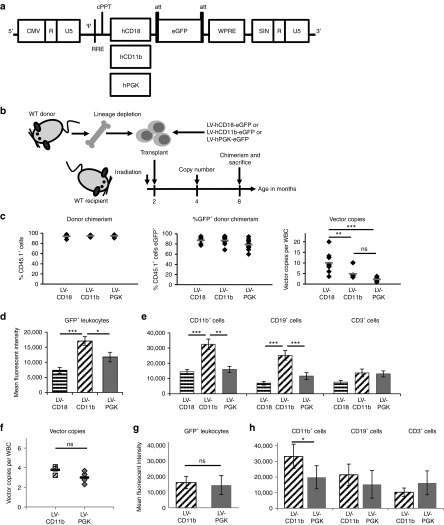
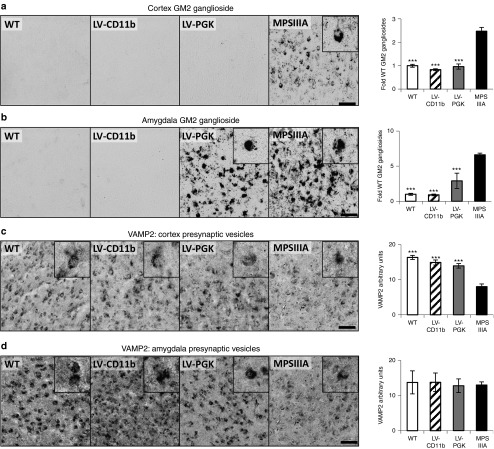
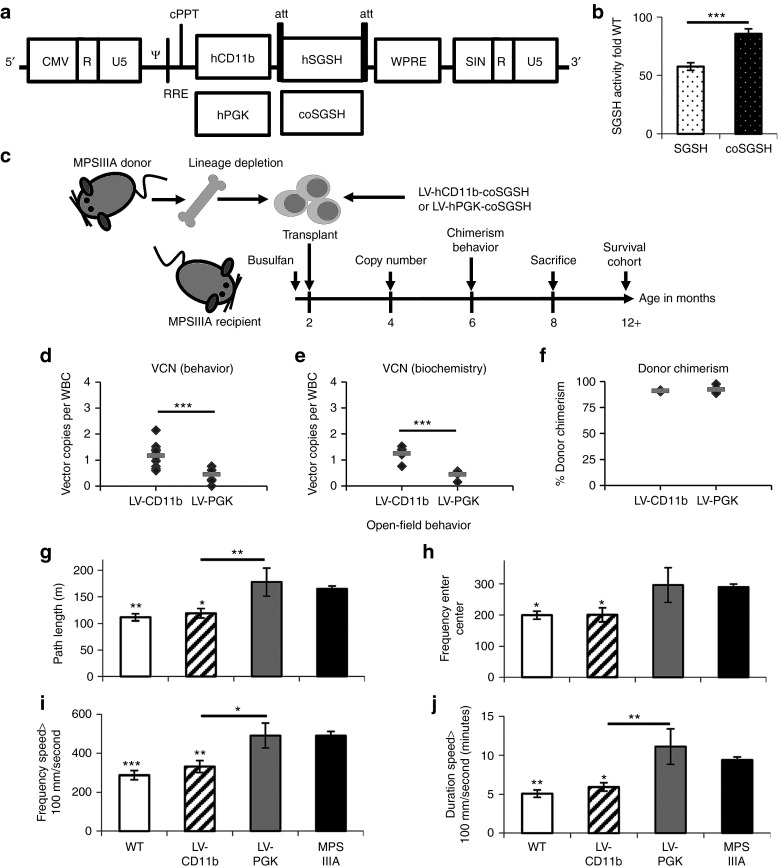
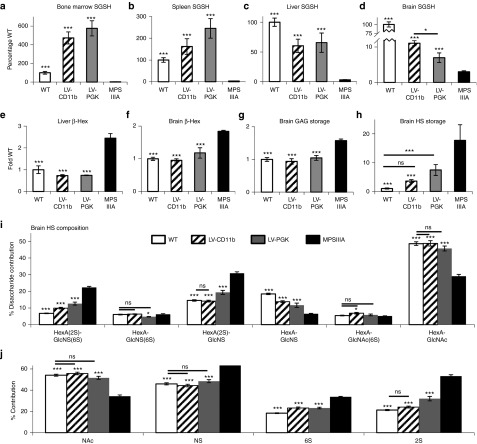
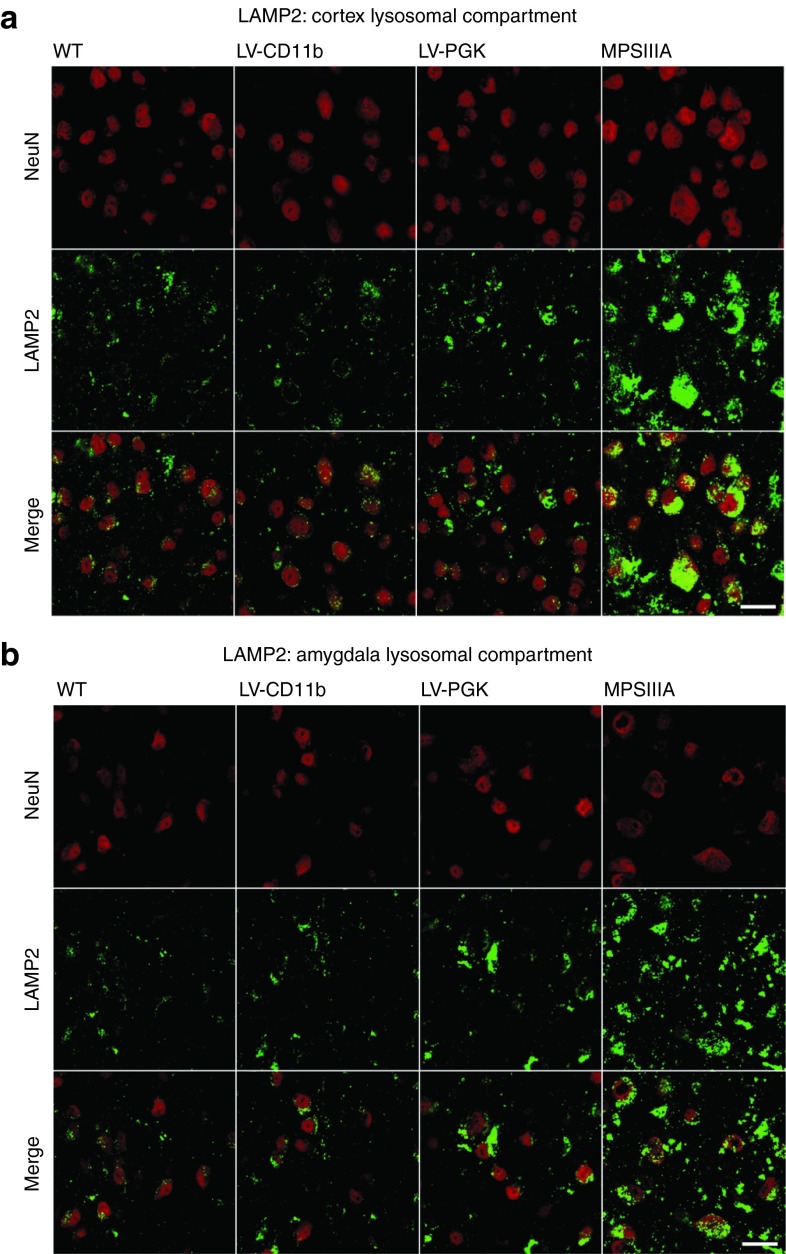
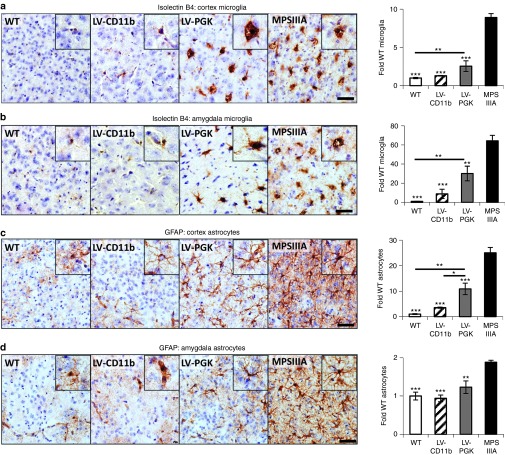
Mucopolysaccharidosis type IIIA (MPSIIIA) is a lysosomal storage disorder caused by mutations in N-sulfoglucosamine sulfohydrolase (SGSH), resulting in heparan sulfate (HS) accumulation and progressive neurodegeneration. There are no treatments. We previously demonstrated improved neuropathology in MPSIIIA mice using lentiviral vectors (LVs) overexpressing SGSH in wild-type (WT) hematopoietic stem cell (HSC) transplants (HSCTs), achieved via donor monocyte/microglial engraftment in the brain. However, neurological disease was not corrected using LVs in autologous MPSIIIA HSCTs. To improve brain expression via monocyte/microglial specificity, LVs expressing enhanced green fluorescent protein (eGFP) under ubiquitous phosphoglycerate kinase (PGK) or myeloid-specific promoters were compared in transplanted HSCs. LV-CD11b-GFP gave significantly higher monocyte/B-cell eGFP expression than LV-PGK-GFP or LV-CD18-GFP after 6 months. Subsequently, autologous MPSIIIA HSCs were transduced with either LV-PGK-coSGSH or LV-CD11b-coSGSH vectors expressing codon-optimized SGSH and transplanted into MPSIIIA mice. Eight months after HSCT, LV-PGK-coSGSH vectors produced bone marrow SGSH (576% normal activity) similar to LV-CD11b-coSGSH (473%), but LV-CD11b-coSGSH had significantly higher brain expression (11 versus 7%), demonstrating improved brain specificity. LV-CD11b-coSGSH normalized MPSIIIA behavior, brain HS, GM2 ganglioside, and neuroinflammation to WT levels, whereas LV-PGK-coSGSH partly corrected neuropathology but not behavior. We demonstrate compelling evidence of neurological disease correction using autologous myeloid driven lentiviral-HSC gene therapy in MPSIIIA mice.
III 型黏多糖贮积症(MPSIIIA)是一种溶酶体贮积症,由 N-磺基葡萄糖胺磺基水解酶(SGSH)突变引起,导致硫酸乙酰肝素(HS)积累和进行性神经退行性变。目前尚无治疗方法。我们之前通过供体单核细胞/小胶质细胞在大脑中的植入,在野生型(WT)造血干细胞(HSC)移植(HSCT)中使用过表达 SGSH 的慢病毒载体(LV),在 MPSIIIA 小鼠中证明了神经病理学的改善。然而,在自体 MPSIIIA HSCT 中使用 LV 并不能纠正神经疾病。为了通过单核细胞/小胶质细胞特异性来提高脑表达,我们比较了在移植的 HSCs 中,由泛磷酸甘油激酶(PGK)或髓系特异性启动子驱动的表达增强型绿色荧光蛋白(eGFP)的 LV。6 个月后,LV-CD11b-GFP 比 LV-PGK-GFP 或 LV-CD18-GFP 显著提高了单核细胞/ B 细胞 eGFP 的表达。随后,用表达优化密码子的 SGSH 的 LV-PGK-coSGSH 或 LV-CD11b-coSGSH 转导自体 MPSIIIA HSCs,并将其移植到 MPSIIIA 小鼠中。HSCT 后 8 个月,LV-PGK-coSGSH 载体产生的骨髓 SGSH(正常活性的 576%)与 LV-CD11b-coSGSH(473%)相似,但 LV-CD11b-coSGSH 的脑表达显著更高(11 比 7%),表明脑特异性提高。LV-CD11b-coSGSH 将 MPSIIIA 的行为、脑 HS、GM2 神经节苷脂和神经炎症正常化为 WT 水平,而 LV-PGK-coSGSH 部分纠正了神经病理学但没有纠正行为。我们在 MPSIIIA 小鼠中使用自体髓系驱动的慢病毒-HSC 基因治疗证明了神经疾病纠正的有力证据。