Stott Colin, White Linda, Wright Stephen, Wilbraham Darren, Guy Geoffrey
GW Pharma Ltd, Porton Down Science Park Salisbury, Wiltshire, SP4 0JQ UK.
Springerplus. 2013 May 24;2(1):236. doi: 10.1186/2193-1801-2-236. Print 2013 Dec.
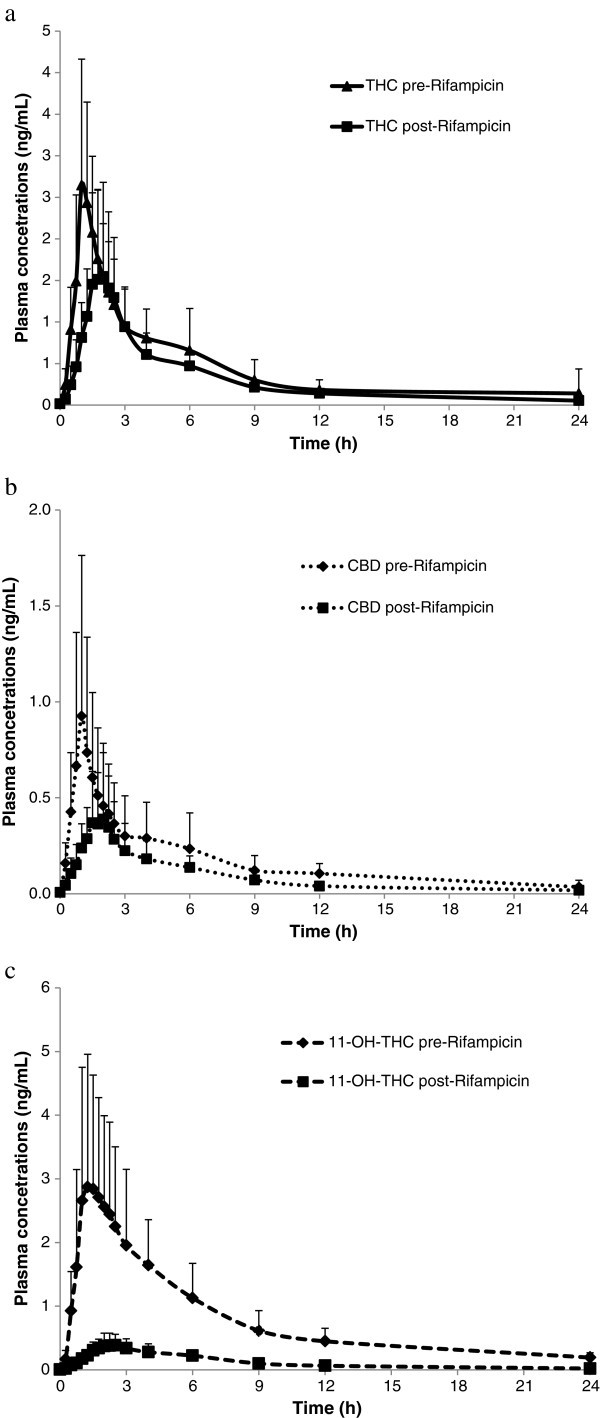
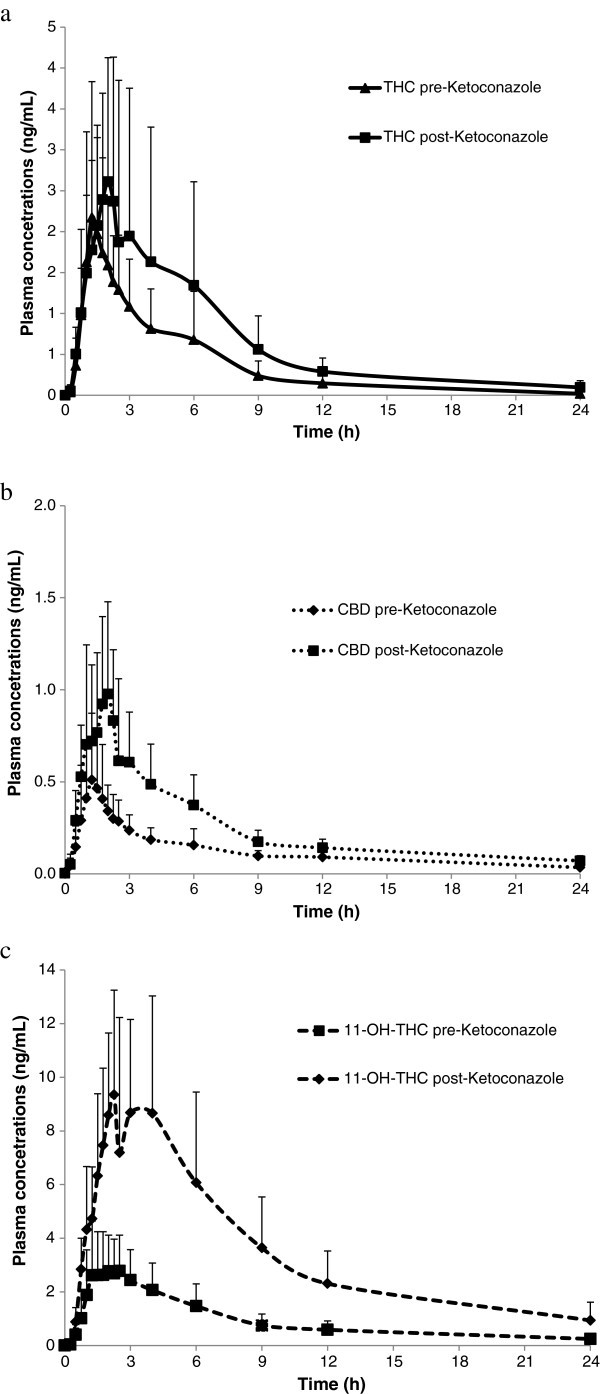
This Phase I study aimed to assess the potential drug-drug interactions (pharmacokinetic [PK] and safety profile) of Δ9-tetrahydrocannabinol (THC)/cannabidiol (CBD) oromucosal spray (Sativex (®), nabiximols) in combination with cytochrome P450 (CYP450) inducer (rifampicin) or inhibitors (ketoconazole or omeprazole). Thirty-six healthy male subjects were divided into three groups of 12, and then randomized to one of two treatment sequences per group. Subjects received four sprays of THC/CBD (10.8/10 mg) alongside single doses of the CYP3A and 2C19 inducer rifampicin (600 mg), CYP3A inhibitor ketoconazole (400 mg) or CYP2C19 inhibitor omeprazole (40 mg). Plasma samples were analyzed for CBD, THC and its metabolite 11-hydroxy-THC (11-OH-THC). A single dose of four sprays of THC/CBD spray (10.8/10 mg) following repeated doses of rifampicin (600 mg) reduced the Cmax and AUC of all analytes. Cmax reduced from 2.94 to 1.88 ng/mL (-36%), 1.03 to 0.50 ng/mL (-52%) and 3.38 to 0.45 ng/mL (-87%) for THC, CBD and 11-OH-THC, respectively compared to single dose administration of THC/CBD spray alone. Ketoconazole co-administration with THC/CBD spray had the opposite effect, increasing the Cmax of the respective analytes from 2.65 to 3.36 ng/mL (+27%), 0.66 to 1.25 ng/mL (+89%) and 3.59 to 10.92 ng/mL (+204%). No significant deviations in Cmax or AUC for any analyte were observed when THC/CBD spray was co-administered with omeprazole. THC/CBD spray was well tolerated by the study subjects both alone and in combination with rifampicin, ketoconazole and omeprazole. Evaluation of the PKs of THC/CBD spray alone and in combination with CYP450 inhibitors/inducers suggests that all analytes are substrates for the isoenzyme CYP3A4, but not CYP2C19. On the basis of our findings, there is likely to be little impact on other drugs metabolized by CYP enzymes on the PK parameters of THC/CBD spray, but potential effects should be taken into consideration when co-administering THC/CBD spray with compounds which share the CYP3A4 pathway such as rifampicin or ketoconazole.
NCT01323465.
本I期研究旨在评估Δ9-四氢大麻酚(THC)/大麻二酚(CBD)口腔黏膜喷雾剂(Sativex(®),纳布西莫尔)与细胞色素P450(CYP450)诱导剂(利福平)或抑制剂(酮康唑或奥美拉唑)联合使用时的潜在药物相互作用(药代动力学[PK]和安全性)。36名健康男性受试者分为3组,每组12人,然后随机分为每组两种治疗顺序之一。受试者接受4喷THC/CBD(10.8/10mg),同时服用单剂量的CYP3A和2C19诱导剂利福平(600mg)、CYP3A抑制剂酮康唑(400mg)或CYP2C19抑制剂奥美拉唑(40mg)。分析血浆样本中的CBD、THC及其代谢物11-羟基-THC(11-OH-THC)。在重复服用利福平(600mg)后单次服用4喷THC/CBD喷雾剂(10.8/10mg)降低了所有分析物的Cmax和AUC。与单独单次服用THC/CBD喷雾剂相比,THC、CBD和11-OH-THC的Cmax分别从2.94降至1.88ng/mL(-36%)、1.03降至0.50ng/mL(-52%)和3.38降至0.45ng/mL(-87%)。酮康唑与THC/CBD喷雾剂联合使用产生相反效果,使各分析物的Cmax从2.65增至3.36ng/mL(+27%)、0.66增至1.25ng/mL(+89%)和3.59增至10.92ng/mL(+204%)。当THC/CBD喷雾剂与奥美拉唑联合使用时,未观察到任何分析物的Cmax或AUC有显著偏差。THC/CBD喷雾剂单独使用以及与利福平、酮康唑和奥美拉唑联合使用时,研究受试者均耐受性良好。单独及与CYP4!0抑制剂/诱导剂联合使用时对THC/CBD喷雾剂药代动力学的评估表明,所有分析物均是同工酶CYP3A4的底物,而非CYP2C19的底物。根据我们的研究结果,CYP酶代谢的其他药物对THC/CBD喷雾剂的PK参数可能影响不大,但在将THC/CBD喷雾剂与共享CYP3A4途径的化合物如利福平或酮康唑联合使用时,应考虑潜在影响。
NCT01323465。