Department of Molecular, Cellular and Biomedical Sciences, Center for Molecular and Comparative Endocrinology, University of New Hampshire Durham, NH, USA.
Front Neurosci. 2013 May 28;7:88. doi: 10.3389/fnins.2013.00088. eCollection 2013.
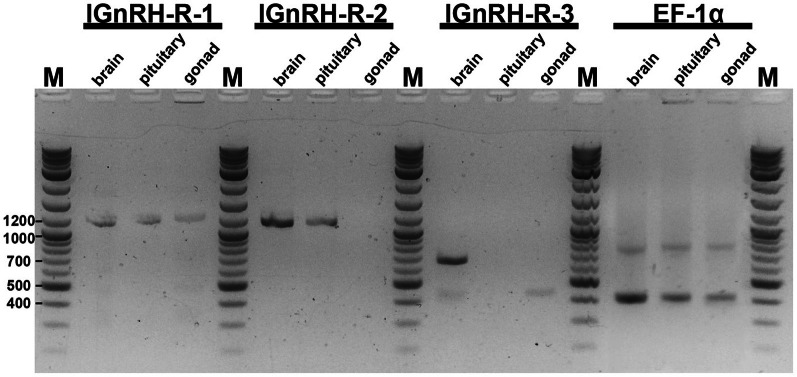
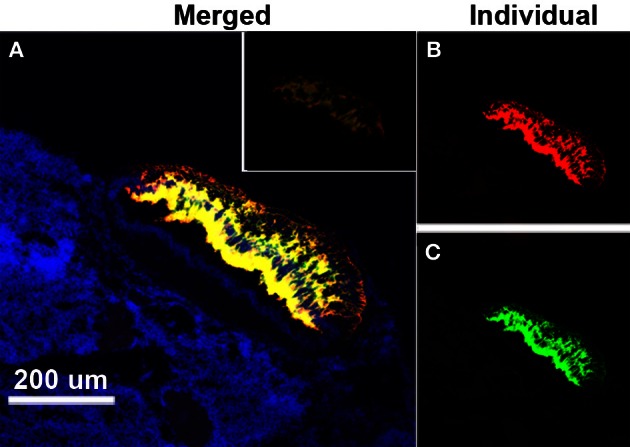
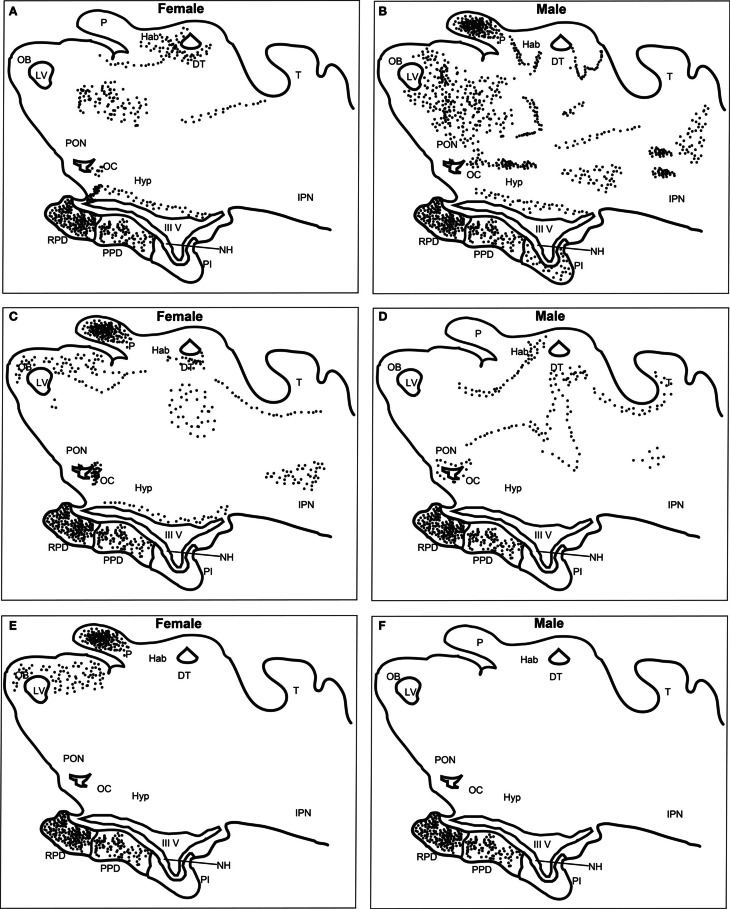
Two recently cloned gonadotropin-releasing hormone (GnRH) receptors (lamprey GnRH-R-2 and lamprey GnRH-R-3) along with lamprey (l) GnRH-R-1 were shown to share similar structural features and amino acid motifs common to other vertebrate receptors. Here we report on our findings of RNA expression of these three GnRH receptors in the three major life stages (larval, parasitic, and adult phases) of the sea lamprey, Petromyzon marinus, a basal vertebrate. For each stage, we examined the expression of messenger RNA encoding the receptors in the brain, pituitary, gonad, heart, muscle, liver, eye, intestine, kidney, skin, thyroid, gill, and endostyle by RT-PCR. In adult lampreys, the spatial expression of the three receptors in the brain and pituitary was investigated by in situ hybridization. In general, the receptors were more widely expressed in adult tissues as compared to parasitic-phase tissues and least widely expressed in the larval tissues. There were noted differences in male and female lampreys in the adult and parasitic phases for all three receptors. The data showed the presence of all three receptor transcripts in brain tissues for adult and parasitic phases and all three receptor transcripts were expressed in the adult pituitaries, but not in the parasitic pituitaries. However, in the larval phase, only lGnRH-R-1 was expressed in the larval brain and pituitary. In situ hybridization revealed that lGnRH-R-2 and -3 were expressed in the pineal tissue of adult female lampreys while lGnRH-R-1 was expressed in the pineal in adult male lampreys, all restricted to the pineal pellucida. In summary, these data provide an initial comparative analysis of expression of three lamprey GnRH receptors suggesting differential regulation within males and females at three different life/reproductive stages.
两种最近克隆的促性腺激素释放激素 (GnRH) 受体(七鳃鳗 GnRH-R-2 和七鳃鳗 GnRH-R-3)以及七鳃鳗 (l) GnRH-R-1 被证明具有相似的结构特征和与其他脊椎动物受体共有的氨基酸基序。在这里,我们报告了这三种 GnRH 受体在海七鳃鳗(Petromyzon marinus)的三个主要生命阶段(幼虫、寄生和成年阶段)中的 RNA 表达。对于每个阶段,我们通过 RT-PCR 检查了编码受体的信使 RNA 在大脑、垂体、性腺、心脏、肌肉、肝脏、眼睛、肠、肾、皮肤、甲状腺、鳃和内鳃的表达。在成年七鳃鳗中,通过原位杂交研究了三种受体在大脑和垂体中的空间表达。一般来说,与寄生阶段组织相比,这些受体在成年组织中的表达更为广泛,而在幼虫组织中的表达则最为广泛。在成年和寄生阶段,所有三种受体在雄性和雌性七鳃鳗中都存在差异。数据显示,所有三种受体的转录本都存在于成年和寄生阶段的脑组织中,所有三种受体的转录本都在成年垂体中表达,但在寄生垂体中不表达。然而,在幼虫阶段,只有 lGnRH-R-1 在幼虫大脑和垂体中表达。原位杂交显示,lGnRH-R-2 和 -3 在成年雌性七鳃鳗的松果体组织中表达,而 lGnRH-R-1 在成年雄性七鳃鳗的松果体组织中表达,均局限于松果体透明质。总之,这些数据提供了三种七鳃鳗 GnRH 受体表达的初步比较分析,表明在三个不同的生命/生殖阶段,雌雄个体的调节存在差异。