Istituto di BioRobotica, Scuola Superiore Sant'Anna, Piazza Martiri della Libertà 33, Pisa, Italy.
J Neuroeng Rehabil. 2013 Jun 12;10(1):53. doi: 10.1186/1743-0003-10-53.
Comparison between healthy and hemiparetic gait is usually carried out while subjects walk overground at preferred speed. This generates bias due to the lack of uniformity across selected speeds because they reflect the great variability of the functional level of post-stroke patients. This study aimed at examining coordinative adaptations during walking in response to unilateral brain damage, while homologous participants walked at two fixed speeds.
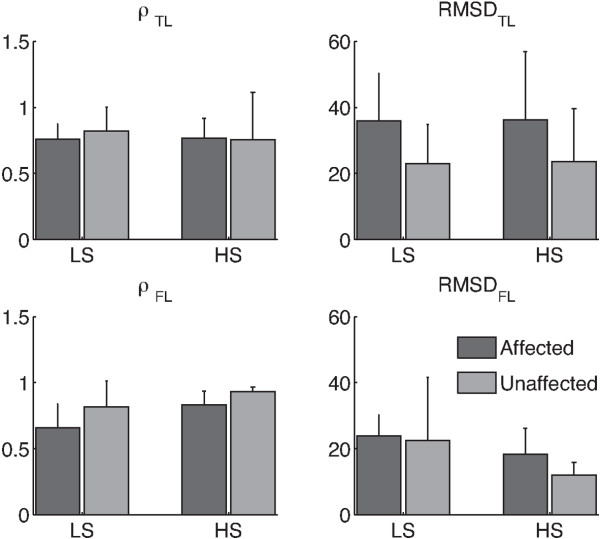
Five patients with left and five with right chronic hemiparesis, characterized by similar level of motor functioning, were enrolled. Ten non-disabled volunteers were recruited as matched control group. Spatio-temporal parameters, and intralimb thigh-leg and leg-foot coordination patterns were used to compare groups while walking on a treadmill at 0.4 and 0.6 m/s. The likelihood of Continuous Relative Phase patterns between healthy and hemiparetic subjects was evaluated by means of the root mean square of the difference and the cross correlation coefficient. The effects of the group (i.e., healthy vs. hemiparetics), side (i.e., affected vs.unaffected), and speed (e.g., slow vs. fast) were analyzed on all metrics using the Analysis of Variance.
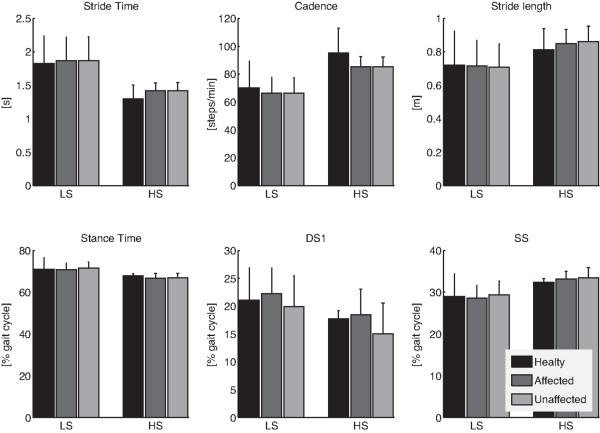
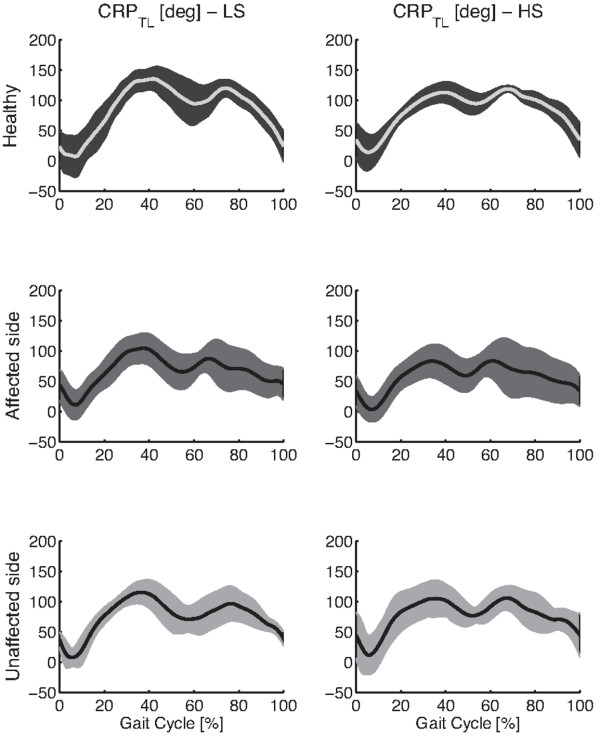
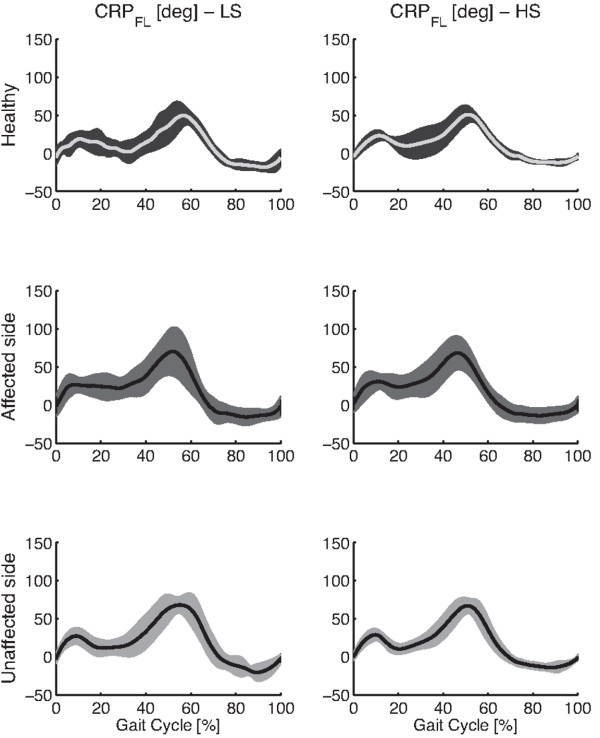
Spatio-temporal parameters of all hemiparetic subjects did not significantly differ from those of healthy subjects nor showed any asymmetry between affected and unaffected limbs. Conversely, both thigh-leg and foot-leg coordination patterns appeared to account for pathology related modifications.
Comparisons between hemiparetic and healthy gait should be carried out when all participants are asked to seek the same suitable dynamic equilibrium led by the same external (i.e., the speed) and internal (i.e., severity of the pathology) conditions. In this respect, biomechanical adaptations reflecting the pathology can be better highlighted by coordinative patterns of coupled segments within each limb than by the spatio-temporal parameters. Accordingly, a deep analysis of the intralimb coordination may be helpful for clinicians while designing therapeutic treatments.
健康人和偏瘫患者的步态比较通常是在他们以惯用速度在地面上行走时进行的。由于所选速度的一致性不足,这会产生偏差,因为它们反映了脑卒中患者功能水平的巨大变化。本研究旨在检查在以两种固定速度行走时,由于单侧大脑损伤而导致的协调适应。
纳入了 5 名左侧偏瘫和 5 名右侧偏瘫的慢性偏瘫患者,这些患者的运动功能水平相似。招募了 10 名非残疾志愿者作为匹配的对照组。在跑步机上以 0.4 和 0.6 m/s 的速度行走时,使用时空参数以及肢体的大腿-小腿和小腿-足部协调模式来比较组间差异。通过均方根差和互相关系数评估健康和偏瘫受试者之间连续相对相位模式的可能性。使用方差分析对所有指标进行组(即健康与偏瘫)、侧(即患侧与健侧)和速度(即慢与快)的效应分析。
所有偏瘫患者的时空参数与健康受试者均无显著差异,也未显示患侧与健侧之间的任何不对称性。相反,大腿-小腿和小腿-足部协调模式都表现出与病理相关的改变。
在要求所有参与者在相同的外部(即速度)和内部(即病理严重程度)条件下寻求相同的合适动态平衡时,应进行偏瘫和健康步态的比较。在这方面,反映病理的生物力学适应可以通过每个肢体的耦合节段的协调模式而不是时空参数更好地突出。因此,对肢体内部协调的深入分析可能有助于临床医生在设计治疗方案时提供帮助。