Division of Optometry and Visual Science, City University London, Northampton Square, London, UK.
BMC Public Health. 2013 Jun 10;13:564. doi: 10.1186/1471-2458-13-564.
In the absence of a cure, there has been considerable interest in attempts to prevent or reduce the progression of age-related macular degeneration (AMD) by targeting particular modifiable risk factors. The aim of this study was to conduct a cross-sectional survey of the current practice of UK eye care professionals in relation to advice given on diet and other lifestyle modifications for patients with or at risk of AMD.
Optometrists and ophthalmologists on the membership databases of professional organisations for the two professions were invited to participate in an online survey. The survey was open for 12 weeks between July and September 2012.
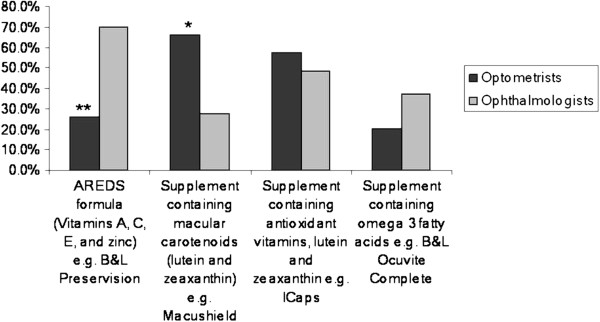
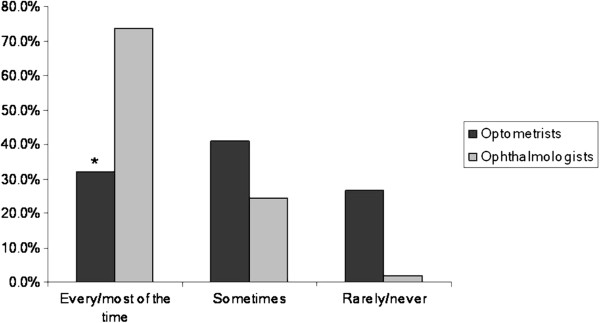
A total of 1,468 responses were received (96.3% from optometrists and 3.7% from ophthalmologists). The response rate of those receiving the invitation was 16.2% (1,414/8735) for optometrists and 6% (54/1460) for ophthalmologists. A majority of respondents reported that they frequently provide dietary advice to patients with established AMD (67.9%) and those at risk of AMD (53.6%). Typical advice consisted of a recommendation to eat plenty of leafy green vegetables and eat more oily fish. The decision to recommend nutritional supplements was based on the risk of progression to advanced AMD, with approximately 93% of respondents recommending supplementation in a patient with advanced AMD in one eye. However for the majority, the type of supplement recommended did not comply with current best research evidence, based on the findings of the Age-related Eye Disease Study (AREDS). Only one in three optometrists regularly assessed smoking status and advised on smoking cessation.
Within a large sample of eye care professionals, consisting predominantly of optometrists, who responded to a cross-sectional survey, there was active engagement in providing nutritional advice to patients with or at risk of AMD. However, the results demonstrate a need to raise awareness of the evidence underpinning the use of nutritional supplements together with an increased involvement in targeted smoking cessation.
由于目前尚无治愈方法,因此人们对通过针对特定可改变的危险因素来预防或减缓与年龄相关的黄斑变性(AMD)的进展产生了浓厚的兴趣。本研究的目的是对英国眼科保健专业人员针对 AMD 患者或有 AMD 风险的患者就饮食和其他生活方式改变提供建议的当前做法进行横断面调查。
邀请专业组织成员数据库中的验光师和眼科医生参与在线调查。该调查于 2012 年 7 月至 9 月之间进行了 12 周。
共收到 1468 份回复(来自验光师的占 96.3%,来自眼科医生的占 3.7%)。收到邀请的回复率为验光师的 16.2%(1414/8735),眼科医生的 6%(54/1460)。大多数受访者表示,他们经常向已确诊 AMD 的患者(67.9%)和有 AMD 风险的患者(53.6%)提供饮食建议。典型的建议包括建议多吃绿叶蔬菜和多吃油性鱼类。决定推荐营养补充剂是基于向进展为晚期 AMD 的患者发展的风险,约有 93%的受访者建议在一眼患有晚期 AMD 的患者中补充营养。但是,对于大多数人来说,根据“年龄相关性眼病研究(AREDS)”的研究结果,推荐的补充剂类型不符合当前最佳的研究证据。只有三分之一的验光师定期评估吸烟状况并建议戒烟。
在一项由大多数为验光师的眼科保健专业人员的大型样本中,对横断面调查做出了回应,他们积极参与向 AMD 患者或有 AMD 风险的患者提供营养建议。但是,调查结果表明,需要提高对营养补充剂使用的证据的认识,并增加针对戒烟的参与。