Tongji School of Pharmacy, Huazhong University of Science and Technology, Wuhan, Hubei Province, China.
PLoS One. 2013 Jun 7;8(6):e65768. doi: 10.1371/journal.pone.0065768. Print 2013.
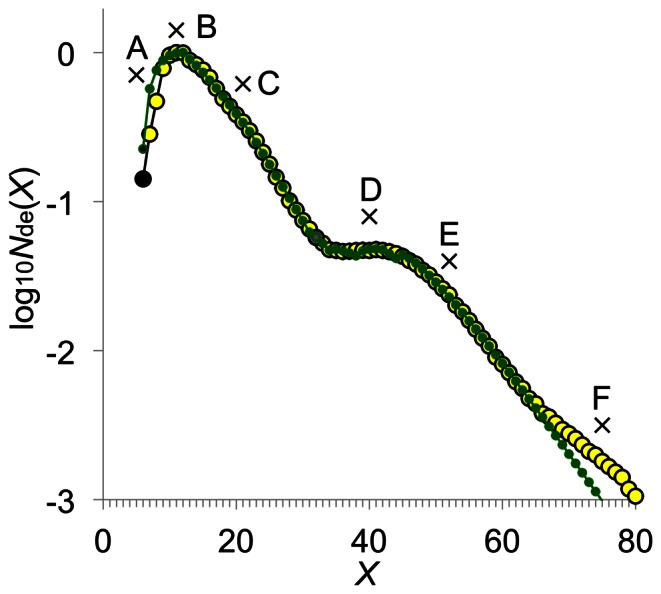
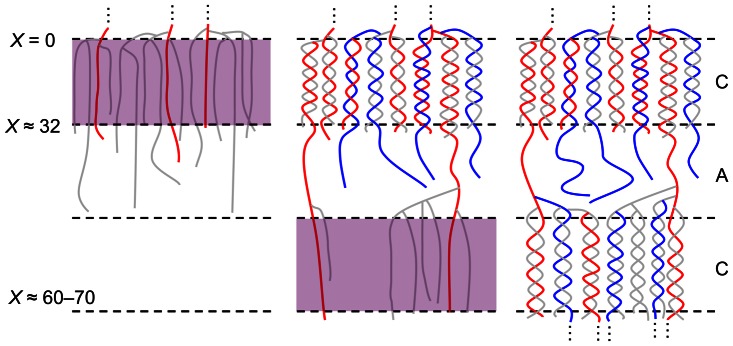
A core set of genes involved in starch synthesis has been defined by genetic studies, but the complexity of starch biosynthesis has frustrated attempts to elucidate the precise functional roles of the enzymes encoded. The chain-length distribution (CLD) of amylopectin in cereal endosperm is modeled here on the basis that the CLD is produced by concerted actions of three enzyme types: starch synthases, branching and debranching enzymes, including their respective isoforms. The model, together with fitting to experiment, provides four key insights. (1) To generate crystalline starch, defined restrictions on particular ratios of enzymatic activities apply. (2) An independent confirmation of the conclusion, previously reached solely from genetic studies, of the absolute requirement for debranching enzyme in crystalline amylopectin synthesis. (3) The model provides a mechanistic basis for understanding how successive arrays of crystalline lamellae are formed, based on the identification of two independent types of long amylopectin chains, one type remaining in the amorphous lamella, while the other propagates into, and is integral to the formation of, an adjacent crystalline lamella. (4) The model provides a means by which a small number of key parameters defining the core enzymatic activities can be derived from the amylopectin CLD, providing the basis for focusing studies on the enzymatic requirements for generating starches of a particular structure. The modeling approach provides both a new tool to accelerate efforts to understand granular starch biosynthesis and a basis for focusing efforts to manipulate starch structure and functionality using a series of testable predictions based on a robust mechanistic framework.
已通过遗传研究定义了参与淀粉合成的一组核心基因,但淀粉生物合成的复杂性阻碍了对酶编码的确切功能作用的阐明。本文基于以下假设构建了谷物胚乳中支链淀粉的链长分布(CLD)模型:CLD 是由三种酶类型(淀粉合酶、分支和脱支酶,包括它们各自的同工酶)的协同作用产生的。该模型与实验拟合一起提供了四个关键见解。(1)为了生成结晶淀粉,需要对特定酶活性比施加明确的限制。(2)独立证实了以前仅从遗传研究得出的结论,即在结晶支链淀粉合成中脱支酶是绝对必需的。(3)该模型为理解如何形成连续的结晶层片提供了一个机械基础,其基础是鉴定两种独立类型的长支链淀粉链,一种类型留在非晶层片中,而另一种类型则延伸到相邻的结晶层片中,并成为其形成的一部分。(4)该模型提供了一种从支链淀粉 CLD 中推导出定义核心酶活性的少数关键参数的方法,为集中研究生成特定结构淀粉的酶要求提供了基础。该建模方法不仅为加速理解颗粒状淀粉生物合成提供了新工具,而且为使用一系列基于稳健机械框架的可测试预测来集中精力操纵淀粉结构和功能提供了基础。