Department of Ecology and Evolutionary Biology, Yale University, New Haven, Connecticut, United States of America.
PLoS One. 2013 Jun 10;8(6):e65830. doi: 10.1371/journal.pone.0065830. Print 2013.
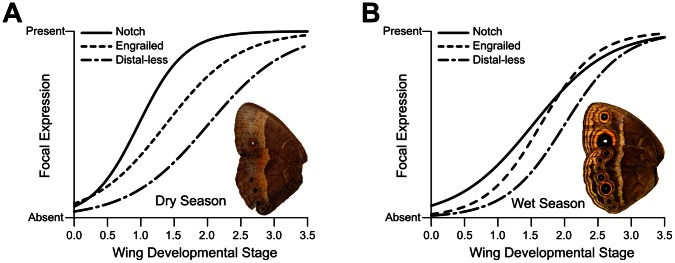
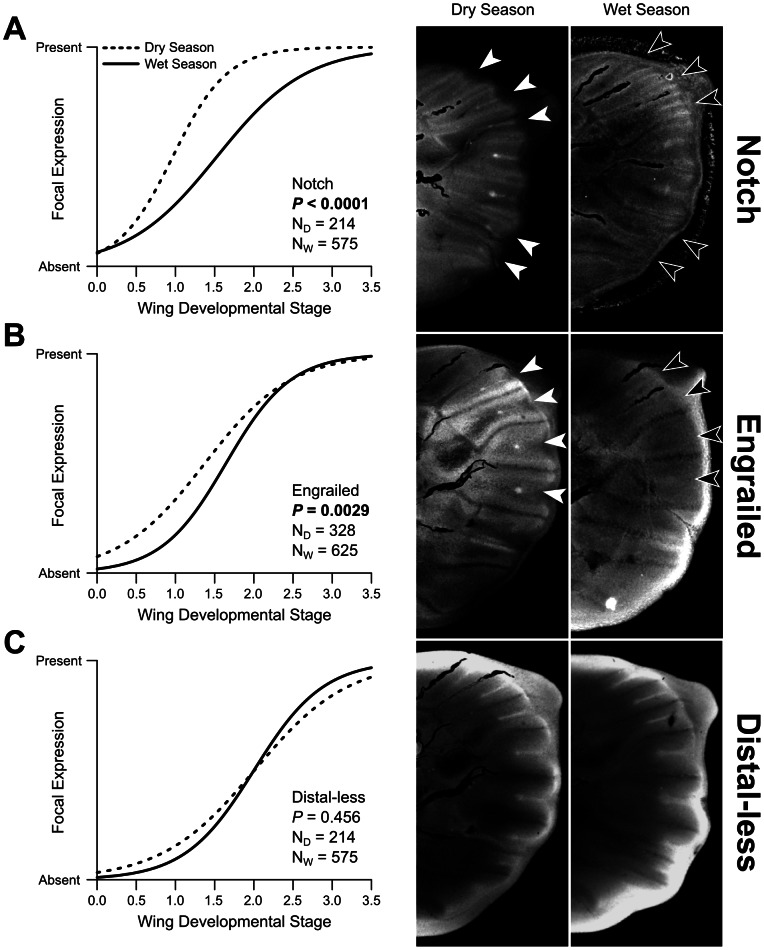
Seasonal polyphenism demonstrates an organism's ability to respond to predictable environmental variation with alternative phenotypes, each presumably better suited to its respective environment. However, the molecular mechanisms linking environmental variation to alternative phenotypes via shifts in development remain relatively unknown. Here we investigate temporal gene expression variation in the seasonally polyphenic butterfly Bicyclus anynana. This species shows drastic changes in eyespot size depending on the temperature experienced during larval development. The wet season form (larvae reared over 24°C) has large ventral wing eyespots while the dry season form (larvae reared under 19°C) has much smaller eyespots. We compared the expression of three proteins, Notch, Engrailed, and Distal-less, in the future eyespot centers of the two forms to determine if eyespot size variation is associated with heterochronic shifts in the onset of their expression. For two of these proteins, Notch and Engrailed, expression in eyespot centers occurred earlier in dry season than in wet season larvae, while Distal-less showed no temporal difference between the two forms. These results suggest that differences between dry and wet season adult wings could be due to a delay in the onset of expression of these eyespot-associated genes. Early in eyespot development, Notch and Engrailed may be functioning as repressors rather than activators of the eyespot gene network. Alternatively, temporal variation in the onset of early expressed genes between forms may have no functional consequences to eyespot size regulation and may indicate the presence of an 'hourglass' model of development in butterfly eyespots.
季节多态性展示了生物体对环境变化的预测性适应能力,其表现为具有不同表型的个体,这些表型可能更适合它们各自的环境。然而,通过发育变化将环境变化与不同表型联系起来的分子机制仍知之甚少。在这里,我们研究了季节多态性蝴蝶 Bicyclus anynana 中的时间基因表达变化。该物种的眼斑大小根据幼虫发育过程中经历的温度而发生剧烈变化。湿季型(在 24°C 以上饲养的幼虫)具有较大的腹侧翅膀眼斑,而干季型(在 19°C 以下饲养的幼虫)具有较小的眼斑。我们比较了两种形式未来眼斑中心的三种蛋白质(Notch、Engrailed 和 Distal-less)的表达,以确定眼斑大小的变化是否与它们表达的起始异时变化有关。对于这两种蛋白质中的两种(Notch 和 Engrailed),在干季幼虫中的表达比在湿季幼虫中更早,而 Distal-less 在两种形式之间没有时间差异。这些结果表明,干季和湿季成虫翅膀之间的差异可能是由于这些眼斑相关基因表达的起始延迟所致。在眼斑发育的早期,Notch 和 Engrailed 可能作为眼斑基因网络的抑制剂而不是激活剂发挥作用。或者,两种形式之间早期表达基因的起始时间的时间变化可能对眼斑大小调节没有功能后果,并且可能表明蝴蝶眼斑中存在“沙漏”发育模型。