PERCRO Laboratory, TeCIP Institute, Scuola Superiore Sant'Anna, Pisa 56127, Italy.
Sensors (Basel). 2013 Jun 13;13(6):7618-32. doi: 10.3390/s130607618.
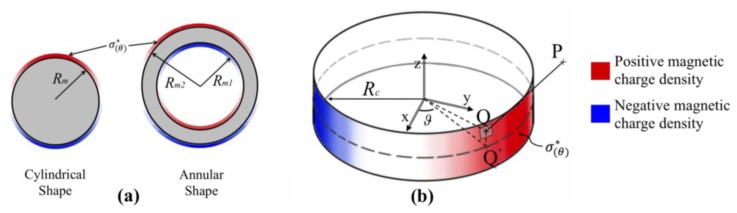
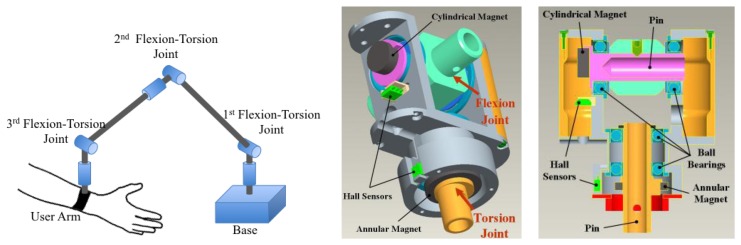
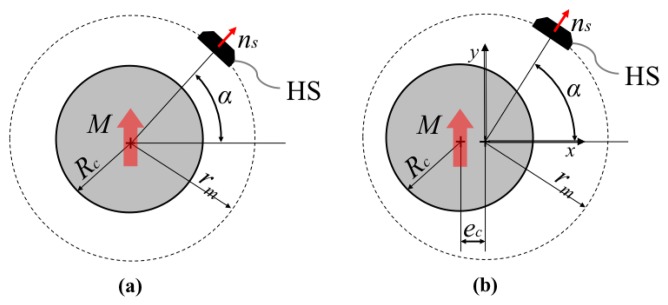
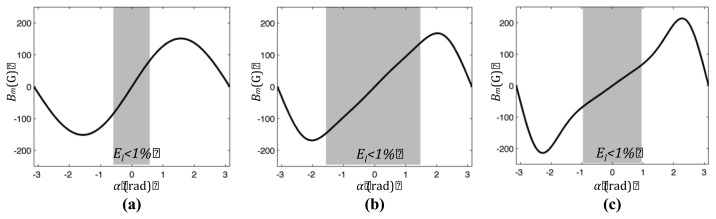
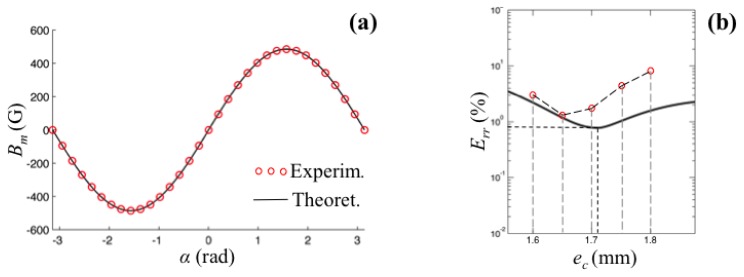
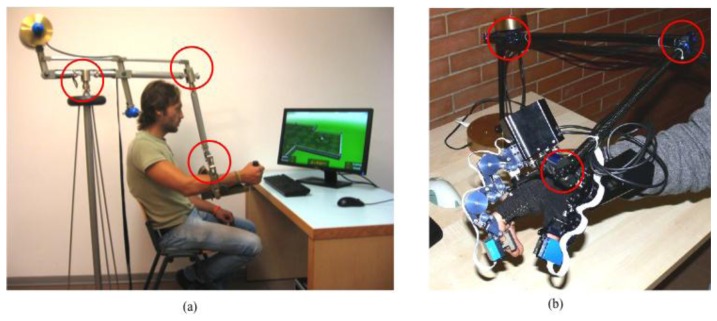
This paper introduces a novel contactless sensing principle conceived for measuring the rotation angle of a shaft. The sensor is based on a smart combination of low-cost components that can be effectively integrated in a mechanical assembly of a rotary joint. The working principle is based on the relative rotation of a small diametrically magnetized cylindrical or annular magnet and at least one Hall effect sensor. One of the main strengths of the new sensing principle is to be adaptable to any assigned dimensions and encumbrances without typical design limitations given by the use of standard components. A numerical model is developed for predicting the sensor output characteristic on the base of the concept of magnetic charge. Such a model is validated against results from laboratory experiments. The parameters that define the geometry and layout of the sensor are optimized in order to maximize linearity over an assigned angular range of measurement. Two examples of mechatronic systems that employ the new sensing principle are presented in order to show the possibility of obtaining with the new principle a compact/integrated sensor-design.
本文介绍了一种新颖的非接触式感应原理,用于测量轴的旋转角度。该传感器基于低成本组件的智能组合,可有效地集成到旋转接头的机械组件中。其工作原理基于小直径磁化圆柱形或环形磁铁与至少一个霍尔效应传感器的相对旋转。新感应原理的主要优势之一是可以适应任何指定的尺寸和限制,而不会受到使用标准组件带来的典型设计限制。基于磁荷的概念开发了一种数值模型来预测传感器的输出特性。该模型通过实验室实验结果进行验证。优化了定义传感器几何形状和布局的参数,以在指定的测量角度范围内最大化线性度。为了展示使用新原理获得紧凑/集成传感器设计的可能性,本文介绍了两种采用新感应原理的机电系统示例。