Conner Shayna N, Verticchio Juliana C, Tuuli Methodius G, Odibo Anthony O, Macones George A, Cahill Alison G
Department of Obstetrics and Gynecology, Washington University in St. Louis, St. Louis, Missouri.
Am J Perinatol. 2014 Apr;31(4):299-304. doi: 10.1055/s-0033-1348402. Epub 2013 Jun 13.
To estimate the effect of increasing severity of obesity on postcesarean wound complications and surgical characteristics.
We performed a retrospective cohort study of consecutive cesarean deliveries at a tertiary care facility from 2004 to 2008. Four comparison groups were defined by body mass index (BMI; kg/cm2): < 30 (n = 728), 30 to 39.9 (n = 1,087), 40 to 49.9 (n = 428), or ≥ 50 (n = 201). The primary outcome was wound complication, defined as wound disruption or infection within 6 weeks postoperatively. Surgical characteristics were compared between groups including administration of preoperative antibiotics, type of skin incision, estimated blood loss (EBL), operative time, and type of skin closure.
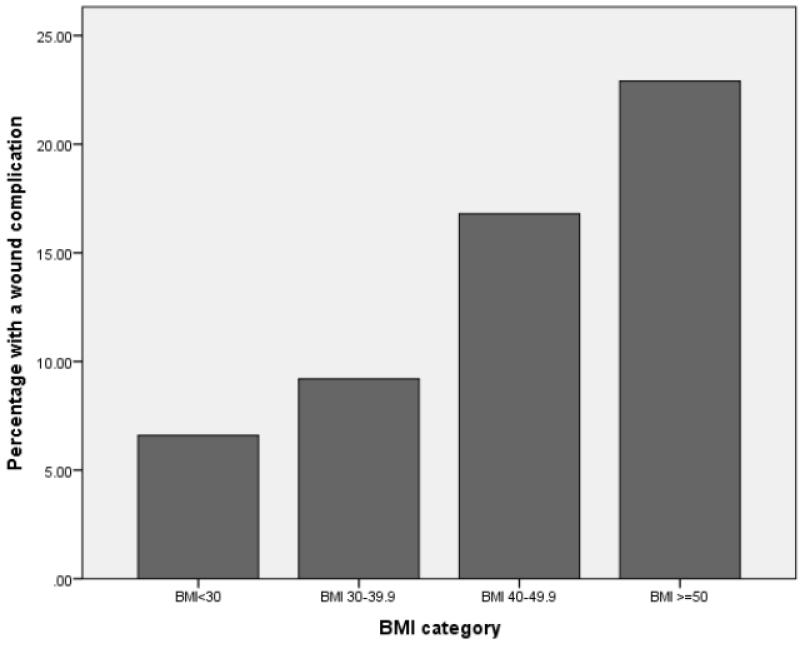
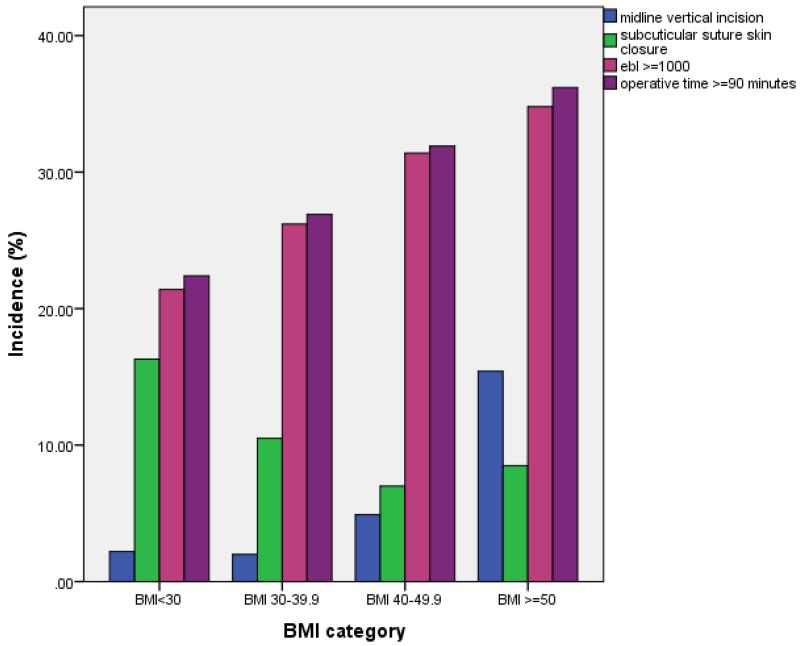
Of the 2,444 women with complete follow-up data, 266 (10.9%) developed a wound complication. Compared with nonobese women (6.6%), increasing BMI was associated with an increased risk of wound complications: BMI 30.0 to 39.9, 9.2%, adjusted odds ratio (aOR) 1.4 (95% confidence interval [CI] 0.99 to 2.0); BMI 40.0 to 49.9, 16.8%, aOR 2.6 (95% CI 1.7 to 3.8); BMI ≥ 50, 22.9%, aOR 3.0 (95% CI 1.9 to 4.9). Increasing BMI was also associated with increased rates of midline vertical incision, longer operative time, higher EBL, and lower rates of subcuticular skin closure.
A dose-response relationship exists between increasing BMI and risk of postcesarean wound complications. Increasing obesity also significantly influences operative outcomes.
评估肥胖程度增加对剖宫产术后伤口并发症及手术特征的影响。
我们对2004年至2008年在一家三级医疗机构连续进行的剖宫产分娩进行了一项回顾性队列研究。根据体重指数(BMI;kg/cm²)定义了四个比较组:<30(n = 728)、30至39.9(n = 1087)、40至49.9(n = 428)或≥50(n = 201)。主要结局是伤口并发症,定义为术后6周内伤口裂开或感染。比较了各组之间的手术特征,包括术前抗生素的使用、皮肤切口类型、估计失血量(EBL)、手术时间和皮肤缝合类型。
在2444例有完整随访数据的女性中,266例(10.9%)发生了伤口并发症。与非肥胖女性(6.6%)相比,BMI增加与伤口并发症风险增加相关:BMI 30.0至39.9,9.2%,调整优势比(aOR)1.4(95%置信区间[CI]0.99至2.0);BMI 40.0至49.9,16.8%,aOR 2.6(95%CI 1.7至3.8);BMI≥50,22.9%,aOR 3.0(95%CI 1.9至4.9)。BMI增加还与中线垂直切口率增加、手术时间延长、EBL升高以及皮下皮肤缝合率降低相关。
BMI增加与剖宫产术后伤口并发症风险之间存在剂量反应关系。肥胖程度增加也显著影响手术结局。