Laboratory for Cellular and Molecular Thyroid Research, Division of Endocrinology and Metabolism, Johns Hopkins University School of Medicine, 1830 East Monument Street, Baltimore, MD 21287, USA.
Endocr Relat Cancer. 2013 Jul 12;20(4):603-10. doi: 10.1530/ERC-13-0210. Print 2013 Aug.
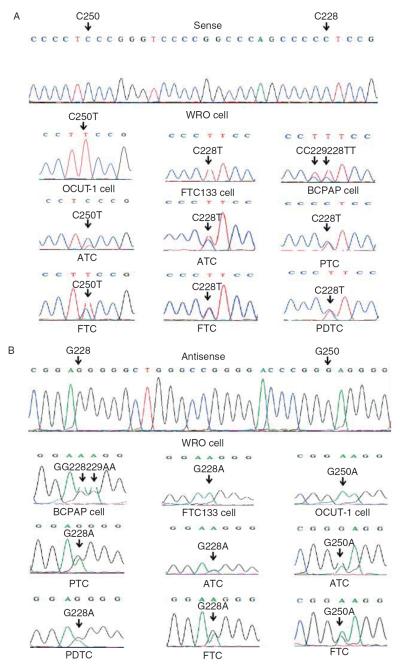
Mutations 1 295 228 C>T and 1 295 250 C>T (termed C228T and C250T respectively), corresponding to -124 C>T and -146 C>T from the translation start site in the promoter of the telomerase reverse transcriptase (TERT) gene, have recently been reported in human cancers, but not in thyroid cancers yet. We explored these mutations in thyroid cancers by genomic sequencing of a large number of primary tumor samples. We found the C228T mutation in 0 of 85 (0.0%) benign thyroid tumors, 30 of 257 (11.7%) papillary thyroid cancers (PTC), 9 of 79 (11.4%) follicular thyroid cancers (FTC), 3 of 8 (37.5%) poorly differentiated thyroid cancers (PDTC), 23 of 54 (42.6%) anaplastic thyroid cancers (ATC), and 8 of 12 (66.7%) thyroid cancer cell lines. The C250T mutation was uncommon, but mutually exclusive with the C228T mutation, and the two mutations were collectively found in 11 of 79 (13.9%) FTC, 25 of 54 (46.3%) ATC, and 11 of 12 (91.7%) thyroid cancer cell lines. Among PTC variants, the C228T mutation was found in 4 of 13 (30.8%) tall-cell PTC (TCPTC), 23 of 187 (12.3%) conventional PTC, and 2 of 56 (3.6%) follicular variant PTC samples. No TERT mutation was found in 16 medullary thyroid cancer samples. The C228T mutation was associated with the BRAF V600E mutation in PTC, being present in 19 of 104 (18.3%) BRAF mutation-positive PTC vs 11 of 153 (7.2%) the BRAF mutation-negative PTC samples (P=0.0094). Conversely, BRAF mutation was found in 19 of 30 (63.3%) C228T mutation-positive PTC vs 85 of 227 (37.4%) C228T mutation-negative PTC samples (P=0.0094). We thus for the first time, to our knowledge, demonstrate TERT promoter mutations in thyroid cancers, that are particularly prevalent in the aggressive thyroid cancers TCPTC, PDTC, ATC and BRAF mutation-positive PTC, revealing a novel genetic background for thyroid cancers.
突变 1 295 228 C>T 和 1 295 250 C>T(分别称为 C228T 和 C250T),对应于端粒酶逆转录酶(TERT)基因启动子中翻译起始位点的-124 C>T 和-146 C>T,最近已在人类癌症中报道,但尚未在甲状腺癌中报道。我们通过对大量原发性肿瘤样本进行基因组测序来研究这些突变在甲状腺癌中的作用。我们发现 C228T 突变在 85 例(0.0%)良性甲状腺肿瘤、257 例(11.7%)甲状腺乳头状癌(PTC)、79 例(11.4%)滤泡性甲状腺癌(FTC)、8 例(37.5%)低分化甲状腺癌(PDTC)、54 例(42.6%)间变性甲状腺癌(ATC)和 12 例(66.7%)甲状腺癌细胞系中均未发现。C250T 突变不太常见,但与 C228T 突变相互排斥,这两种突变共同存在于 11 例 FTC(13.9%)、25 例 ATC(46.3%)和 11 例(91.7%)甲状腺癌细胞系中。在 PTC 变体中,C228T 突变存在于 13 例(30.8%)高细胞 PTC(TCPTC)、187 例(12.3%)常规 PTC 和 56 例(3.6%)滤泡变体 PTC 样本中。16 例髓样甲状腺癌样本中未发现 TERT 突变。C228T 突变与 PTC 中的 BRAF V600E 突变相关,在 104 例(18.3%)BRAF 突变阳性 PTC 中存在 19 例,而在 153 例(7.2%)BRAF 突变阴性 PTC 样本中存在 11 例(P=0.0094)。相反,BRAF 突变存在于 30 例(63.3%)C228T 突变阳性 PTC 中,而存在于 227 例(37.4%)C228T 突变阴性 PTC 样本中(P=0.0094)。因此,据我们所知,我们首次在甲状腺癌中证实了 TERT 启动子突变,这些突变在侵袭性甲状腺癌 TCPTC、PDTC、ATC 和 BRAF 突变阳性 PTC 中特别普遍,揭示了甲状腺癌的新遗传背景。