Department of Molecular Reproduction, Development and Genetics, Indian Institute of Science, Bangalore 560012, India.
Mol Cancer. 2013 Jun 16;12:63. doi: 10.1186/1476-4598-12-63.
Insulin like growth factor binding proteins modulate the mitogenic and pro survival effects of IGF. Elevated expression of IGFBP2 is associated with progression of tumors that include prostate, ovarian, glioma among others. Though implicated in the progression of breast cancer, the molecular mechanisms involved in IGFBP2 actions are not well defined. This study investigates the molecular targets and biological pathways targeted by IGFBP2 in breast cancer.
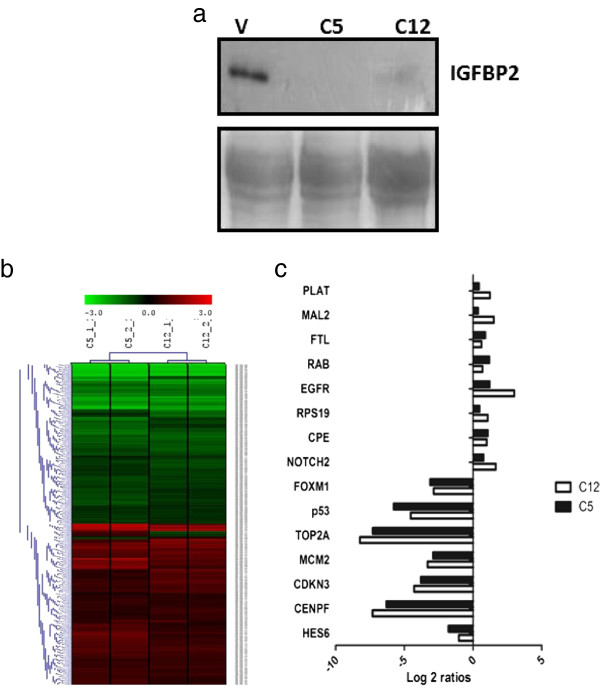
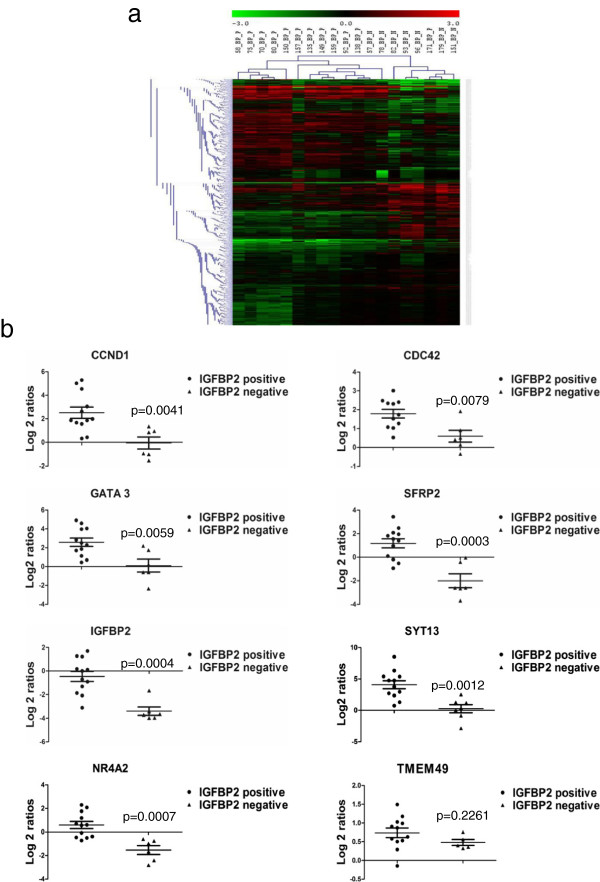
Transcriptome analysis of breast tumor cells (BT474) with stable knockdown of IGFBP2 and breast tumors having differential expression of IGFBP2 by immunohistochemistry was performed using microarray. Differential gene expression was established using R-Bioconductor package. For validation, gene expression was determined by qPCR. Inhibitors of IGF1R and integrin pathway were utilized to study the mechanism of regulation of β-catenin. Immunohistochemical and immunocytochemical staining was performed on breast tumors and experimental cells, respectively for β-catenin and IGFBP2 expression.
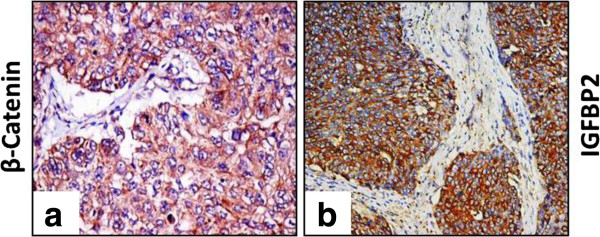
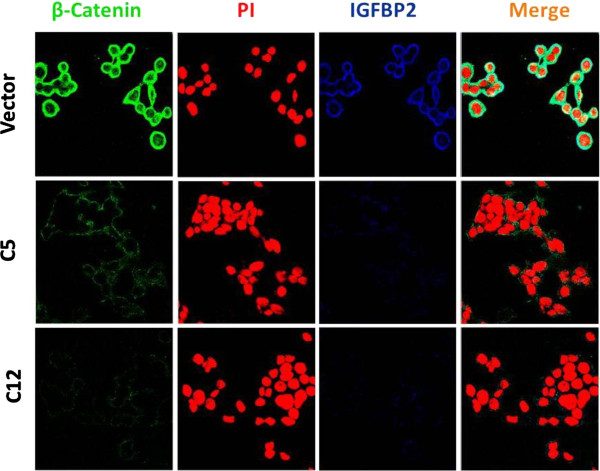
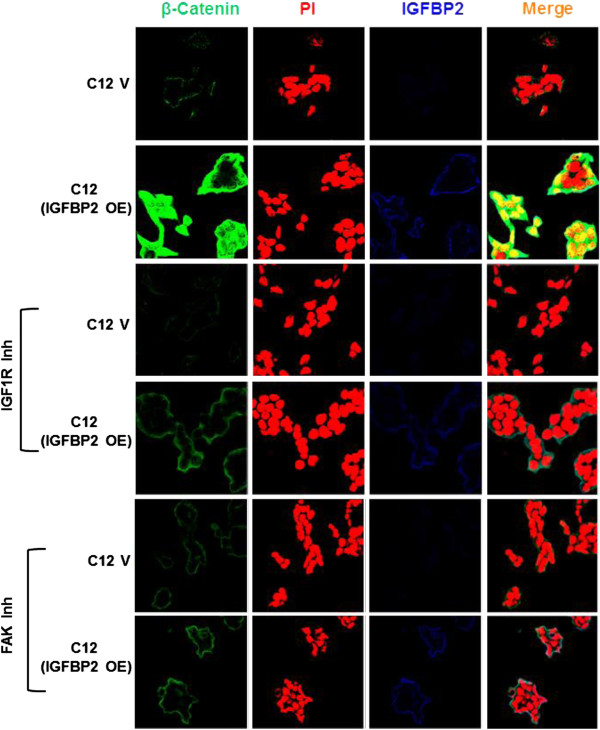
Knockdown of IGFBP2 resulted in differential expression of 2067 up regulated and 2002 down regulated genes in breast cancer cells. Down regulated genes principally belong to cell cycle, DNA replication, repair, p53 signaling, oxidative phosphorylation, Wnt signaling. Whole genome expression analysis of breast tumors with or without IGFBP2 expression indicated changes in genes belonging to Focal adhesion, Map kinase and Wnt signaling pathways. Interestingly, IGFBP2 knockdown clones showed reduced expression of β- catenin compared to control cells which was restored upon IGFBP2 re-expression. The regulation of β-catenin by IGFBP2 was found to be IGF1R and integrin pathway dependent. Furthermore, IGFBP2 and β-catenin are co-ordinately overexpressed in breast tumors and correlate with lymph node metastasis.
This study highlights regulation of β-catenin by IGFBP2 in breast cancer cells and most importantly, combined expression of IGFBP2 and β-catenin is associated with lymph node metastasis of breast tumors.
胰岛素样生长因子结合蛋白调节 IGF 的有丝分裂和促生存作用。IGFBP2 的高表达与包括前列腺癌、卵巢癌、神经胶质瘤等在内的肿瘤的进展有关。尽管 IGFBP2 参与了乳腺癌的进展,但 IGFBP2 作用的分子机制尚未明确。本研究探讨了 IGFBP2 在乳腺癌中的分子靶点和生物学途径。
采用微阵列对稳定敲低 IGFBP2 的乳腺癌细胞(BT474)和免疫组织化学法显示 IGFBP2 差异表达的乳腺癌肿瘤进行转录组分析。使用 R-Bioconductor 包确定差异基因表达。为了验证,通过 qPCR 确定基因表达。利用 IGF1R 和整合素途径抑制剂研究 β-连环蛋白调节的机制。对乳腺癌和实验细胞分别进行 β-连环蛋白和 IGFBP2 表达的免疫组织化学和免疫细胞化学染色。
IGFBP2 敲低导致乳腺癌细胞中 2067 个上调和 2002 个下调基因的差异表达。下调基因主要属于细胞周期、DNA 复制、修复、p53 信号、氧化磷酸化、Wnt 信号。有或无 IGFBP2 表达的乳腺癌肿瘤的全基因组表达分析表明,属于黏附斑、MAP 激酶和 Wnt 信号通路的基因发生了变化。有趣的是,与对照细胞相比,IGFBP2 敲低克隆显示 β-连环蛋白表达降低,而在 IGFBP2 重新表达后恢复。IGFBP2 对 β-连环蛋白的调节被发现依赖于 IGF1R 和整合素途径。此外,IGFBP2 和 β-连环蛋白在乳腺癌中协同过表达,并与淋巴结转移相关。
本研究强调了 IGFBP2 在乳腺癌细胞中对 β-连环蛋白的调节,最重要的是,IGFBP2 和 β-连环蛋白的联合表达与乳腺癌肿瘤的淋巴结转移相关。