Division of Evolutionary Biology, National Institute for Basic Biology, Okazaki 444-8585, Japan.
Nat Commun. 2013;4:1967. doi: 10.1038/ncomms2967.
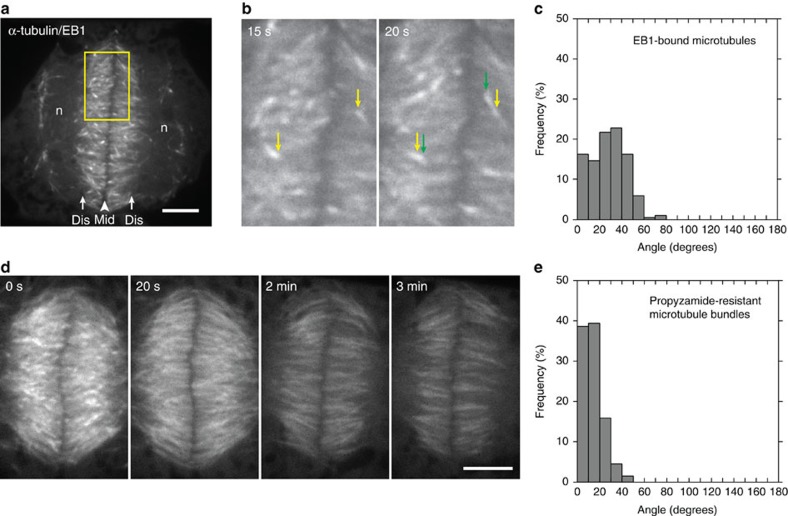
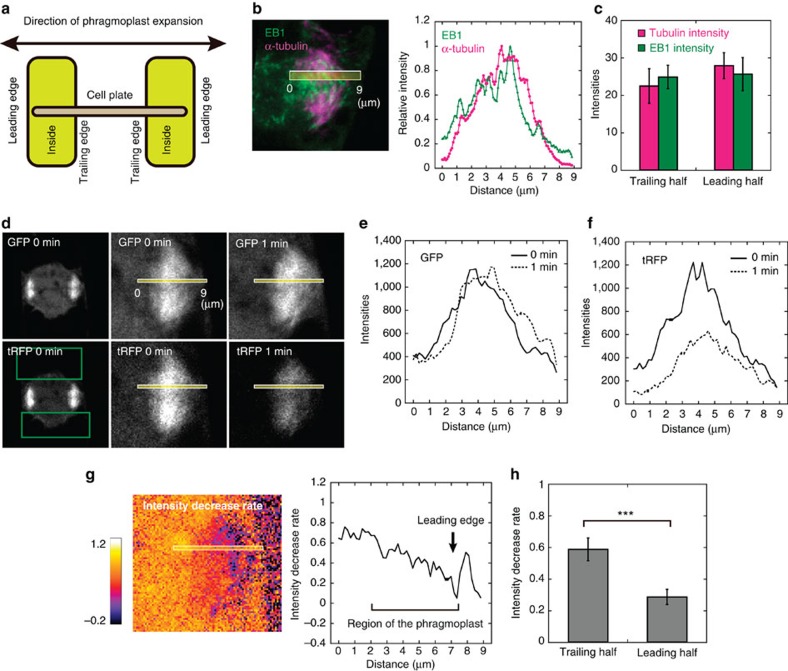
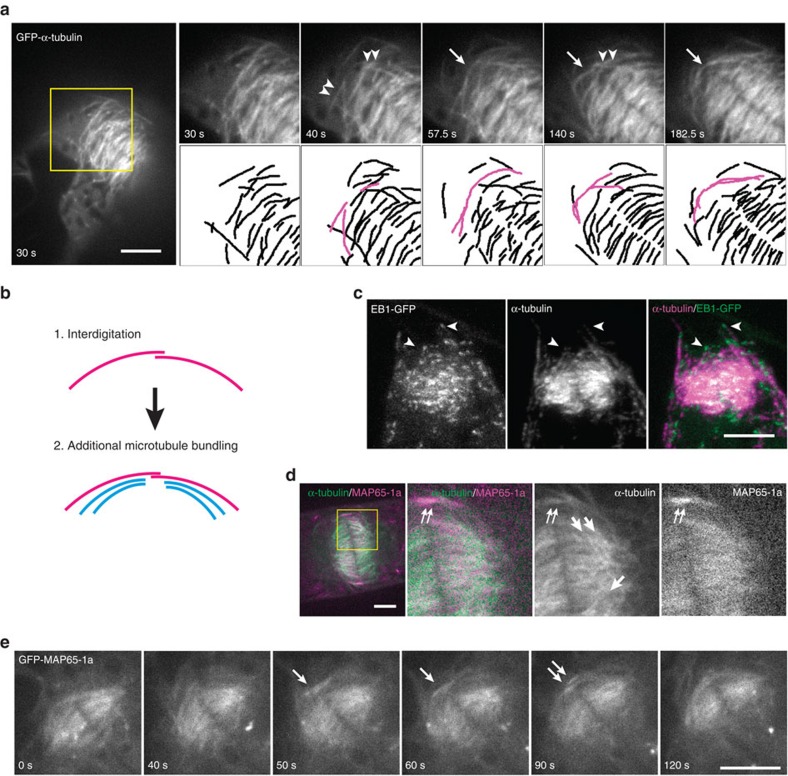
In land plants, the cell plate partitions the daughter cells at cytokinesis. The cell plate initially forms between daughter nuclei and expands centrifugally until reaching the plasma membrane. The centrifugal development of the cell plate is driven by the centrifugal expansion of the phragmoplast microtubule array, but the molecular mechanism underlying this expansion is unknown. Here, we show that the phragmoplast array comprises stable microtubule bundles and dynamic microtubules. We find that the dynamic microtubules are nucleated by γ-tubulin on stable bundles. The dynamic microtubules elongate at the plus ends and form new bundles preferentially at the leading edge of the phragmoplast. At the same time, they are moved away from the cell plate, maintaining a restricted distribution of minus ends. We propose that cycles of attachment of γ-tubulin complexes onto the microtubule bundles, microtubule nucleation and bundling, accompanied by minus-end-directed motility, drive the centrifugal development of the phragmoplast.
在陆生植物中,细胞板在胞质分裂时将子细胞分隔开。细胞板最初在子核之间形成,并向心扩展,直到到达质膜。细胞板的向心发育由胞质纺锤体微管阵列的向心扩展驱动,但这种扩展的分子机制尚不清楚。在这里,我们表明质膜纺锤体阵列由稳定的微管束和动态微管组成。我们发现,动态微管由γ-微管蛋白在稳定的微管束上成核。动态微管在正极延伸,并优先在质膜纺锤体的前缘形成新的束。同时,它们从细胞板上移开,保持负端的限制分布。我们提出,γ-微管蛋白复合物附着在微管束上、微管成核和束形成的循环,伴随着负端定向运动,驱动质膜纺锤体的向心发育。