Department of Public Health Sciences, School of Medicine and Dentistry, University of Rochester, Rochester, New York 14642, USA.
J Am Geriatr Soc. 2013 Jul;61(7):1066-73. doi: 10.1111/jgs.12330. Epub 2013 Jun 17.
To describe the longitudinal patterns and the within- and between-facility differences in hospice use and in-hospital deaths between long-term nursing home (NH) residents with and without dementia.
Retrospective analyses of secondary data sets from 2003 to 2007.
NHs in the United States.
A total of 1,261,726 decedents in 16,347 NHs were included in 2003 to 2007 trend analysis and 236,619 decedents in 15,098 NHs in 2007 were included in the within- and between-facility analyses.
Hospice use in the last 100 days of life and in-hospital deaths were outcome measures. Dementia was defined as having a diagnosis of Alzheimer's disease or other dementia based on Minimum Data Set (MDS) health assessments.
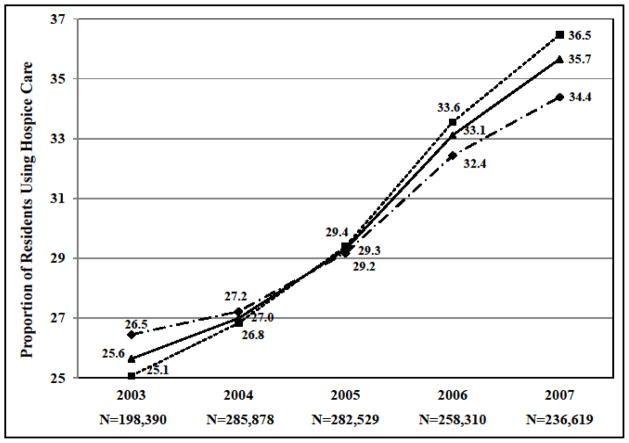
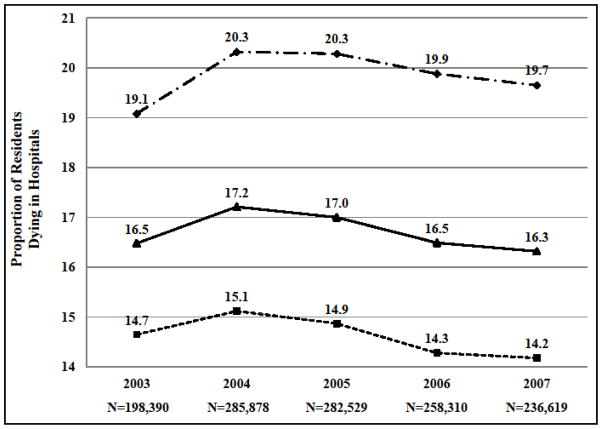
Overall hospice use increased from 25.6% in 2003 to 35.7% in 2007. During this time, hospice use for decedents with dementia increased from 25.1% to 36.5%, compared with an increase from 26.5% to 34.4% for decedents without dementia. The rate of in-hospital deaths remained virtually unchanged. Within the same facility, decedents with dementia were significantly more likely to use hospice (odds ratio (OR) = 1.07, 95% confidence interval (CI) = 1.04-1.11) and less likely to die in a hospital (OR = 0.76, 95% CI = 0.74-0.78). Decedents in NHs with higher dementia prevalence, regardless of individual dementia status, were more likely to use hospice (OR = 1.67, 95% CI = 1.22-2.27).
NHs appear to provide less-aggressive end-of-life care to decedents with dementia than to those without. Although significantly more residents with dementia now receive hospice care at the end of life, the quality evaluation and monitoring of hospice programs have not been systematically conducted, and additional research in this area is warranted.
描述患有和不患有痴呆症的长期护理院(NH)居民在临终关怀使用和院内死亡方面的纵向模式以及机构内和机构间差异。
对 2003 年至 2007 年的二次数据进行回顾性分析。
美国的 NH。
2003 年至 2007 年趋势分析共纳入 16347 家 NH 中的 1261726 名死者,2007 年机构内和机构间分析共纳入 15098 家 NH 中的 236619 名死者。
临终关怀使用情况(生命最后 100 天内使用和未使用)和院内死亡为结局指标。痴呆症的定义是根据最低数据集(MDS)健康评估,有阿尔茨海默病或其他痴呆症的诊断。
总体而言,临终关怀的使用比例从 2003 年的 25.6%增加到 2007 年的 35.7%。在此期间,患有痴呆症的死者中临终关怀的使用比例从 25.1%增加到 36.5%,而没有痴呆症的死者中临终关怀的使用比例从 26.5%增加到 34.4%。院内死亡的比例基本保持不变。在同一机构内,患有痴呆症的死者更有可能使用临终关怀(优势比[OR] = 1.07,95%置信区间[CI] = 1.04-1.11),不太可能在医院死亡(OR = 0.76,95%CI = 0.74-0.78)。痴呆症发病率较高的 NH 中的死者,无论个人痴呆症状况如何,使用临终关怀的可能性更大(OR = 1.67,95%CI = 1.22-2.27)。
NH 似乎为患有痴呆症的死者提供的临终关怀不如为没有痴呆症的死者提供的临终关怀积极。尽管现在有更多患有痴呆症的居民在生命末期接受临终关怀,但临终关怀项目的质量评估和监测尚未系统进行,因此该领域需要进一步研究。