
在一项 III 期随机试验中,高风险膀胱癌患者的坏死预测缺氧修饰治疗获益。
Necrosis predicts benefit from hypoxia-modifying therapy in patients with high risk bladder cancer enrolled in a phase III randomised trial.
机构信息
Translational Radiobiology Group, Institute of Cancer Sciences, The University of Manchester, Manchester Academic Health Centre, Christie Hospital, Manchester, UK.
出版信息
Radiother Oncol. 2013 Jul;108(1):40-7. doi: 10.1016/j.radonc.2013.05.017. Epub 2013 Jun 14.
BACKGROUND AND PURPOSE
Addition of carbogen and nicotinamide (hypoxia-modifying agents) to radiotherapy improves the survival of patients with high risk bladder cancer. The study investigated whether histopathological tumour features and putative hypoxia markers predicted benefit from hypoxia modification.
MATERIALS AND METHODS
Samples were available from 231 patients with high grade and invasive bladder carcinoma from the BCON phase III trial of radiotherapy (RT) alone or with carbogen and nicotinamide (RT+CON). Histopathological tumour features examined were: necrosis, growth pattern, growing margin, and tumour/stroma ratio. Hypoxia markers carbonic anhydrase-IX and glucose transporter-1 were examined using tissue microarrays.
RESULTS
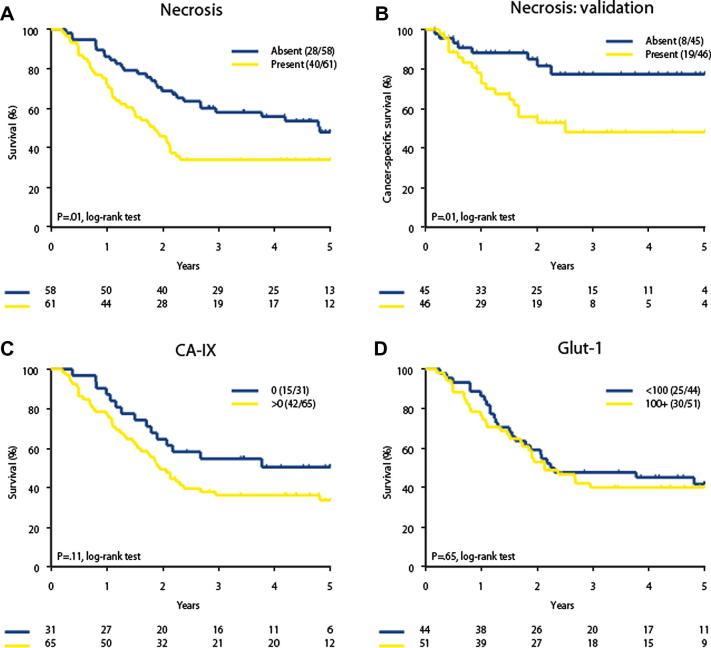
Necrosis was the only independent prognostic indicator (P=0.04). Necrosis also predicted benefit from hypoxia modification. Five-year overall survival was 48% (RT) versus 39% (RT+CON) (P=0.32) in patients without necrosis and 34% (RT) versus 56% (RT+CON) (P=0.004) in patients with necrosis. There was a significant treatment by necrosis strata interaction (P=0.001 adjusted). Necrosis was an independent predictor of benefit from RT+CON versus RT (hazard ratio [HR]: 0.43, 95% CI 0.25-0.73, P=0.002). This trend was not observed when there was no necrosis (HR: 1.64, 95% CI 0.95-2.85, P=0.08).
CONCLUSIONS
Necrosis predicts benefit from hypoxia modification in patients with high risk bladder cancer and should be used to select patients; it is simple to identify and easy to incorporate into routine histopathological examination.
背景与目的
在放疗中加入碳化水和烟酰胺(缺氧修饰剂)可提高高危膀胱癌患者的生存率。本研究旨在探讨组织学肿瘤特征和潜在的缺氧标志物是否能预测缺氧修饰的获益。
材料与方法
本研究从 BCON 期 III 试验中获取了 231 例高级别浸润性膀胱癌患者的样本,这些患者接受了单纯放疗(RT)或放疗联合碳化水和烟酰胺(RT+CON)治疗。检查的组织学肿瘤特征包括:坏死、生长模式、生长边缘和肿瘤/基质比。使用组织微阵列检查了缺氧标志物碳酸酐酶-IX 和葡萄糖转运蛋白-1。
结果
坏死是唯一独立的预后指标(P=0.04)。坏死也预测了缺氧修饰的获益。无坏死患者的 5 年总生存率为 48%(RT)与 39%(RT+CON)(P=0.32),而有坏死患者的 5 年总生存率为 34%(RT)与 56%(RT+CON)(P=0.004)。存在坏死分层的治疗交互作用(P=0.001 调整)。在 RT+CON 与 RT 相比,坏死是独立的获益预测因子(风险比[HR]:0.43,95%CI 0.25-0.73,P=0.002)。当不存在坏死时,这种趋势并不明显(HR:1.64,95%CI 0.95-2.85,P=0.08)。
结论
在高危膀胱癌患者中,坏死预测了缺氧修饰的获益,应该用于选择患者;它易于识别,易于纳入常规组织病理学检查。


 Zotero 插件