Translational Radiobiology Group, Institute of Cancer Sciences, University of Manchester, Christie Hospital, Manchester, United Kingdom.
Clin Cancer Res. 2013 Sep 1;19(17):4879-88. doi: 10.1158/1078-0432.CCR-13-0542. Epub 2013 Jul 2.
Tumor hypoxia is associated with a poor prognosis, hypoxia modification improves outcome, and hypoxic status predicts benefit from treatment. Yet, there is no universal measure of clinical hypoxia. The aim of this study was to investigate whether a 26-gene hypoxia signature predicted benefit from hypoxia-modifying treatment in both cancer types.
Samples were available from 157 T2-T4 laryngeal cancer and 185 T1-T4a bladder cancer patients enrolled on the accelerated radiotherapy with carbogen and nicotinamide (ARCON) and bladder carbogen nicotinamide (BCON) phase III randomized trials of radiotherapy alone or with carbogen and nicotinamide (CON) respectively. Customized TaqMan low density arrays (TLDA) were used to assess expression of the 26-gene signature using quantitative real-time PCR. The median expression of the 26 genes was used to derive a hypoxia score (HS). Patients were categorized as TLDA-HS low (≤median) or TLDA-HS high (>median). The primary outcome measures were regional control (RC; ARCON) and overall survival (BCON).
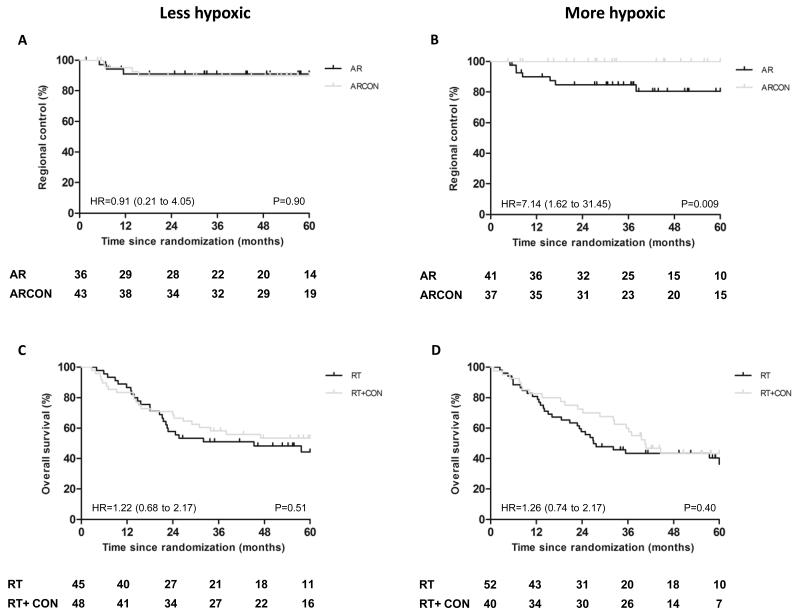
Laryngeal tumors categorized as TLDA-HS high showed greater benefit from ARCON than TLDA-HS low tumors. Five-year RC was 81% (radiotherapy alone) versus 100% (CON) for TLDA-HS high (P=0.009). For TLDA-HS low, 5-year RC was 91% (radiotherapy alone) versus 90% (CON; P=0.90). TLDA-HS did not predict benefit from CON in bladder cancer.
The 26-gene hypoxia signature predicts benefit from hypoxia-modifying treatment in laryngeal cancer. These findings will be evaluated in a prospective clinical trial.
肿瘤缺氧与预后不良相关,缺氧修饰可改善预后,缺氧状态可预测治疗获益。然而,目前尚无普遍的临床缺氧评估方法。本研究旨在探讨 26 基因缺氧标志物是否可预测两种癌症类型中缺氧修饰治疗的获益。
本研究纳入了 157 例 T2-T4 喉癌和 185 例 T1-T4a 膀胱癌患者,这些患者分别入组了单纯放疗(ARCON)或加用卡泊芬净和烟酰胺(CON)的加速放疗与卡泊芬净和烟酰胺(ARCON)和膀胱卡泊芬净烟酰胺(BCON)三期随机临床试验。采用定制 TaqMan 低密度芯片(TLDA)通过定量实时 PCR 评估 26 基因标志物的表达。根据 26 个基因的中位数表达计算出一个缺氧评分(HS)。患者被分为 TLDA-HS 低(≤中位数)或 TLDA-HS 高(>中位数)。主要的结局测量指标是区域控制(ARCON)和总生存(BCON)。
TLDA-HS 高的喉癌患者从 ARCON 治疗中获益更大,5 年局部控制率(RC)分别为单独放疗组的 81%(单独放疗)和 CON 组的 100%(CON)(TLDA-HS 高,P=0.009)。TLDA-HS 低的喉癌患者,5 年 RC 分别为单独放疗组的 91%(单独放疗)和 CON 组的 90%(CON;P=0.90)。TLDA-HS 对膀胱癌患者从 CON 治疗中获益无预测作用。
26 基因缺氧标志物可预测喉癌患者从缺氧修饰治疗中获益。这些发现将在一项前瞻性临床试验中进行评估。