Dominguez Laura M, Dodson Kelley M
Department of Otolaryngology, Head and Neck Surgery, Virginia Commonwealth University, Richmond, VA.
Appl Clin Genet. 2012 Oct 18;5:97-104. doi: 10.2147/TACG.S35525. Print 2012.
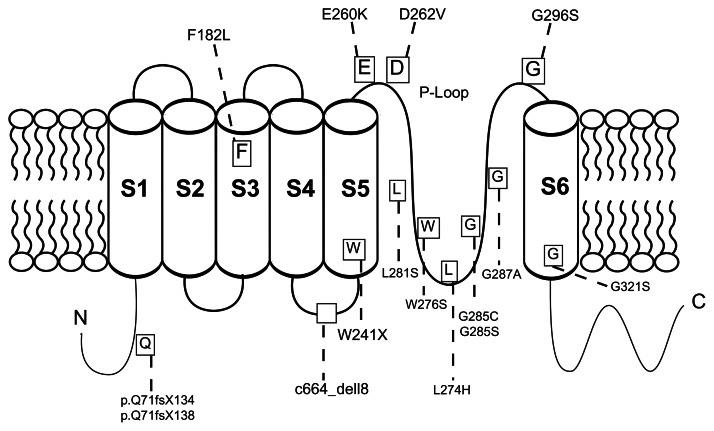
The purpose of this review is to assess the current literature on deafness nonsyndromic autosomal dominant 2 (DFNA2) hearing loss and the mutations linked to this disorder. Hearing impairment, particularly nonsyndromic hearing loss, affects multiple families across the world. After the identification of the DFNA2 locus on chromosome 1p34, multiple pathogenic mutations in two genes (GJB3 and KCNQ4) have been reported. The overwhelming majority of pathogenic mutations linked to this form of nonsyndromic hearing loss have been identified in the KCNQ4 gene encoding a voltage-gated potassium channel. It is believed that KCNQ4 channels are present in outer hair cells and possibly inner hair cells and the central auditory pathway. This form of hearing loss is both phenotypically and genetically heterogeneous and there are still DFNA2 pedigrees that have not been associated with changes in either GJB3 or KCNQ4, suggesting that a possible third gene exists at this locus. Further studies of the DFNA2 locus will lead to a better understanding of progressive hearing loss and provide a better means of early detection and treatment.
本综述的目的是评估目前关于非综合征性常染色体显性遗传性耳聋2型(DFNA2)听力损失及与之相关的突变的文献。听力障碍,尤其是非综合征性听力损失,影响着世界各地的多个家庭。在确定了1p34染色体上的DFNA2基因座后,已报道了两个基因(GJB3和KCNQ4)中的多个致病突变。与这种非综合征性听力损失形式相关的绝大多数致病突变已在编码电压门控钾通道的KCNQ4基因中被鉴定出来。据信,KCNQ4通道存在于外毛细胞中,也可能存在于内毛细胞和中枢听觉通路中。这种听力损失形式在表型和遗传上都是异质性的,仍有一些DFNA2家系与GJB3或KCNQ4的变化无关,这表明该基因座可能存在第三个基因。对DFNA2基因座的进一步研究将有助于更好地理解进行性听力损失,并提供更好的早期检测和治疗方法。