Peel Andrew D, Schanda Julia, Grossmann Daniela, Ruge Frank, Oberhofer Georg, Gilles Anna F, Schinko Johannes B, Klingler Martin, Bucher Gregor
Institute of Molecular Biology and Biotechnology (IMBB), Foundation for Research and Technology - Hellas (FoRTH), Nikolaou Plastira 100, GR-70013, Heraklion, Crete, Greece.
BMC Dev Biol. 2013 Jun 18;13:25. doi: 10.1186/1471-213X-13-25.
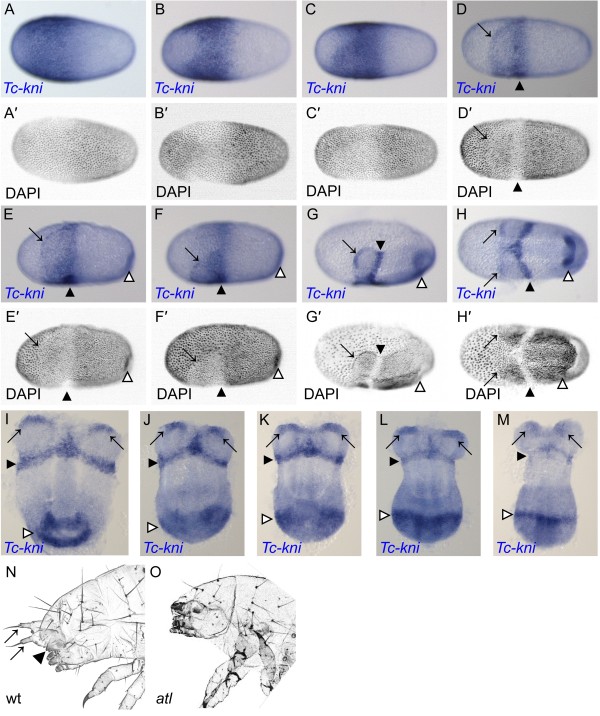
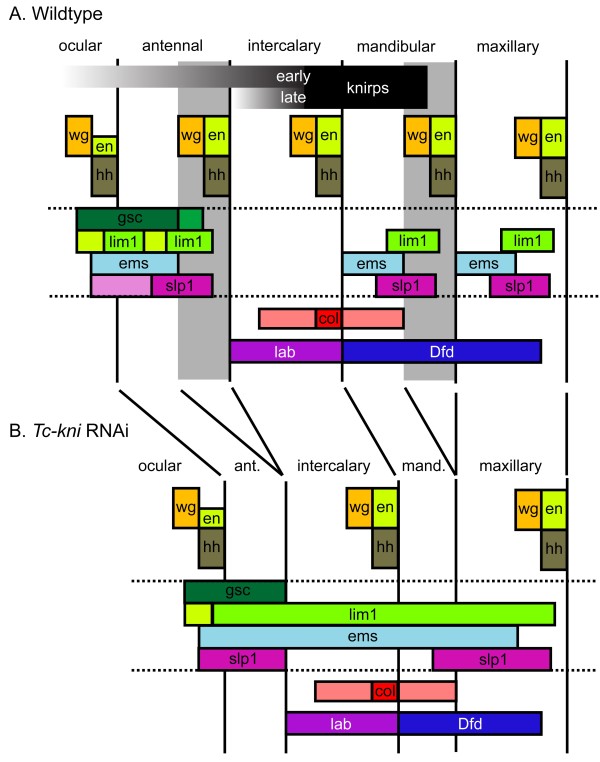
The Drosophila larval head is evolutionarily derived at the genetic and morphological level. In the beetle Tribolium castaneum, development of the larval head more closely resembles the ancestral arthropod condition. Unlike in Drosophila, a knirps homologue (Tc-kni) is required for development of the antennae and mandibles. However, published Tc-kni data are restricted to cuticle phenotypes and Tc-even-skipped and Tc-wingless stainings in knockdown embryos. Hence, it has remained unclear whether the entire antennal and mandibular segments depend on Tc-kni function, and whether the intervening intercalary segment is formed completely. We address these questions with a detailed examination of Tc-kni function.
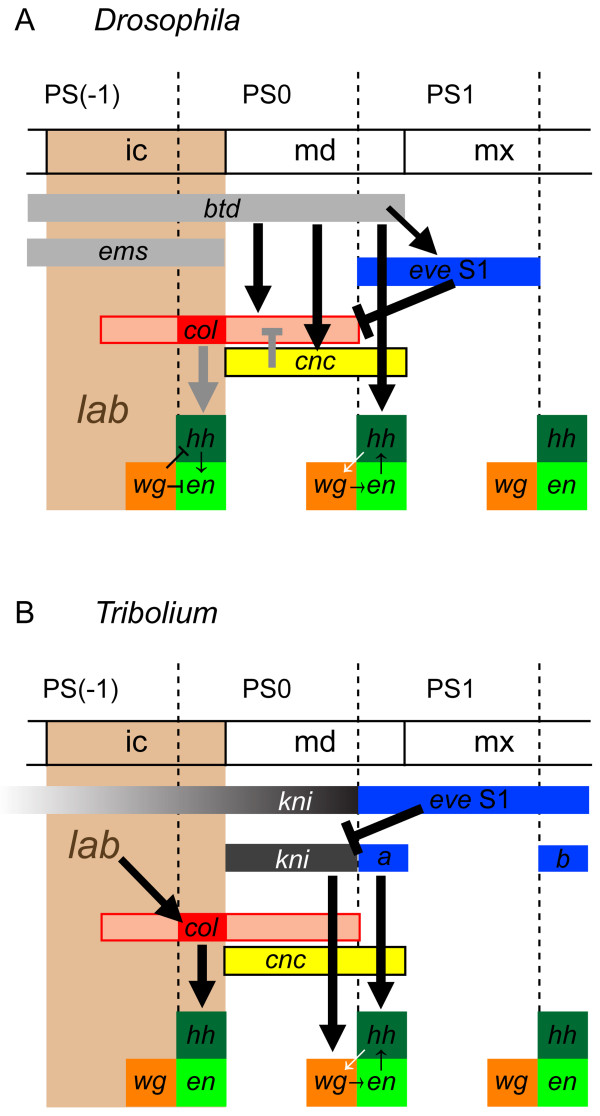
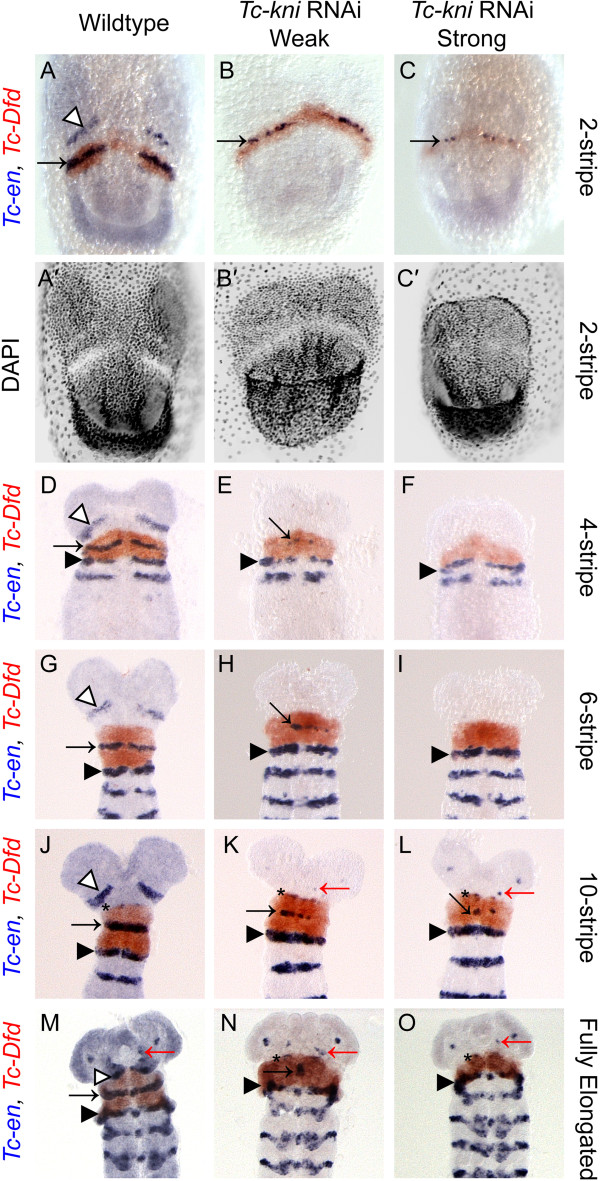
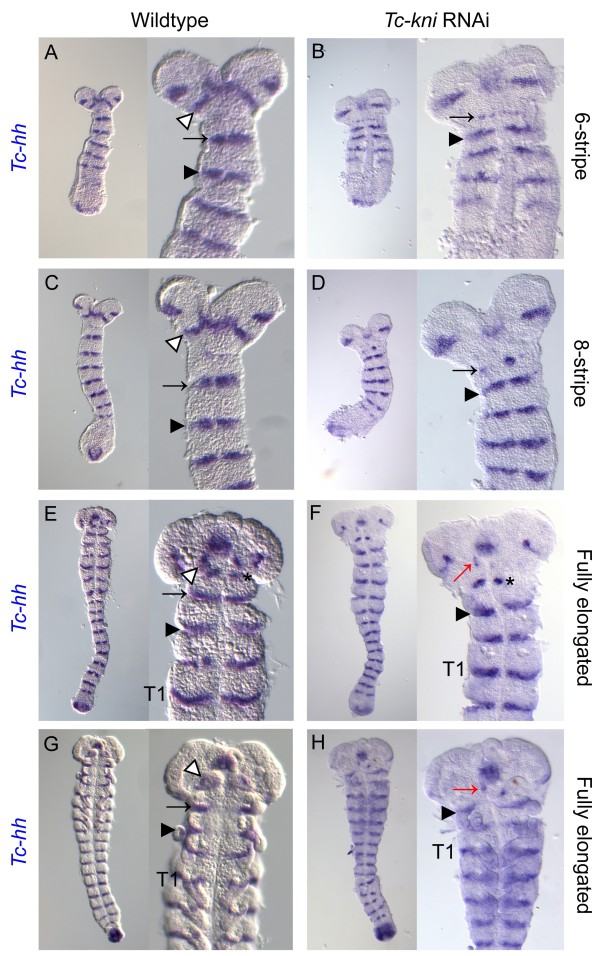
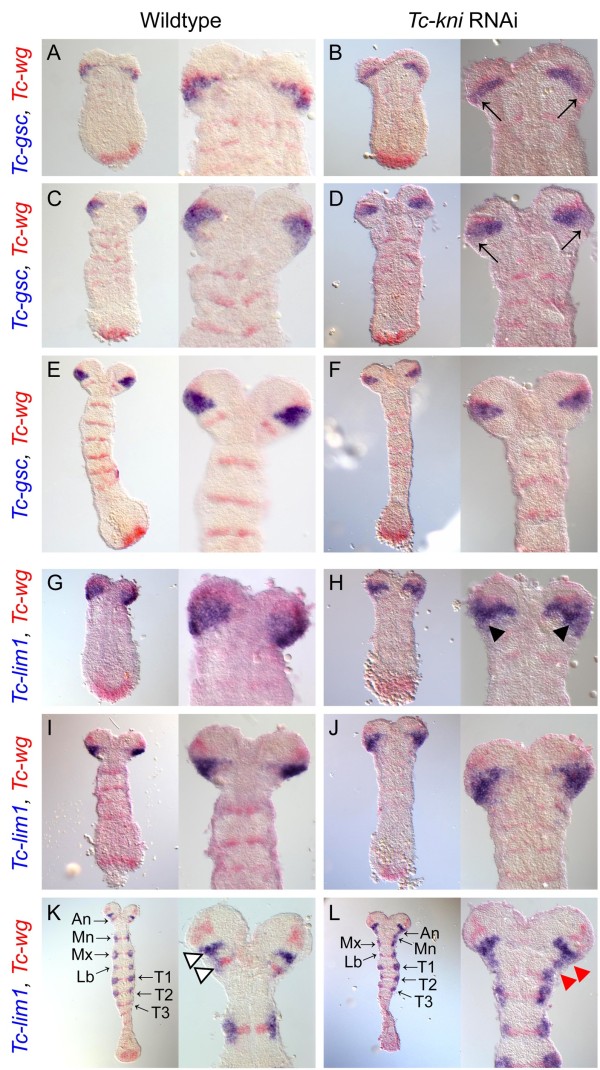
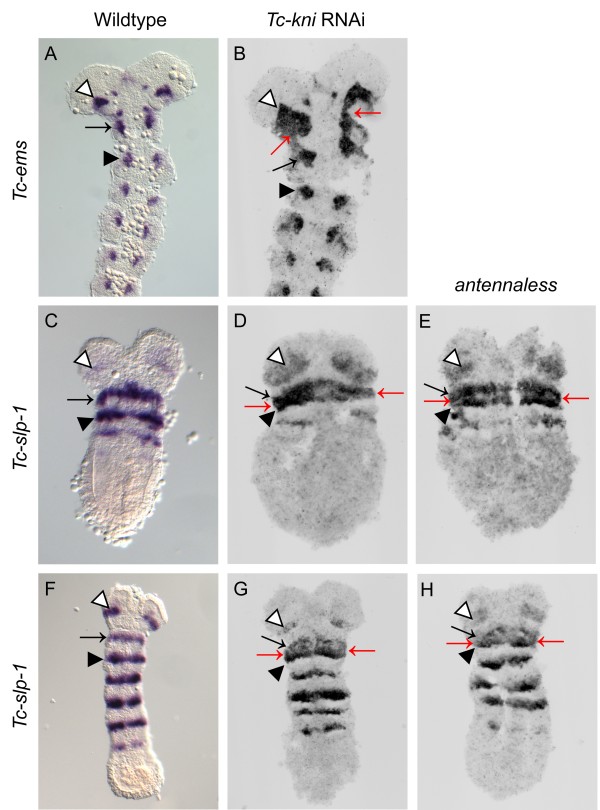
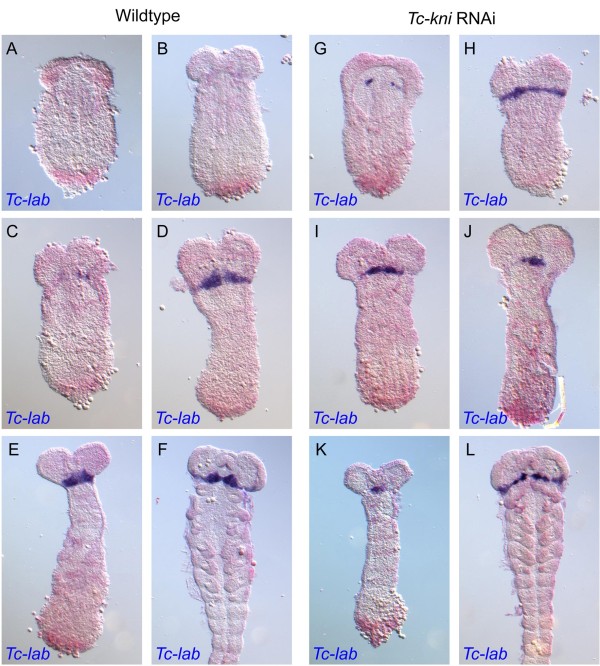
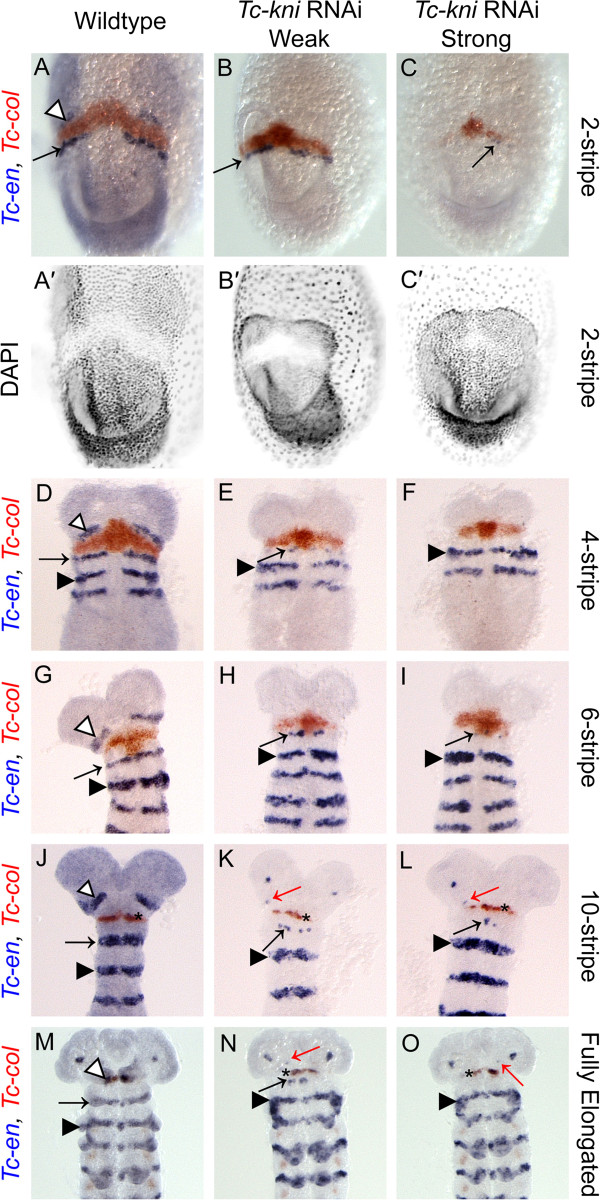
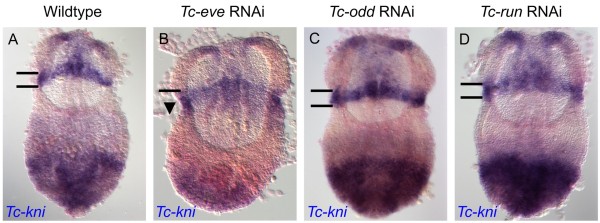
By examining the expression of marker genes in RNAi embryos, we show that Tc-kni is required only for the formation of the posterior parts of the antennal and mandibular segments (i.e. the parasegmental boundaries). Moreover, we find that the role of Tc-kni is distinct in these segments: Tc-kni is required for the initiation of the antennal parasegment boundary, but only for the maintenance of the mandibular parasegmental boundary. Surprisingly, Tc-kni controls the timing of expression of the Hox gene Tc-labial in the intercalary segment, although this segment does form in the absence of Tc-kni function. Unexpectedly, we find that the pair-rule gene Tc-even-skipped helps set the posterior boundary of Tc-kni expression in the mandible. Using the mutant antennaless, a likely regulatory Null mutation at the Tc-kni locus, we provide evidence that our RNAi studies represent a Null situation.
Tc-kni is required for the initiation of the antennal and the maintenance of the mandibular parasegmental boundaries. Tc-kni is not required for specification of the anterior regions of these segments, nor the intervening intercalary segment, confirming that Tc-kni is not a canonical 'gap-gene'. Our finding that a gap gene orthologue is regulated by a pair rule gene adds to the view that the segmentation gene hierarchies differ between Tribolium and Drosophila upstream of the pair rule gene level. In Tribolium, as in Drosophila, head and trunk segmentation gene networks cooperate to pattern the mandibular segment, albeit involving Tc-kni as novel component.
果蝇幼虫头部在遗传和形态水平上是进化衍生而来的。在甲虫赤拟谷盗中,幼虫头部的发育更类似于节肢动物的祖先状态。与果蝇不同,触角和上颚的发育需要一个克尼普斯同源物(Tc-kni)。然而,已发表的关于Tc-kni的数据仅限于表皮表型以及敲低胚胎中的Tc-偶数跳和Tc-无翅染色。因此,尚不清楚整个触角节和上颚节是否依赖于Tc-kni的功能,以及中间的间插节是否完全形成。我们通过对Tc-kni功能的详细研究来解决这些问题。
通过检查RNAi胚胎中标记基因的表达,我们发现Tc-kni仅对于触角节和上颚节的后部(即副节边界)的形成是必需的。此外,我们发现在这些节中Tc-kni的作用是不同的:Tc-kni对于触角副节边界的起始是必需的,但仅对于上颚副节边界的维持是必需的。令人惊讶的是,Tc-kni控制着间插节中Hox基因Tc-唇的表达时间,尽管在没有Tc-kni功能的情况下这个节也会形成。出乎意料的是,我们发现成对规则基因Tc-偶数跳有助于设定Tc-kni在下颚中的表达后边界。使用突变体无触角(一种可能在Tc-kni位点的调控无效突变),我们提供证据表明我们的RNAi研究代表了一种无效情况。
Tc-kni对于触角副节边界的起始和上颚副节边界的维持是必需的。这些节的前部区域以及中间的间插节的特化不需要Tc-kni,这证实了Tc-kni不是一个典型的“间隙基因”。我们发现一个间隙基因直系同源物受一个成对规则基因调控,这进一步支持了这样一种观点,即在成对规则基因水平上游,赤拟谷盗和果蝇的体节基因层次结构是不同的。在赤拟谷盗中,与果蝇一样,头部和躯干体节基因网络协同作用以使上颚节形成模式,尽管涉及到Tc-kni作为一个新的组成部分。