Department of Surgery and Perioperative Sciences, Umeå University, 901 85 Umeå, Sweden.
BMJ. 2013 Jun 18;346:f3406. doi: 10.1136/bmj.f3406.
To assess the association between 5α-reductase inhibitor (5-ARI) use in men with lower urinary tract symptoms and prostate cancer risk.
Nationwide, population based case-control study for men diagnosed with prostate cancer in 2007-09 within the Prostate Cancer data Base Sweden 2.0.
The National Prostate Cancer Register, National Patient Register, census, and Prescribed Drug Register in Sweden, from which we obtained data on 5-ARI use before date of prostate cancer diagnosis.
26,735 cases and 133,671 matched controls; five controls per case were randomly selected from matched men in the background population. 7815 men (1499 cases and 6316 controls) had been exposed to 5-ARI. 412 men had been exposed to 5-ARI before the diagnosis of a cancer with Gleason score 8-10.
Risk of prostate cancer calculated as odds ratios and 95% confidence intervals by conditional logistic regression analyses.
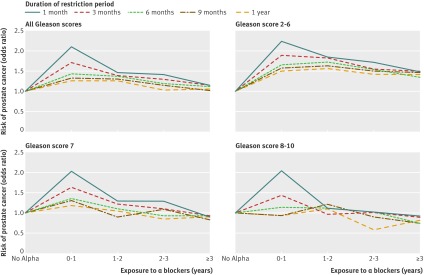
Risk of prostate cancer overall decreased with an increasing duration of exposure; men on 5-ARI treatment for more than three years had an odds ratio of 0.72 (95% confidence interval 0.59 to 0.89; P<0.001 for trend). The same pattern was seen for cancers with Gleason scores 2-6 and score 7 (both P<0.001 for trend). By contrast, the risk of tumours with Gleason scores 8-10 did not decrease with increasing exposure time to 5-ARI (for 0-1 year of exposure, odds ratio 0.96 (95% confidence interval 0.83 to 1.11); for 1-2 years, 1.07 (0.88 to 1.31); for 2-3 years, 0.96 (0.72 to 1.27); for >3 years, 1.23 (0.90 to 1.68); P=0.46 for trend).
Men treated with 5-ARI for lower urinary tract symptoms had a decreased risk of cancer with Gleason scores 2-7, and showed no evidence of an increased risk of cancer with Gleason scores 8-10 after up to four years' treatment.
评估患有下尿路症状的男性使用 5α-还原酶抑制剂(5-ARI)与前列腺癌风险之间的关联。
这是一项全国范围内基于人群的病例对照研究,针对的是 2007-09 年间在瑞典前列腺癌数据库 2.0 中被诊断为前列腺癌的男性。
瑞典国家前列腺癌登记处、国家患者登记处、人口普查和处方药物登记处,我们从这些地方获得了在前列腺癌诊断日期之前使用 5-ARI 的数据。
26735 例病例和 133671 例匹配对照;每例病例随机选择 5 名匹配男性作为对照。7815 名男性(1499 例病例和 6316 例对照)接受了 5-ARI 治疗。412 名男性在诊断为 Gleason 评分为 8-10 的癌症之前接受了 5-ARI 治疗。
通过条件逻辑回归分析计算前列腺癌的风险比和 95%置信区间。
总体而言,随着暴露时间的延长,前列腺癌的风险降低;5-ARI 治疗超过三年的男性的优势比为 0.72(95%置信区间 0.59 至 0.89;趋势检验 P<0.001)。对于 Gleason 评分 2-6 和评分 7 的癌症也观察到了同样的趋势(趋势检验 P<0.001)。相比之下,随着暴露于 5-ARI 的时间增加,Gleason 评分 8-10 的肿瘤风险并未降低(暴露 0-1 年的优势比为 0.96(95%置信区间 0.83 至 1.11);暴露 1-2 年为 1.07(0.88 至 1.31);暴露 2-3 年为 0.96(0.72 至 1.27);暴露>3 年为 1.23(0.90 至 1.68);趋势检验 P=0.46)。
患有下尿路症状并接受 5-ARI 治疗的男性患 Gleason 评分 2-7 的癌症风险降低,并且在接受长达四年的治疗后,没有证据表明 Gleason 评分 8-10 的癌症风险增加。