Department of Psychiatry, University of Iowa Carver College of Medicine, Iowa City, IA 52242, USA.
Psychosom Med. 2013 Jul-Aug;75(6):537-44. doi: 10.1097/PSY.0b013e31829a0ae3. Epub 2013 Jun 20.
Anxiety predicts cardiovascular events, although the mechanism remains unclear. We hypothesized that anxiety symptoms will correlate with impaired resistance and conduit vessel function in participants aged 55 to 90 years.
Anxiety symptoms were measured with the Symptom Checklist-90--Revised in 89 participants with clinically diagnosed atherosclerotic cardiovascular disease and 54 healthy control participants. Vascular function in conduit arteries was measured using flow-mediated dilatation, and vascular function in forearm resistance vessels (FRVs) was measured using intra-arterial drug administration and plethysmography.
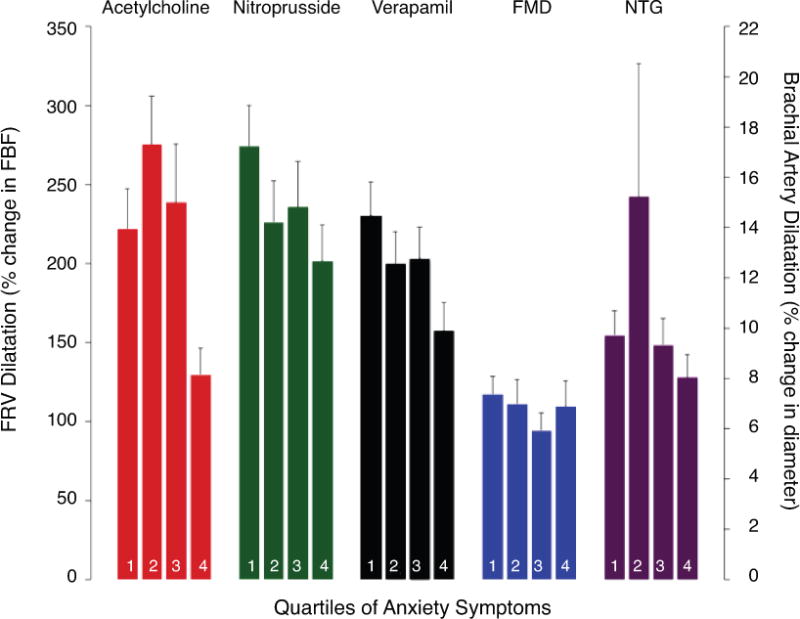
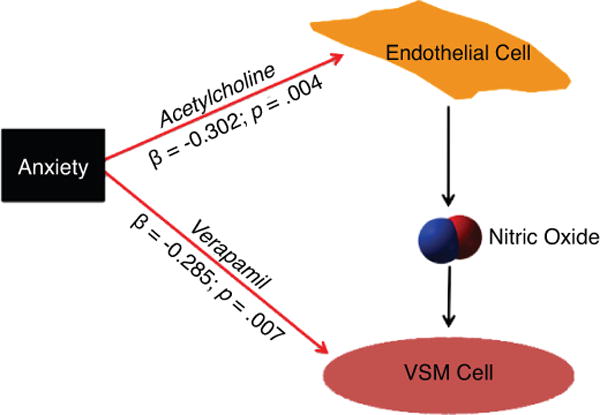
Anxiety symptoms were not associated with flow-mediated dilatation in either group. Participants with atherosclerosis exhibited significant inverse associations of anxiety symptoms with FRV dilatation (acetylcholine: β = -.302, p = .004). Adjustment for medication, risk factors, and depression symptoms did not alter the association between anxiety and FRV dysfunction, except for body mass index (BMI; anxiety: β = -.175, p = .060; BMI: β = -.494, p < .001). Although BMI was more strongly associated with FRV function than anxiety, combined BMI and anxiety accounted for greater variance in FRV function than either separately. Control participants showed no association of anxiety with FRV function.
Anxiety is uniquely and substantially related to poorer resistance vessel function (both endothelial and vascular smooth muscle functions) in individuals with atherosclerosis. These relationships are independent of medication, depression, and cardiovascular risk factors, with the exception of BMI. These findings support the concept that anxiety potentially increases vascular events through worsening of vascular function in atherosclerotic disease.
焦虑症可预测心血管事件,但其发病机制尚不清楚。我们假设,在 55 至 90 岁的参与者中,焦虑症状与阻力血管和导血管功能受损相关。
89 名临床诊断为动脉粥样硬化性心血管疾病的患者和 54 名健康对照者使用症状清单-90 修订版(Symptom Checklist-90--Revised)评估焦虑症状。通过血流介导的扩张来测量导血管的血管功能,通过动脉内药物给药和容积描记法来测量前臂阻力血管(FRV)的血管功能。
在两组中,焦虑症状与血流介导的扩张均无相关性。动脉粥样硬化患者的焦虑症状与 FRV 扩张呈显著负相关(乙酰胆碱:β = -.302,p =.004)。调整药物、危险因素和抑郁症状并不能改变焦虑与 FRV 功能障碍之间的关联,除了体重指数(BMI;焦虑:β = -.175,p =.060;BMI:β = -.494,p <.001)。尽管 BMI 与 FRV 功能的相关性强于焦虑,但 BMI 和焦虑联合起来可以解释 FRV 功能的更大差异,而不是单独解释。对照组患者的焦虑与 FRV 功能无相关性。
焦虑与动脉粥样硬化患者的阻力血管功能(内皮和血管平滑肌功能)差具有独特且显著的相关性。这些关系独立于药物、抑郁和心血管危险因素,BMI 除外。这些发现支持焦虑通过加重动脉粥样硬化疾病中的血管功能恶化从而增加血管事件的概念。