Department of Physics and Interdisciplinary Program of Integrated Biotechnology, Sogang University, Seoul 121-742, Korea, Kavli Institute of NanoScience, Department of BioNanoScience, Delft University of Technology, 2628 CJ, Delft, The Netherlands, Department of Physics and Center for the Physics of Living Cells, Institute for Genomic Biology and Center for Biophysics and Computational Biology, University of Illinois at Urbana-Champaign, Urbana, IL 61801, USA and Howard Hughes Medical Institute, Urbana, IL 61801, USA.
Nucleic Acids Res. 2013 Sep;41(16):7738-44. doi: 10.1093/nar/gkt570. Epub 2013 Jun 26.
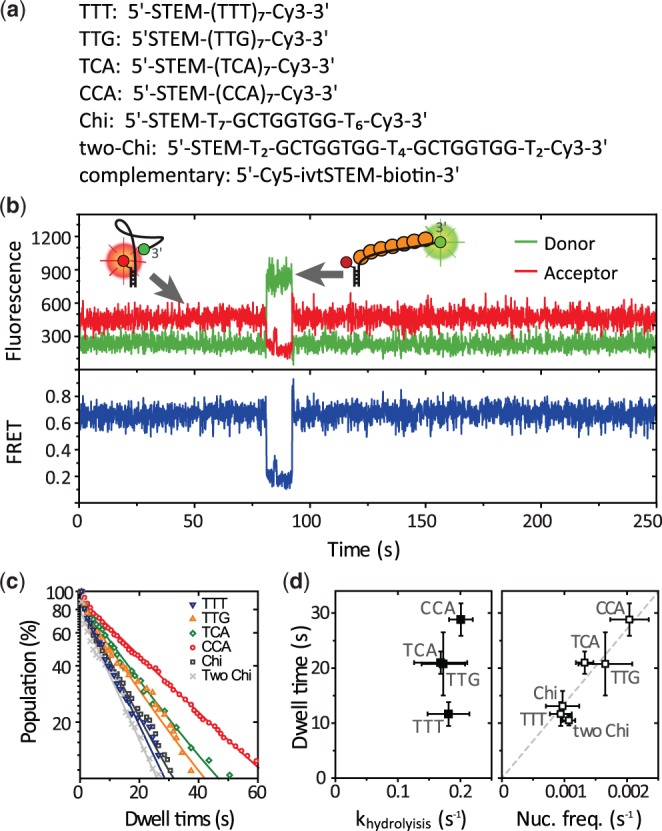
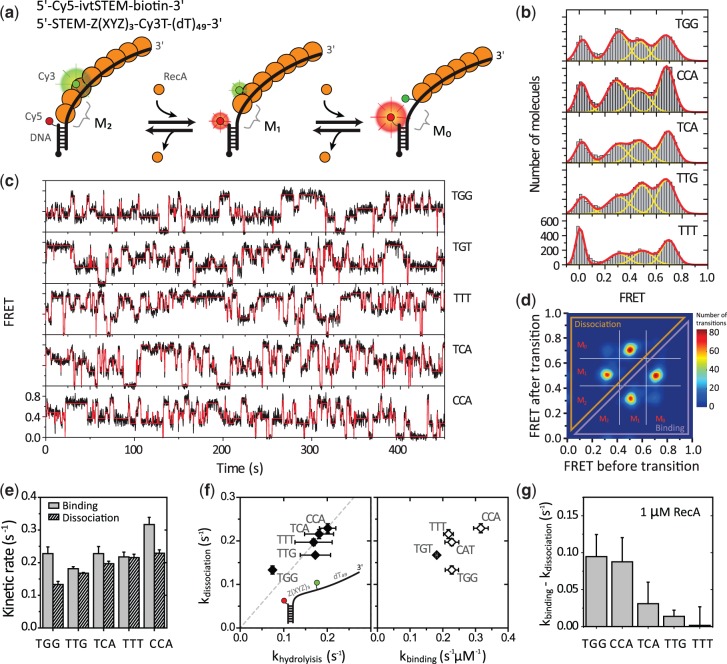
RecA is a DNA-dependent ATPase and mediates homologous recombination by first forming a filament on a single-stranded (ss) DNA. RecA binds preferentially to TGG repeat sequence, which resembles the recombination hot spot Chi (5'-GCTGGTGG-3') and is the most frequent pattern (GTG) of the codon usage in Escherichia coli. Because of the highly dynamic nature of RecA filament formation, which consists of filament nucleation, growth and shrinkage, we need experimental approaches that can resolve each of these processes separately to gain detailed insights into the molecular mechanism of sequence preference. By using a single-molecule fluorescence assay, we examined the effect of sequence on individual stages of nucleation, monomer binding and dissociation. We found that RecA does not recognize the Chi sequence as a nucleation site. In contrast, we observed that it is the reduced monomer dissociation that mainly determines the high filament stability on TGG repeats. This sequence dependence of monomer dissociation is well-correlated with that of ATP hydrolysis, suggesting that DNA sequence dictates filament stability through modulation of ATP hydrolysis.
RecA 是一种依赖于 DNA 的 ATP 酶,通过首先在单链 (ss) DNA 上形成细丝来介导同源重组。RecA 优先结合 TGG 重复序列,该序列类似于重组热点 Chi(5'-GCTGGTGG-3'),并且是大肠杆菌中密码子使用最频繁的模式 (GTG)。由于 RecA 丝形成的高度动态性质,包括丝核的形成、生长和收缩,我们需要能够分别解析这些过程的实验方法,以深入了解序列偏好的分子机制。通过使用单分子荧光测定法,我们检查了序列对核形成、单体结合和解离各个阶段的影响。我们发现 RecA 并不将 Chi 序列识别为核形成位点。相比之下,我们观察到单体解离的减少主要决定了 TGG 重复上的高丝稳定性。单体解离的这种序列依赖性与 ATP 水解的依赖性很好地相关,表明 DNA 序列通过调节 ATP 水解来决定丝的稳定性。