Department of Radiation Oncology, Cancer Institute and Hospital, Chinese Academy of Medical Sciences (CAMS) and Peking Union Medical College (PUMC), Beijing 100021, China.
Radiat Oncol. 2013 Jun 27;8:157. doi: 10.1186/1748-717X-8-157.
To evaluate the efficacy and toxicity of fractionated stereotactic radiotherapy (FSRT) in patients with residual nasopharyngeal carcinoma (NPC).
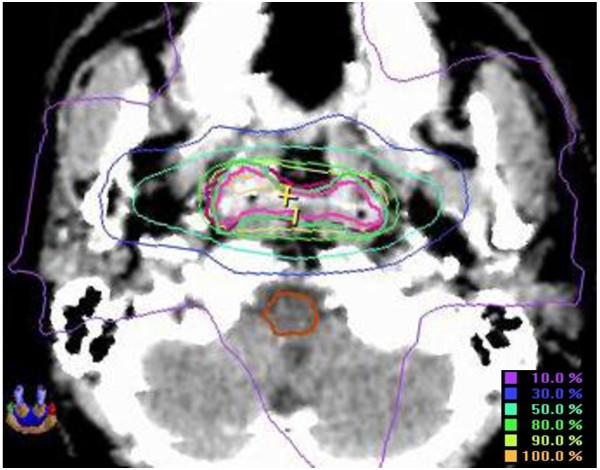
From January 2000 to December 2009, 136 NPC patients with residual lesions after primary radiotherapy (RT) were treated by FSRT. The total dose of primary RT was 68.0-78.0 Gy (median, 70.0 Gy). The median time from the primary RT to FSRT was 24.5 days. Tumor volumes for FSRT ranged from 0.60 to 77.13 cm3 (median, 13.45 cm3). The total FSRT doses were 8.0-32.0Gy (median, 19.5 Gy) with 2.0-10.0 Gy per fraction.
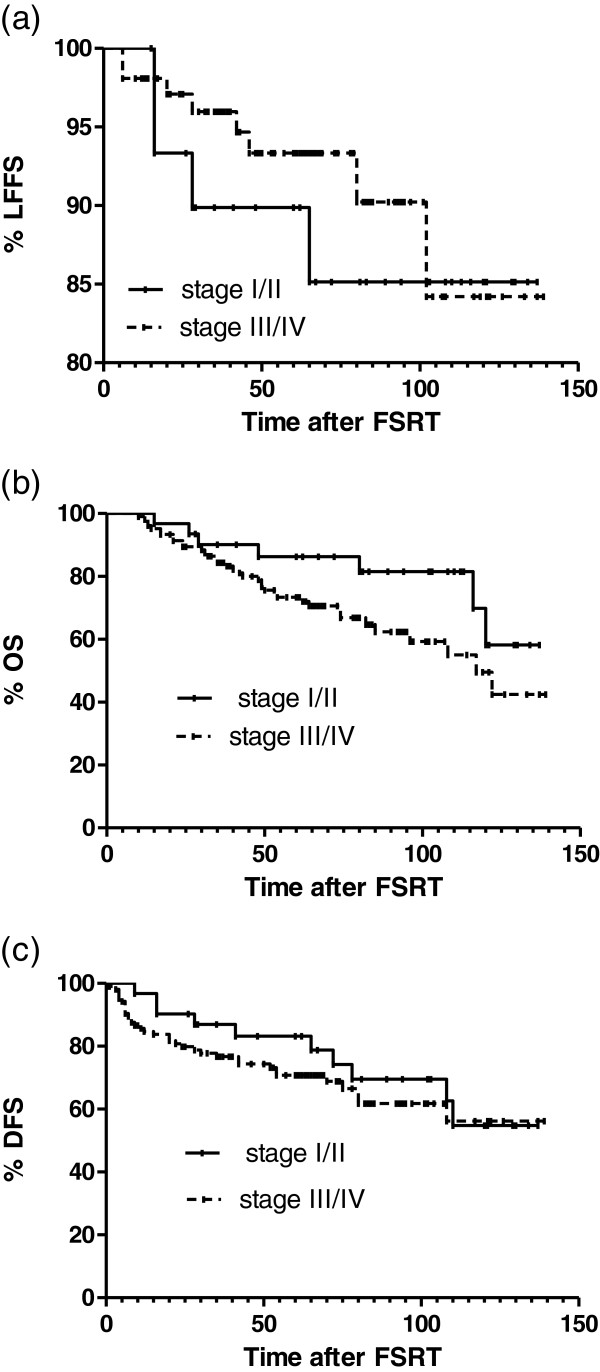
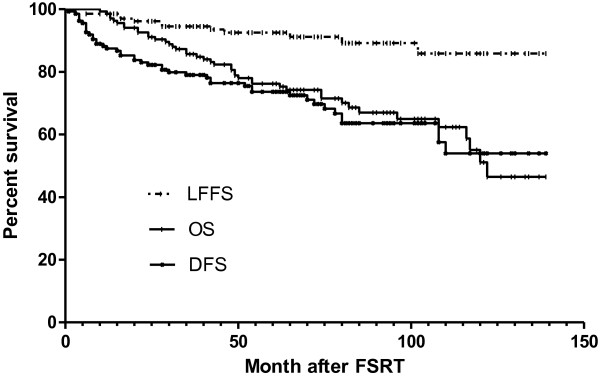
Five-year local failure-free survival (LFFS), freedom from distant metastasis (FFDM), overall survival (OS), and disease free survival (DFS) rates for all patients were 92.5%, 77.0%, 76.2%, and 73.6%, respectively. No statistical significant differences were found in LFFS, DFS and OS in patients with stage I/II versus stage III/ IV diseases. Nineteen patients exhibited late toxicity. T stage at diagnosis was a significant prognostic factor for OS and DFS. Age was a prognostic factor for OS.
FSRT after external beam radiotherapy provides excellent local control for patients with residual NPC. The incidence of severe late toxicity is low and acceptable. Further investigation of optimal fractionation regimens will facilitate reduction of long-term complications.
评估分割立体定向放疗(FSRT)在残留鼻咽癌(NPC)患者中的疗效和毒性。
从 2000 年 1 月至 2009 年 12 月,对 136 例经原发放疗(RT)后有残留病变的 NPC 患者进行 FSRT 治疗。原发 RT 的总剂量为 68.0-78.0Gy(中位数,70.0Gy)。从原发 RT 到 FSRT 的中位时间为 24.5 天。FSRT 的肿瘤体积范围为 0.60-77.13cm3(中位数,13.45cm3)。FSRT 的总剂量为 8.0-32.0Gy(中位数,19.5Gy),每次分割 2.0-10.0Gy。
所有患者的 5 年局部无失败生存率(LFFS)、无远处转移生存率(FFDM)、总生存率(OS)和无疾病生存率(DFS)分别为 92.5%、77.0%、76.2%和 73.6%。I/II 期和 III/IV 期患者的 LFFS、DFS 和 OS 无统计学差异。19 例患者出现晚期毒性。诊断时的 T 分期是 OS 和 DFS 的显著预后因素。年龄是 OS 的预后因素。
外照射放疗后进行 FSRT 可为残留 NPC 患者提供良好的局部控制。严重晚期毒性的发生率低且可接受。进一步研究最佳分割方案将有助于减少长期并发症。