BMC Infect Dis. 2013 Jun 28;13:293. doi: 10.1186/1471-2334-13-293.
HIV-infected patients starting antiretroviral treatment (ART) experience deep and early disorders in fat and bone metabolism, leading to concomitant changes in fat mass and bone mineral density.
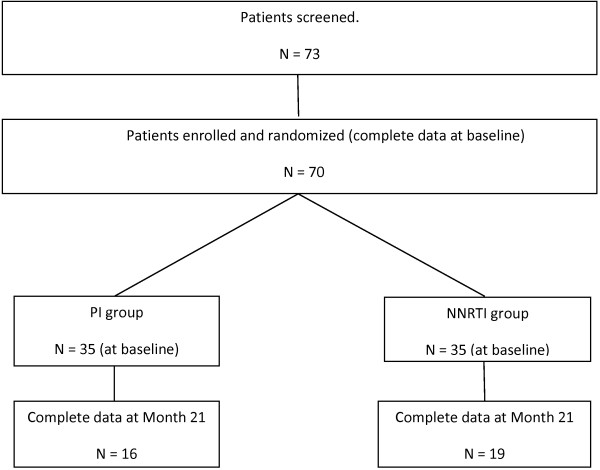
We conducted a prospective study in treatment-naive HIV-infected patients randomized to receive two nucleoside reverse transcriptase inhibitors in combination with either a protease inhibitor (PI) or a non-nucleosidic reverse transcriptase inhibitor (NNRTI), to evaluate early changes in body composition, bone mineral density and metabolic markers as differentially induced by antiretroviral therapies. We measured changes in markers of carbohydrate, of fat and bone metabolism, and, using dual-emission X-ray absorptiometry (DXA), body composition and bone mineral density (BMD). Complete data on changes between baseline and after 21 months treatment were available for 35 patients (16 in the PI group and 19 in the NNRTI group).
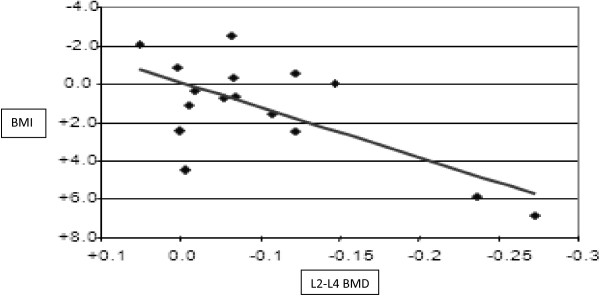
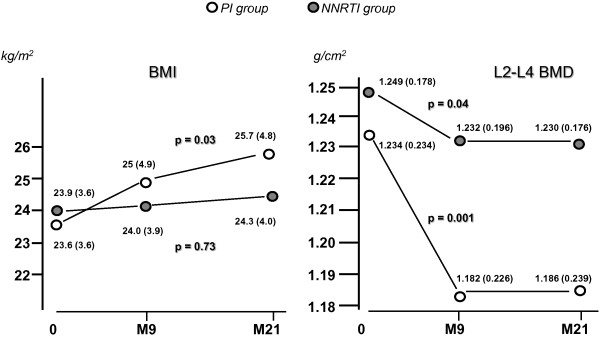
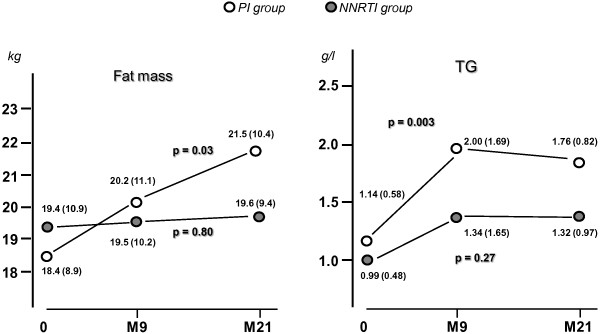
A significant gain in BMI and in total and lower limb fat mass was recorded only in patients receiving PI. A loss of lumbar BMD was observed in both groups, being higher with PI. Plasma markers of bone metabolism (alkaline phosphatase, osteocalcin, collagen crosslaps) and levels of parathormone and of 1,25diOH-vitamin D3 significantly increased in both groups, concomitant with a decline in 25OH-vitamin D3. Lipids and glucose levels increased in both groups but rise in triglyceride was more pronounced with PI. A correlation between loss of BMD and gain of fat mass is observed in patients starting PI.
We evidenced an early effect of ART on lipid and bone metabolisms. PI lead to a significant gain in fat mass correlated with a sharp drop in BMD but active bone remodelling is evident with all antiretroviral treatments, associated with low vitamin D levels and hyperparathyroidism. In parallel, signs of metabolic restoration are evident. However, early increases in lean and fat mass, triglycerides, waist circumference and leptin are much more pronounced with PI.
开始抗逆转录病毒治疗(ART)的 HIV 感染者经历脂肪和骨代谢的深刻和早期紊乱,导致脂肪质量和骨矿物质密度同时发生变化。
我们对接受两种核苷逆转录酶抑制剂联合蛋白酶抑制剂(PI)或非核苷逆转录酶抑制剂(NNRTI)治疗的初治 HIV 感染者进行了前瞻性研究,以评估抗逆转录病毒治疗对身体成分、骨矿物质密度和代谢标志物的早期变化的影响。我们测量了糖、脂肪和骨代谢标志物的变化,并使用双能 X 线吸收法(DXA)测量了身体成分和骨矿物质密度(BMD)。共有 35 名患者(PI 组 16 名,NNRTI 组 19 名)的基线和 21 个月治疗后的数据完整。
仅在接受 PI 治疗的患者中观察到 BMI 以及总脂肪量和下肢脂肪量的显著增加。两组均观察到腰椎 BMD 丢失,PI 组更高。两组的骨代谢标志物(碱性磷酸酶、骨钙素、胶原交联)和甲状旁腺激素水平以及 1,25-二羟维生素 D3 水平均显著升高,同时 25-羟维生素 D3 水平下降。两组的血脂和血糖水平均升高,但 PI 组的甘油三酯升高更为明显。在开始使用 PI 的患者中观察到 BMD 丢失与脂肪量增加之间的相关性。
我们证明了 ART 对脂质和骨代谢的早期影响。PI 导致脂肪量显著增加,与 BMD 急剧下降相关,但所有抗逆转录病毒治疗均表现出活跃的骨重塑,与低维生素 D 水平和甲状旁腺功能亢进有关。同时,代谢恢复的迹象明显。然而,PI 引起的瘦体重和脂肪量、甘油三酯、腰围和瘦素的早期增加更为明显。