
实验检测拟南芥信号肽肽酶的蛋白水解活性。
Experimental detection of proteolytic activity in a signal peptide peptidase of Arabidopsis thaliana.
机构信息
Department of Applied Biological Chemistry, The University of Tokyo, Tokyo, Japan.
出版信息
BMC Biochem. 2013 Jul 6;14:16. doi: 10.1186/1471-2091-14-16.
BACKGROUND
Signal peptide peptidase (SPP) is a multi-transmembrane aspartic protease involved in intramembrane-regulated proteolysis (RIP). RIP proteases mediate various key life events by releasing bioactive peptides from the plane of the membrane region. We have previously isolated Arabidopsis SPP (AtSPP) and found that this protein is expressed in the ER. An AtSPP-knockout plant was found to be lethal because of abnormal pollen formation; however, there is negligible information describing the physiological function of AtSPP. In this study, we have investigated the proteolytic activity of AtSPP to define the function of SPPs in plants.
RESULTS
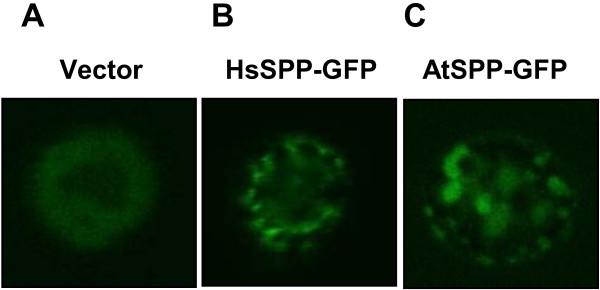
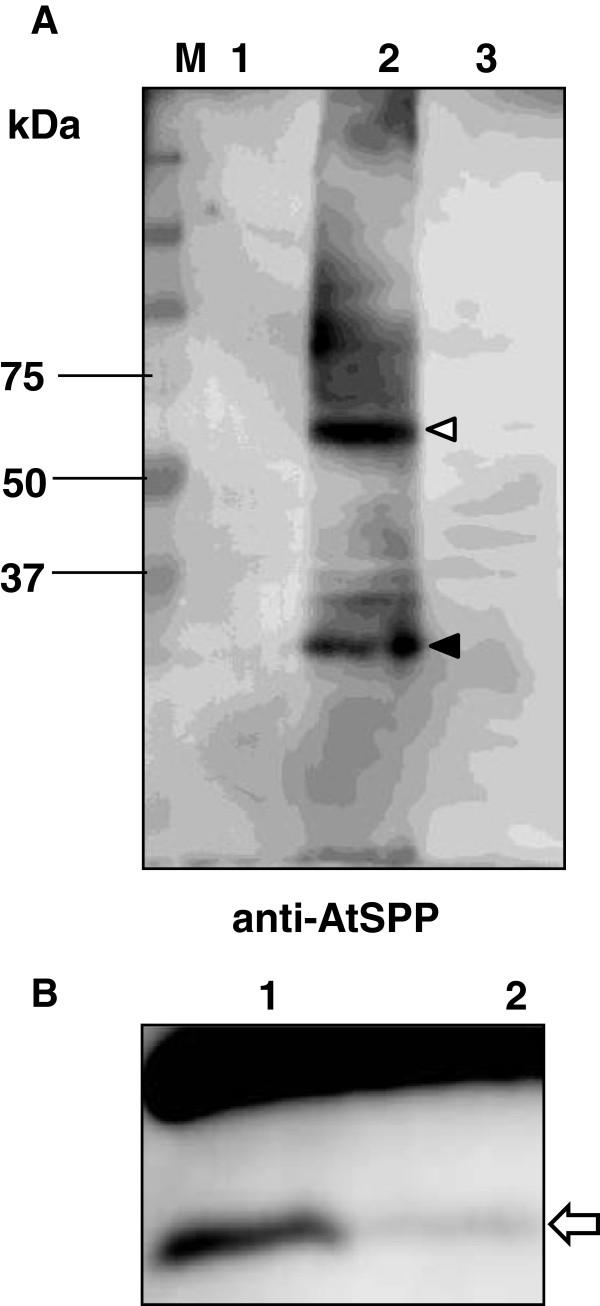
We found that an n-dodecyl-ß-maltoside (DDM)-solubilized membrane fraction from Arabidopsis cells digested the myc-Prolactin-PP-Flag peptide, a human SPP substrate, and this activity was inhibited by (Z-LL)2-ketone, an SPP-specific inhibitor. The proteolytic activities from the membrane fractions solubilized by other detergents were not inhibited by (Z-LL)2-ketone. To confirm the proteolytic activity of AtSPP, the protein was expressed as either a GFP fusion protein or solely AtSPP in yeast. SDS-PAGE analysis showed that migration of the fragments that were cleaved by AtSPP were identical in size to the fragments produced by human SPP using the same substrate. These membrane-expressed proteins digested the substrate in a manner similar to that in Arabidopsis cells.
CONCLUSIONS
The data from the in vitro cell-free assay indicated that the membrane fraction of both Arabidopsis cells and AtSPP recombinantly expressed in yeast actually possessed proteolytic activity for a human SPP substrate. We concluded that plant SPP possesses proteolytic activity and may be involved in RIP.
背景
信号肽肽酶(SPP)是一种参与跨膜调节蛋白水解(RIP)的多跨膜天冬氨酸蛋白酶。RIP 蛋白酶通过将生物活性肽从膜区域的平面释放来介导各种关键生命事件。我们之前分离了拟南芥 SPP(AtSPP),并发现该蛋白在 ER 中表达。AtSPP 敲除植物由于花粉形成异常而致死;然而,几乎没有信息描述 AtSPP 的生理功能。在这项研究中,我们研究了 AtSPP 的蛋白水解活性,以确定 SPP 在植物中的功能。
结果
我们发现,来自拟南芥细胞的用 n-十二烷基-β-麦芽糖苷(DDM)溶解的膜部分消化了人 SPP 底物 myc-Prolactin-PP-Flag 肽,该活性被 SPP 特异性抑制剂(Z-LL)2-酮抑制。用其他去污剂溶解的膜部分的蛋白水解活性不受(Z-LL)2-酮抑制。为了确认 AtSPP 的蛋白水解活性,该蛋白在酵母中表达为 GFP 融合蛋白或单独的 AtSPP。SDS-PAGE 分析表明,由 AtSPP 切割的片段的迁移与使用相同底物的人 SPP 产生的片段大小相同。这些在膜上表达的蛋白以与拟南芥细胞相似的方式消化底物。
结论
无细胞体外测定的数据表明,拟南芥细胞的膜部分和在酵母中重组表达的 AtSPP 的膜部分实际上都具有对人 SPP 底物的蛋白水解活性。我们得出结论,植物 SPP 具有蛋白水解活性,可能参与 RIP。



 Zotero 插件