State Key Laboratory of Genetic Resources and Evolution, Kunming Institute of Zoology, Chinese Academy of Sciences, Kunming, China.
PLoS One. 2013 Jun 20;8(6):e66102. doi: 10.1371/journal.pone.0066102. Print 2013.
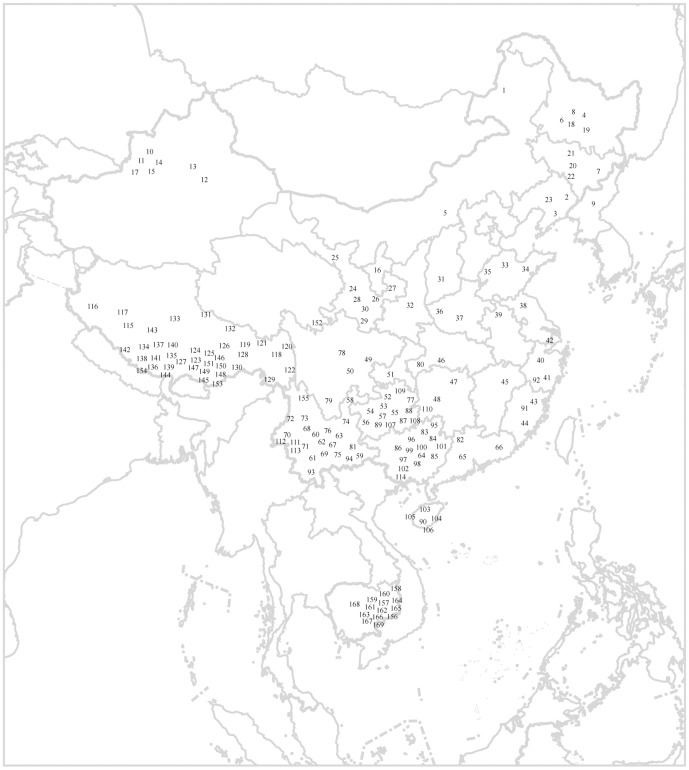
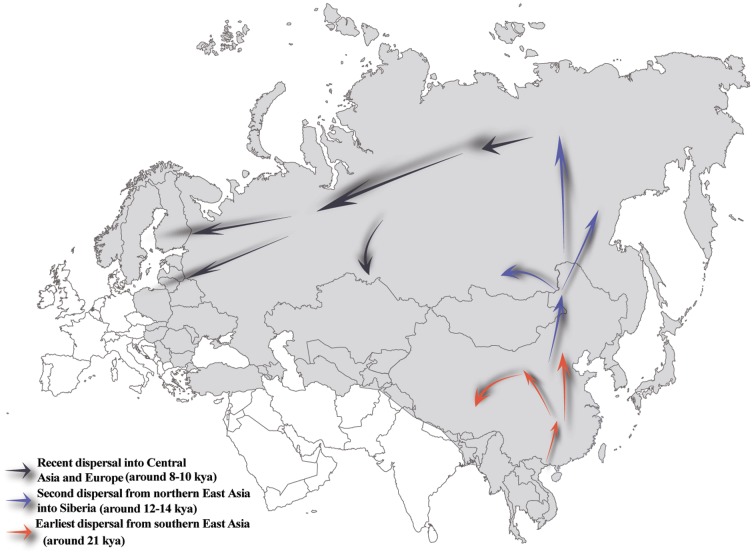
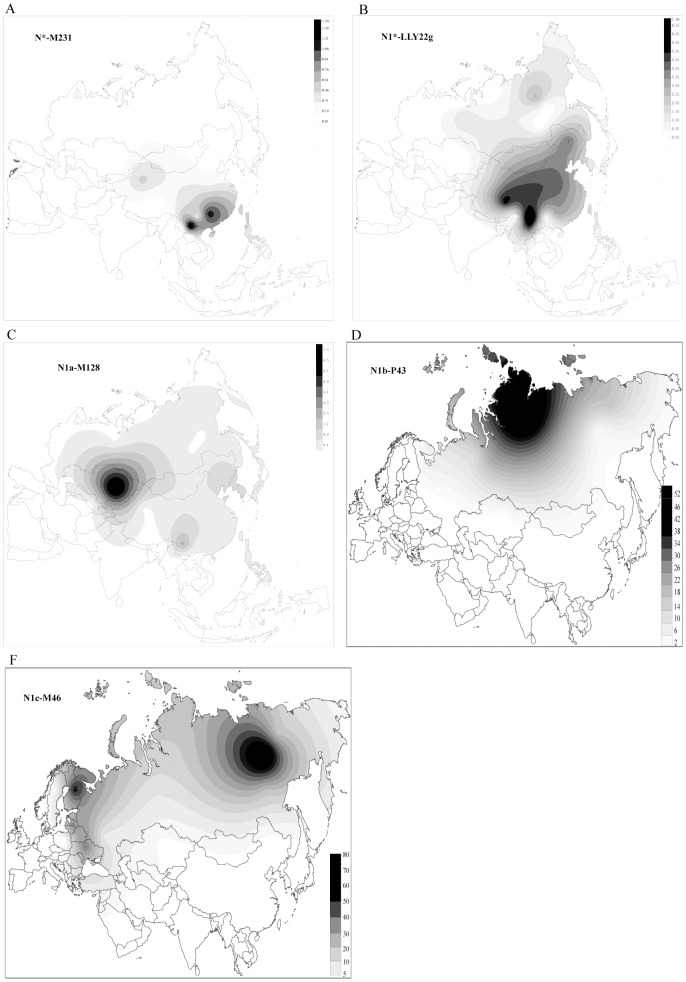
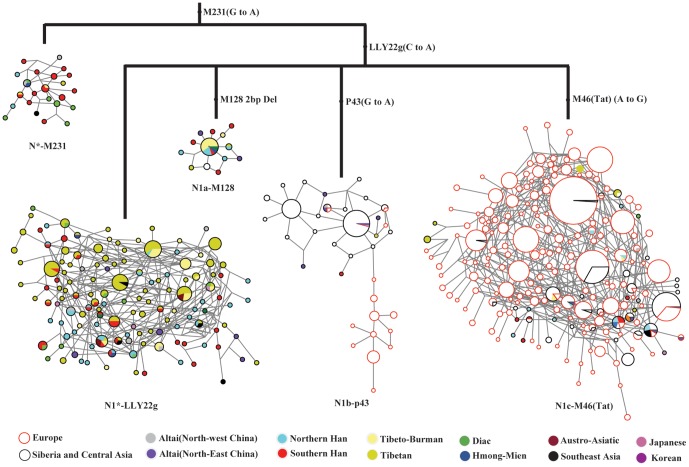
The Y-chromosome haplogroup N-M231 (Hg N) is distributed widely in eastern and central Asia, Siberia, as well as in eastern and northern Europe. Previous studies suggested a counterclockwise prehistoric migration of Hg N from eastern Asia to eastern and northern Europe. However, the root of this Y chromosome lineage and its detailed dispersal pattern across eastern Asia are still unclear. We analyzed haplogroup profiles and phylogeographic patterns of 1,570 Hg N individuals from 20,826 males in 359 populations across Eurasia. We first genotyped 6,371 males from 169 populations in China and Cambodia, and generated data of 360 Hg N individuals, and then combined published data on 1,210 Hg N individuals from Japanese, Southeast Asian, Siberian, European and Central Asian populations. The results showed that the sub-haplogroups of Hg N have a distinct geographical distribution. The highest Y-STR diversity of the ancestral Hg N sub-haplogroups was observed in the southern part of mainland East Asia, and further phylogeographic analyses supports an origin of Hg N in southern China. Combined with previous data, we propose that the early northward dispersal of Hg N started from southern China about 21 thousand years ago (kya), expanding into northern China 12-18 kya, and reaching further north to Siberia about 12-14 kya before a population expansion and westward migration into Central Asia and eastern/northern Europe around 8.0-10.0 kya. This northward migration of Hg N likewise coincides with retreating ice sheets after the Last Glacial Maximum (22-18 kya) in mainland East Asia.
Y 染色体单倍群 N-M231(Hg N)广泛分布于东亚和中亚、西伯利亚以及东欧和北欧。先前的研究表明,Hg N 沿着逆时针方向从古东亚迁徙到东欧和北欧。然而,这种 Y 染色体谱系的起源及其在东亚的详细扩散模式仍不清楚。我们分析了欧亚大陆 359 个人群的 20826 名男性中的 1570 名 Hg N 个体的单倍群谱和系统地理学模式。我们首先对来自中国和柬埔寨的 169 个人群中的 6371 名男性进行基因分型,并生成了 360 名 Hg N 个体的数据,然后结合了来自日本、东南亚、西伯利亚、欧洲和中亚人群的 1210 名 Hg N 个体的已发表数据。结果表明,Hg N 的亚单倍群具有明显的地理分布。在东亚大陆的南部,祖先 Hg N 亚单倍群的 Y-STR 多样性最高。进一步的系统地理学分析支持 Hg N 的起源于中国南方。结合先前的数据,我们提出 Hg N 的早期向北扩散始于约 21 千年前(kya)的中国南方,12-18 kya 扩展到中国北方,约 12-14 kya 到达西伯利亚北部,随后在约 8.0-10.0 kya 发生人口扩张和向西迁移到中亚和东欧/北欧。这种 Hg N 的向北迁移与末次冰盛期(22-18 kya)后东亚大陆上退缩的冰盖相一致。