Department of Radiology, First Affiliated Hospital of Zhejiang Chinese Medical University, Hangzhou, Zhejiang, China.
PLoS One. 2013 Jul 2;8(7):e67731. doi: 10.1371/journal.pone.0067731. Print 2013.
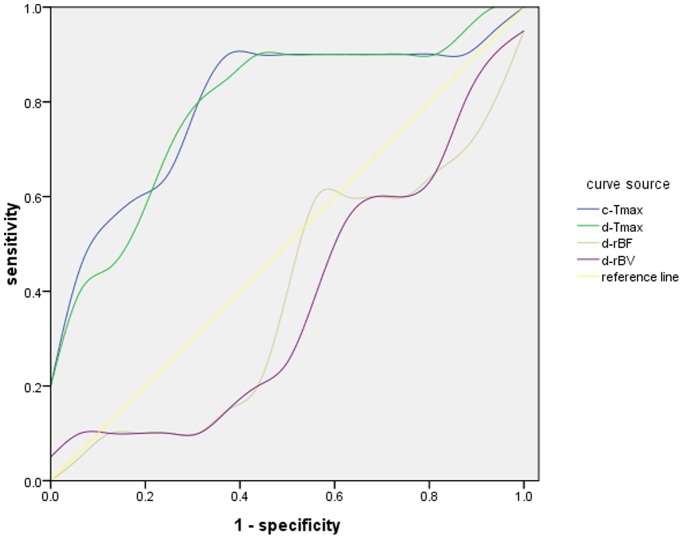
Dynamic contrast-enhanced magnetic resonance imaging (DCE MRI) of the breast is a routinely used imaging method which is highly sensitive for detecting breast malignancy. Specificity, though, remains suboptimal. Dynamic susceptibility contrast magnetic resonance imaging (DSC MRI), an alternative dynamic contrast imaging technique, evaluates perfusion-related parameters unique from DCE MRI. Previous work has shown that the combination of DSC MRI with DCE MRI can improve diagnostic specificity, though an additional administration of intravenous contrast is required. Dual-echo MRI can measure both T1W DCE MRI and T2W DSC MRI parameters with a single contrast bolus, but has not been previously implemented in breast imaging. We have developed a dual-echo gradient-echo sequence to perform such simultaneous measurements in the breast, and use it to calculate the semi-quantitative T1W and T2W related parameters such as peak enhancement ratio, time of maximal enhancement, regional blood flow, and regional blood volume in 20 malignant lesions and 10 benign fibroadenomas in 38 patients. Imaging parameters were compared to surgical or biopsy obtained tissue samples. Receiver operating characteristic (ROC) curves and area under the ROC curves were calculated for each parameter and combination of parameters. The time of maximal enhancement derived from DCE MRI had a 90% sensitivity and 69% specificity for predicting malignancy. When combined with DSC MRI derived regional blood flow and volume parameters, sensitivity remained unchanged at 90% but specificity increased to 80%. In conclusion, we show that dual-echo MRI with a single administration of contrast agent can simultaneously measure both T1W and T2*W related perfusion and kinetic parameters in the breast and the combination of DCE MRI and DSC MRI parameters improves the diagnostic performance of breast MRI to differentiate breast cancer from benign fibroadenomas.
动态对比增强磁共振成像(DCE MRI)是一种常规使用的成像方法,对检测乳腺癌具有高度敏感性。然而,其特异性仍然不理想。动态磁化率对比磁共振成像(DSC MRI)是一种替代的动态对比成像技术,可评估与灌注相关的、与 DCE MRI 不同的参数。先前的工作表明,DSC MRI 与 DCE MRI 的结合可以提高诊断的特异性,尽管需要额外的静脉内造影剂注射。双回波磁共振成像可以用单次造影剂注射测量 T1W DCE MRI 和 T2W DSC MRI 参数,但以前并未在乳腺成像中实施。我们开发了一种双回波梯度回波序列,可以在乳腺中进行这种同时测量,并使用它来计算半定量 T1W 和 T2W 相关参数,如峰值增强比、最大增强时间、区域血流量和 38 例患者的 20 例恶性病变和 10 例良性纤维腺瘤中的区域血容量。对成像参数与手术或活检获得的组织样本进行了比较。为每个参数和参数组合计算了接收器工作特性(ROC)曲线和 ROC 曲线下面积。从 DCE MRI 得出的最大增强时间对预测恶性肿瘤具有 90%的敏感性和 69%的特异性。当与 DSC MRI 得出的区域血流和容积参数结合时,敏感性保持不变,为 90%,但特异性提高到 80%。总之,我们表明,单次造影剂注射的双回波 MRI 可以同时测量乳腺中的 T1W 和 T2*W 相关灌注和动力学参数,DCE MRI 和 DSC MRI 参数的组合提高了乳腺 MRI 鉴别乳腺癌与良性纤维腺瘤的诊断性能。