Department of Wildlife and Fisheries Sciences, Texas A&M University, College Station, Texas, United States of America.
PLoS One. 2013 Jul 2;8(7):e67827. doi: 10.1371/journal.pone.0067827. Print 2013.
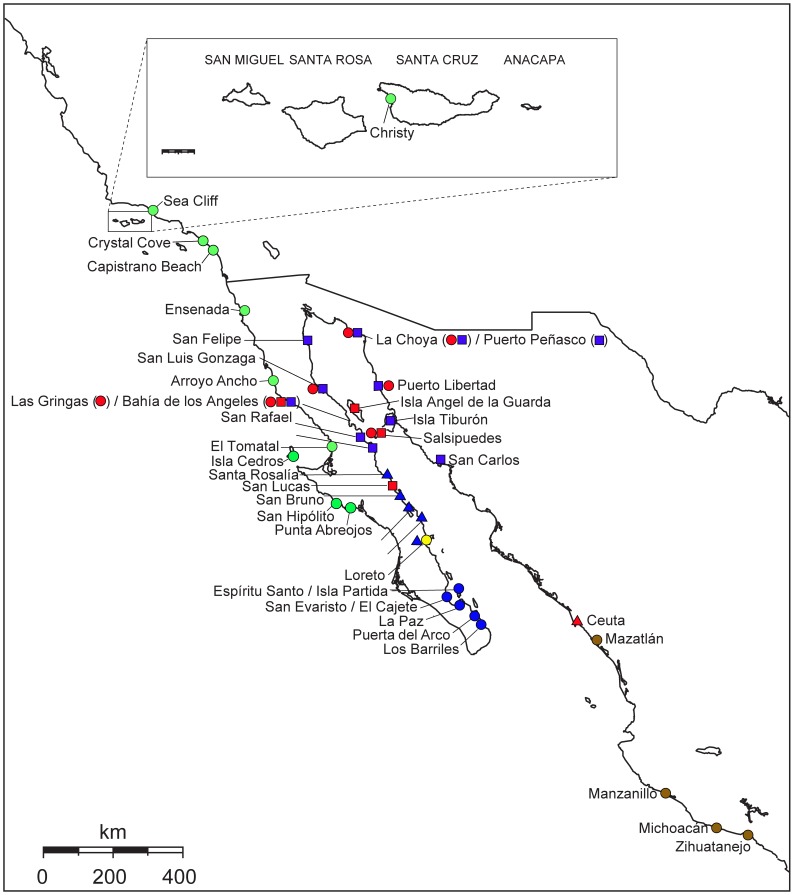
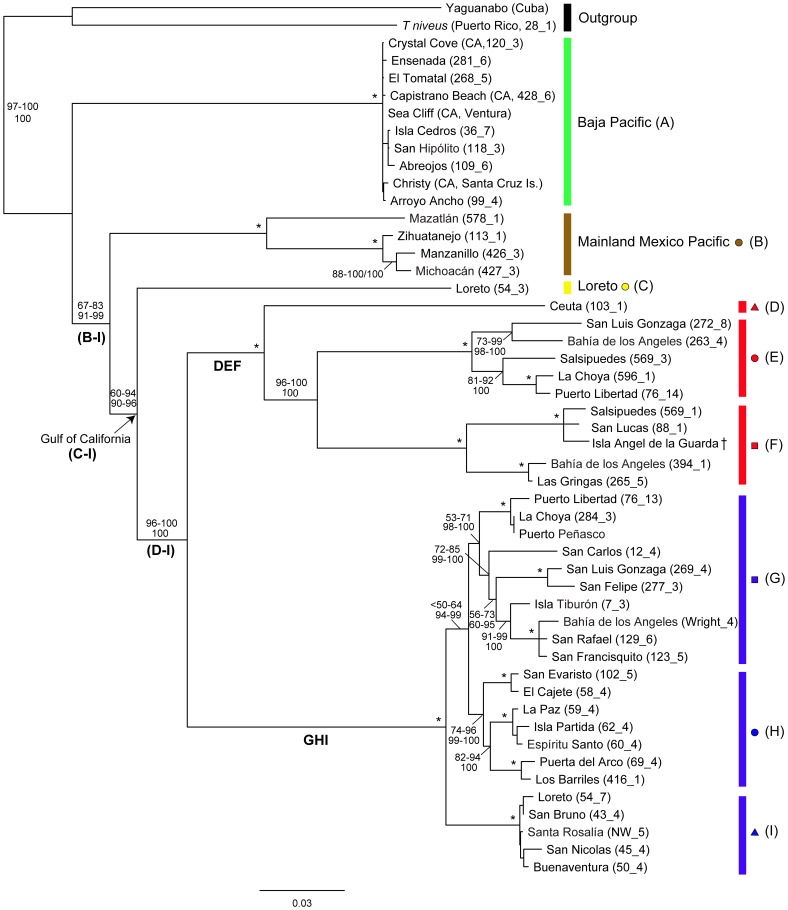
Phylogeographic studies of animals with low vagility and restricted to patchy habitats of the supralittoral zone, can uncover unknown diversity and shed light on processes that shaped evolution along a continent's edge. The Pacific coast between southern California and central Mexico, including the megadiverse Gulf of California, offers a remarkable setting to study biological diversification in the supralittoral. A complex geological history coupled with cyclical fluctuations in temperature and sea level provided ample opportunities for diversification of supralittoral organisms. Indeed, a previous phylogeographic study of Ligia, a supralittoral isopod that has limited dispersal abilities and is restricted to rocky patches, revealed high levels of morphologically cryptic diversity. Herein, we examined phylogeographic patterns of Tylos, another supralittoral isopod with limited dispersal potential, but whose habitat (i.e., sandy shores) appears to be more extensive and connected than that of Ligia. We conducted Maximum Likelihood and Bayesian phylogenetic analyses on mitochondrial and nuclear DNA sequences. These analyses revealed multiple highly divergent lineages with discrete regional distributions, despite the recognition of a single valid species for this region. A traditional species-diagnostic morphological trait distinguished several of these lineages. The phylogeographic patterns of Tylos inside the Gulf of California show a deep and complex history. In contrast, patterns along the Pacific region between southern California and the Baja Peninsula indicate a recent range expansion, probably postglacial and related to changes in sea surface temperature (SST). In general, the phylogeographic patterns of Tylos differed from those of Ligia. Differences in the extension and connectivity of the habitats occupied by Tylos and Ligia may account for the different degrees of population isolation experienced by these two isopods and their contrasting phylogeographic patterns. Identification of divergent lineages of Tylos in the study area is important for conservation, as some populations are threatened by human activities.
对低迁移性且局限于潮间带斑块生境的动物进行系统地理学研究,可以揭示未知的多样性,并阐明塑造大陆边缘进化过程的因素。加利福尼亚南部和墨西哥中部之间的太平洋沿岸,包括生物多样性极高的加利福尼亚湾,为研究潮间带生物多样性提供了一个极好的环境。复杂的地质历史加上温度和海平面的周期性波动,为潮间带生物的多样化提供了充足的机会。事实上,之前对 Ligia 的系统地理学研究表明,这种潮间带等足目动物的扩散能力有限,且局限于岩石斑块,但它具有高度形态上隐蔽的多样性。在此,我们研究了另一种扩散能力有限但栖息地(即沙质海岸)似乎比 Ligia 更广泛和连通的潮间带等足目动物 Tylos 的系统地理学模式。我们对线粒体和核 DNA 序列进行了最大似然法和贝叶斯系统发育分析。尽管该地区只承认了一个有效物种,但这些分析揭示了多个具有离散区域分布的高度分化谱系。传统的物种诊断形态特征可以区分其中的几个谱系。加利福尼亚湾内的 Tylos 系统地理学模式显示出深刻而复杂的历史。相比之下,加利福尼亚南部和下加利福尼亚半岛之间的太平洋地区的模式表明了最近的范围扩张,可能是冰后期的结果,与海面温度 (SST) 的变化有关。总体而言,Tylos 的系统地理学模式与 Ligia 的模式不同。Tylos 和 Ligia 所占据的栖息地的延伸性和连通性的差异可能导致这两种等足目动物经历的种群隔离程度不同,以及它们具有对比鲜明的系统地理学模式。在研究区域识别 Tylos 的分化谱系对保护很重要,因为一些种群受到人类活动的威胁。