Wildsmith Kristin R, Holley Monica, Savage Julie C, Skerrett Rebecca, Landreth Gary E
Development Sciences, Genentech, Inc., 1 DNA Way, South San Francisco, CA 94080, USA.
Department of Neurosciences, Case Western Reserve University School of Medicine, 10900 Euclid Avenue, Cleveland, OH 44106, USA.
Alzheimers Res Ther. 2013 Jul 12;5(4):33. doi: 10.1186/alzrt187. eCollection 2013.
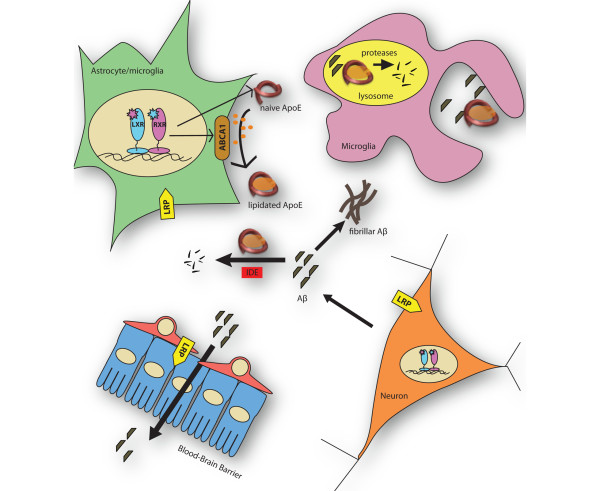
Alzheimer's disease (AD) is a common neurodegenerative disease characterized by the accumulation of extracellular plaques and intracellular tangles. Recent studies support the hypothesis that the accumulation of amyloid beta (Aβ) peptide within the brain arises from an imbalance of the production and clearance of Aβ. In rare genetic forms of AD, this imbalance is often caused by increased production of Aβ. However, recent evidence indicates that, in the majority of cases of AD, Aβ clearance is impaired. Apolipoprotein E (ApoE), the dominant cholesterol and lipid carrier in the brain, is critical for Aβ catabolism. The isoform of ApoE and its degree of lipidation critically regulate the efficiency of Aβ clearance. Studies in preclinical models of AD have demonstrated that coordinately increasing levels of ApoE and its lipid transporter, ABCA1, increases the clearance of Aβ, suggesting that this pathway may be a potential therapeutic target for AD.
阿尔茨海默病(AD)是一种常见的神经退行性疾病,其特征是细胞外斑块和细胞内缠结的积累。最近的研究支持这样一种假说,即大脑中β淀粉样蛋白(Aβ)肽的积累源于Aβ产生与清除的失衡。在罕见的遗传性AD形式中,这种失衡通常是由Aβ产生增加引起的。然而,最近的证据表明,在大多数AD病例中,Aβ清除受损。载脂蛋白E(ApoE)是大脑中主要的胆固醇和脂质载体,对Aβ分解代谢至关重要。ApoE的异构体及其脂化程度严格调节Aβ清除的效率。AD临床前模型的研究表明,协同增加ApoE及其脂质转运蛋白ABCA1的水平可增加Aβ的清除,这表明该途径可能是AD的一个潜在治疗靶点。