Laboratory of Genetics and Genomics, DAFNAE, University of Padova, Campus of Agripolis, Viale dell'Università 16, 35020, Legnaro, Italy.
Plant Reprod. 2013 Sep;26(3):159-79. doi: 10.1007/s00497-013-0222-y. Epub 2013 Jul 14.
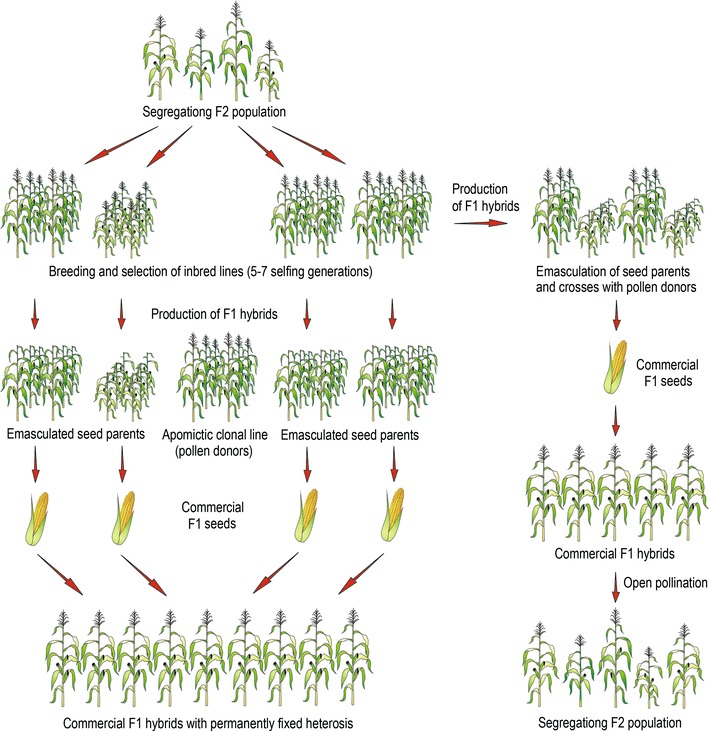
Seed is one of the key factors of crop productivity. Therefore, a comprehension of the mechanisms underlying seed formation in cultivated plants is crucial for the quantitative and qualitative progress of agricultural production. In angiosperms, two pathways of reproduction through seed exist: sexual or amphimictic, and asexual or apomictic; the former is largely exploited by seed companies for breeding new varieties, whereas the latter is receiving continuously increasing attention from both scientific and industrial sectors in basic research projects. If apomixis is engineered into sexual crops in a controlled manner, its impact on agriculture will be broad and profound. In fact, apomixis will allow clonal seed production and thus enable efficient and consistent yields of high-quality seeds, fruits, and vegetables at lower costs. The development of apomixis technology is expected to have a revolutionary impact on agricultural and food production by reducing cost and breeding time, and avoiding the complications that are typical of sexual reproduction (e.g., incompatibility barriers) and vegetative propagation (e.g., viral transfer). However, the development of apomixis technology in agriculture requires a deeper knowledge of the mechanisms that regulate reproductive development in plants. This knowledge is a necessary prerequisite to understanding the genetic control of the apomictic process and its deviations from the sexual process. Our molecular understanding of apomixis will be greatly advanced when genes that are specifically or differentially expressed during embryo and embryo sac formation are discovered. In our review, we report the main findings on this subject by examining two approaches: i) analysis of the apomictic process in natural apomictic species to search for genes controlling apomixis and ii) analysis of gene mutations resembling apomixis or its components in species that normally reproduce sexually. In fact, our opinion is that a novel perspective on this old dilemma pertaining to the molecular control of apomixis can emerge from a cross-check among candidate genes in natural apomicts and a high-throughput analysis of sexual mutants.
种子是作物生产力的关键因素之一。因此,深入了解栽培植物种子形成的机制对于农业生产的数量和质量的提高至关重要。在被子植物中,存在两种通过种子进行繁殖的途径:有性或两性生殖,和无性或无融合生殖;前者主要被种子公司用于培育新品种,而后者正受到科学界和工业界在基础研究项目中越来越多的关注。如果能够以可控的方式将无融合生殖工程应用于有性作物,其对农业的影响将是广泛而深远的。事实上,无融合生殖将允许克隆种子的生产,从而能够以更低的成本高效且一致地生产高质量的种子、果实和蔬菜。无融合生殖技术的发展有望通过降低成本和繁殖时间,并避免有性繁殖(例如,不亲和性障碍)和营养繁殖(例如,病毒转移)的复杂性,对农业和粮食生产产生革命性的影响。然而,无融合生殖技术在农业中的发展需要更深入地了解调节植物生殖发育的机制。这一知识是理解无融合生殖过程的遗传控制及其与有性过程的偏差的必要前提。当发现特定或差异表达于胚胎和胚囊形成过程中的基因时,我们对无融合生殖的分子理解将得到极大推进。在我们的综述中,我们通过检查两种方法来报告关于这个主题的主要发现:i)分析自然无融合生殖物种中的无融合生殖过程,以寻找控制无融合生殖的基因,和 ii)分析在正常有性繁殖的物种中类似无融合生殖或其组成部分的基因突变。事实上,我们的观点是,通过在天然无融合生殖体中的候选基因之间进行交叉检查,以及对有性突变体进行高通量分析,可以从新的视角来解决与无融合生殖的分子控制相关的这个古老难题。