NTNU Nanomechanical Lab, Norwegian University of Science and Technology (NTNU), Richard Birkelands vei 1a, Trondheim 7491, Norway.
Nanoscale Res Lett. 2013 Jul 15;8(1):322. doi: 10.1186/1556-276X-8-322.
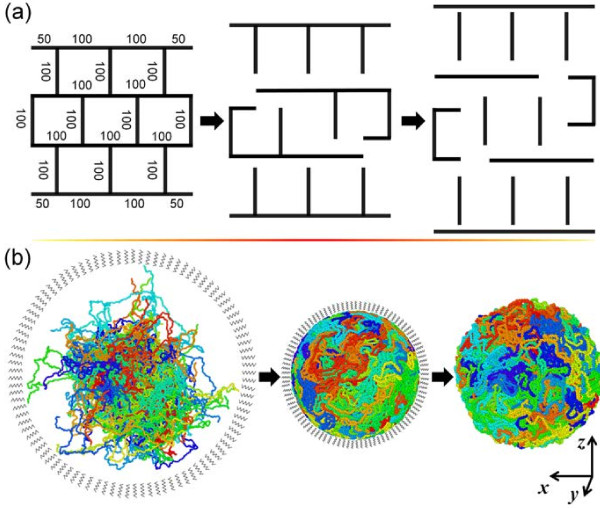
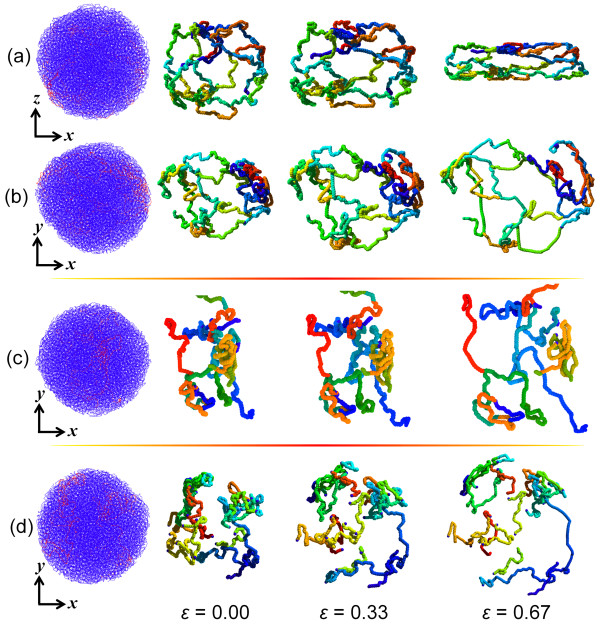
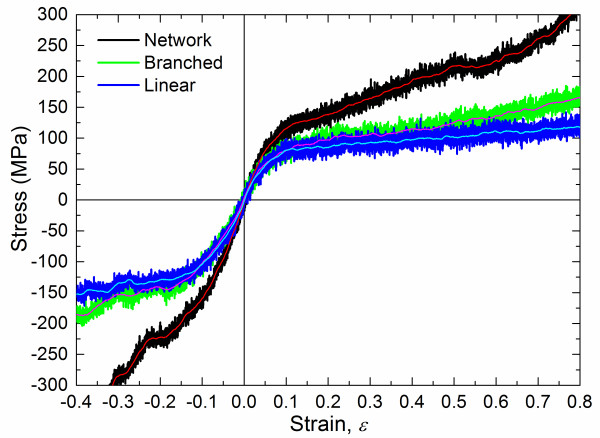
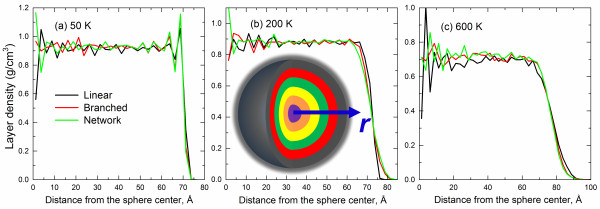
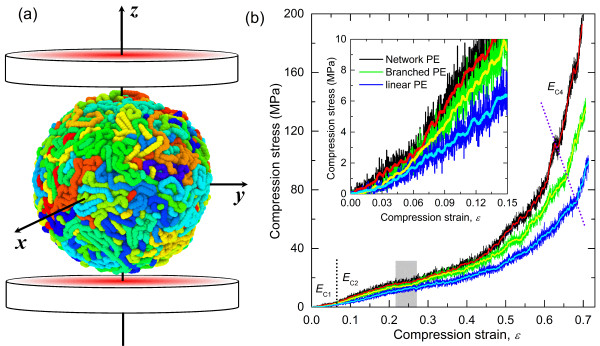
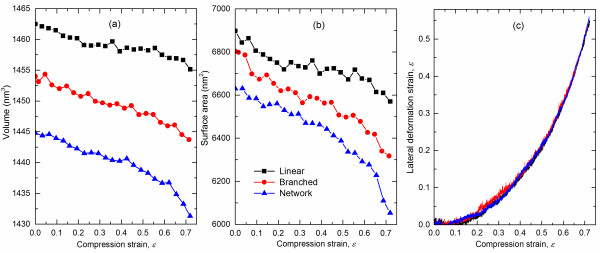
Polymeric particles with controlled internal molecular architectures play an important role as constituents in many composite materials for a number of emerging applications. In this study, classical molecular dynamics techniques are employed to predict the effect of chain architecture on the compression behavior of nanoscale polyethylene particles subjected to simulated flat-punch testing. Cross-linked, branched, and linear polyethylene chain architectures are each studied in the simulations. Results indicate that chain architecture has a significant influence on the mechanical properties of polyethylene nanoparticles, with the network configuration exhibiting higher compressive strengths than the branched and linear architectures. These findings are verified with simulations of bulk polyethylene. The compressive stress versus strain profiles of particles show four distinct regimes, differing with that of experimental micron-sized particles. The results of this study indicate that the mechanical response of polyethylene nanoparticles can be custom-tailored for specific applications by changing the molecular architecture.
具有可控内部分子结构的聚合物颗粒作为许多复合材料的组成部分,在许多新兴应用中发挥着重要作用。在这项研究中,采用经典的分子动力学技术来预测链结构对纳米级聚乙烯颗粒在模拟平头冲头测试下的压缩行为的影响。在模拟中分别研究了交联、支化和线性聚乙烯链结构。结果表明,链结构对聚乙烯纳米颗粒的力学性能有显著影响,网络结构的抗压强度高于支化和线性结构。这一发现通过对大块聚乙烯的模拟得到了验证。颗粒的压缩应力与应变曲线呈现出四个不同的阶段,与实验中微米级颗粒的不同。本研究结果表明,通过改变分子结构,可以为特定应用定制聚乙烯纳米颗粒的机械响应。