Department of Ecology and Evolutionary Biology, Brown University, Providence, RI, USA.
BMC Biol. 2013 Jul 17;11:85. doi: 10.1186/1741-7007-11-85.
Juvenile hormone (JH) has been demonstrated to control adult lifespan in a number of non-model insects where surgical removal of the corpora allata eliminates the hormone's source. In contrast, little is known about how juvenile hormone affects adult Drosophila melanogaster. Previous work suggests that insulin signaling may modulate Drosophila aging in part through its impact on juvenile hormone titer, but no data yet address whether reduction of juvenile hormone is sufficient to control Drosophila life span. Here we adapt a genetic approach to knock out the corpora allata in adult Drosophila melanogaster and characterize adult life history phenotypes produced by reduction of juvenile hormone. With this system we test potential explanations for how juvenile hormone modulates aging.
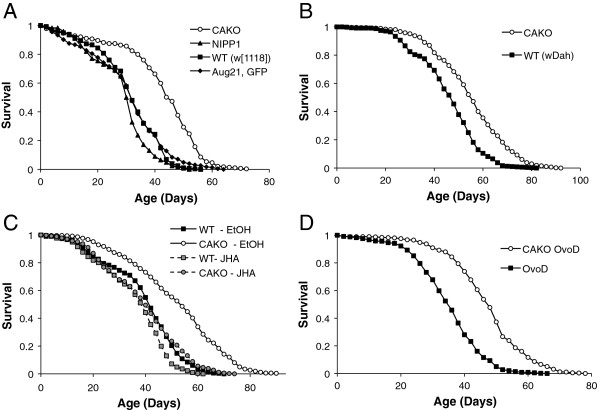
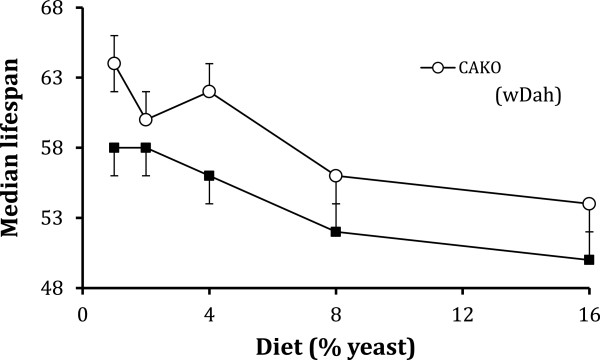
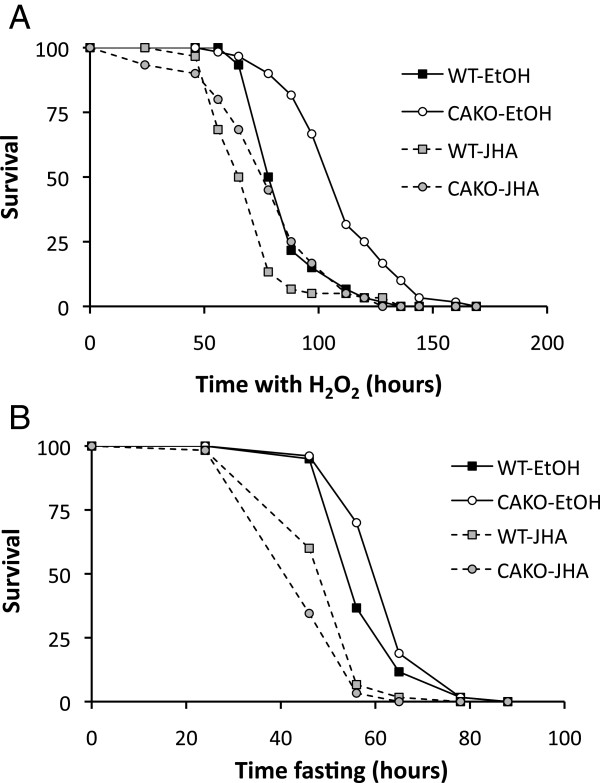
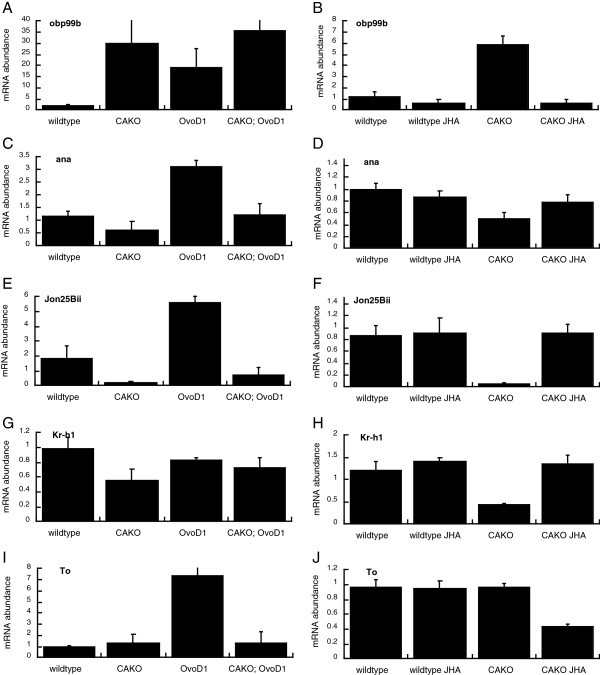
A tissue specific driver inducing an inhibitor of a protein phosphatase was used to ablate the corpora allata while permitting normal development of adult flies. Corpora allata knockout adults had greatly reduced fecundity, inhibited oogenesis, impaired adult fat body development and extended lifespan. Treating these adults with the juvenile hormone analog methoprene restored all traits toward wildtype. Knockout females remained relatively long-lived even when crossed into a genotype that blocked all egg production. Dietary restriction further extended the lifespan of knockout females. In an analysis of expression profiles of knockout females in fertile and sterile backgrounds, about 100 genes changed in response to loss of juvenile hormone independent of reproductive state.
Reduced juvenile hormone alone is sufficient to extend the lifespan of Drosophila melanogaster. Reduced juvenile hormone limits reproduction by inhibiting the production of yolked eggs, and this may arise because juvenile hormone is required for the post-eclosion development of the vitellogenin-producing adult fat body. Our data do not support a mechanism for juvenile hormone control of longevity simply based on reducing the physiological costs of egg production. Nor does the longevity benefit appear to function through mechanisms by which dietary restriction extends longevity. We identify transcripts that change in response to juvenile hormone independent of reproductive state and suggest these represent somatically expressed genes that could modulate how juvenile hormone controls persistence and longevity.
已证实,在许多非模式昆虫中,保幼激素(JH)可控制成虫寿命,其中手术切除咽侧体可消除该激素的来源。相比之下,关于保幼激素如何影响黑腹果蝇的成虫寿命,我们知之甚少。先前的工作表明,胰岛素信号可能通过其对保幼激素滴度的影响部分调节果蝇衰老,但尚无数据表明降低保幼激素是否足以控制果蝇寿命。在这里,我们采用一种遗传方法敲除黑腹果蝇成虫的咽侧体,并描述降低保幼激素产生的成虫生活史表型。通过该系统,我们测试了保幼激素调节衰老的潜在解释。
一种组织特异性驱动剂诱导一种蛋白磷酸酶抑制剂,用于破坏咽侧体,同时允许成年果蝇正常发育。咽侧体敲除成虫的繁殖力大大降低,卵母细胞生成受阻,成虫脂肪体发育受损,寿命延长。用保幼激素类似物灭幼脲处理这些成虫可使所有表型恢复到野生型。敲除雌性即使与阻断所有卵子产生的基因型杂交,仍然相对长寿。饮食限制进一步延长了敲除雌性的寿命。在对有繁殖力和不育背景的敲除雌性的表达谱进行分析时,约有 100 个基因的表达因与生殖状态无关的保幼激素缺失而发生变化。
单独降低保幼激素足以延长黑腹果蝇的寿命。保幼激素降低限制了生殖,因为它抑制了卵黄蛋白的产生,而这可能是因为保幼激素是成年产卵脂肪体出芽后发育所必需的。我们的数据不支持仅仅基于降低产卵的生理成本来控制寿命的保幼激素机制。也没有证据表明这种长寿益处是通过限制饮食来延长寿命的机制发挥作用。我们确定了与生殖状态无关而响应保幼激素变化的转录本,并提出这些转录本可能代表调节保幼激素如何控制持久性和寿命的体细胞表达基因。