Saharkhiz Nasrin, Nikbakht Roshan, Hemadi Masoud
Infertility and In Vitro Fertilization Center, Taleghani Hospital, Shahid Beheshti University of Medical Sciences, Tehran, Iran.
J Hum Reprod Sci. 2013 Jan;6(1):19-22. doi: 10.4103/0974-1208.112373.
This study aimed to evaluate the efficacy of ketotifen on sperm motility of asthenospermic infertile men.
It is a prospective study designed in vivo.
In this interventional experimental study, a total of 40 infertile couples with asthenospermic infertility factor undergoing assisted reproductive technology (ART) cycles were enrolled. The couples were randomly assigned to one of two groups at the starting of the cycle. In control group (n = 20), the men did not receive Ketotifen, while in experiment group (n = 20), the men received oraly ketotifen (1 mg Bid) for 2 months. Semen analysis, under optimal circumferences, was obtained prior to initiation of treatment. The second semen analysis was done 2-3 weeks after stopped ketotifen treatment and sperm motility was defined. Clinical pregnancy was identified as the presence of a fetal sac by vaginal ultrasound examination.
All data are expressed as the mean ± standard error of mean (SEM). t test was used for comparing the data of the control and treated groups.
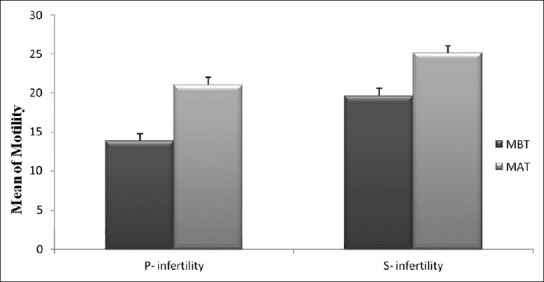
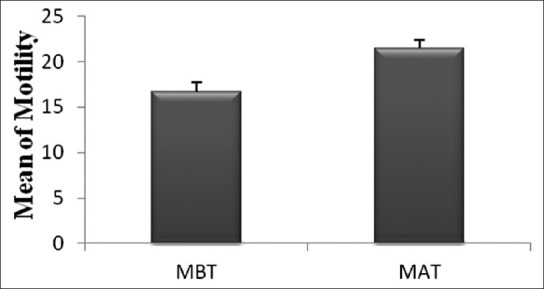
The mean sperm motility increased significantly (from 16.7% to 21.4%) after ketotifen treatment (P < 0.001). This sperm motility improvement was more pronounced in the primary infertility cases (P < 0.003). The rate of pregnancy was 12.5% in infertile couples that their men receiving 1 mg/twice a day ketotifen. In 52% of infertile men's semen, the percentage of sperm motility was increased from 5% to 35% and this sperm motility improvement was also observed in 33% of necrospermia (0% motility) cases.
These results suggest that ketotifen may represent as a novel therapeutic approach to improve sperm motility in the infertile men with cause of asthenospermia or necrospermia.
本研究旨在评估酮替芬对弱精子症不育男性精子活力的疗效。
这是一项体内前瞻性研究。
在这项干预性实验研究中,共纳入40对因弱精子症不育因素而接受辅助生殖技术(ART)周期治疗的不育夫妇。在周期开始时,这些夫妇被随机分为两组。对照组(n = 20)男性不接受酮替芬治疗,而实验组(n = 20)男性口服酮替芬(1毫克,每日两次),持续2个月。在治疗开始前,在最佳条件下进行精液分析。在停止酮替芬治疗2 - 3周后进行第二次精液分析,并确定精子活力。临床妊娠定义为经阴道超声检查发现有孕囊。
所有数据均以均值±均值标准误差(SEM)表示。采用t检验比较对照组和治疗组的数据。
酮替芬治疗后,精子平均活力显著提高(从16.7%提高到21.4%)(P < 0.001)。这种精子活力的改善在原发性不育病例中更为明显(P < 0.003)。男性接受每日两次1毫克酮替芬治疗的不育夫妇的妊娠率为12.5%。在52%的不育男性精液中,精子活力百分比从5%提高到35%,并且在33%的死精症(活力为0%)病例中也观察到了这种精子活力的改善。
这些结果表明,酮替芬可能是一种改善弱精子症或死精症不育男性精子活力的新治疗方法。