Dutch Hospital Data, Utrecht, The Netherlands.
BMJ Open. 2013 Jul 19;3(7). doi: 10.1136/bmjopen-2013-003034. Print 2013.
To investigate whether a priori selection of patient records using unexpectedly long length of stay (UL-LOS) leads to detection of more records with adverse events (AEs) compared to non-UL-LOS.
To investigate the opportunities of the UL-LOS, we looked for AEs in all records of patients with colorectal cancer. Within this group, we compared the number of AEs found in records of patients with a UL-LOS with the number found in records of patients who did not have a UL-LOS.
Our study was done at a general hospital in The Netherlands. The hospital is medium sized with approximately 30 000 admissions on an annual basis. The hospital has two major locations in different cities where both primary and secondary care is provided.
The patient records of 191 patients with colorectal cancer were reviewed.
Number of triggers and adverse events were the primary outcome measures.
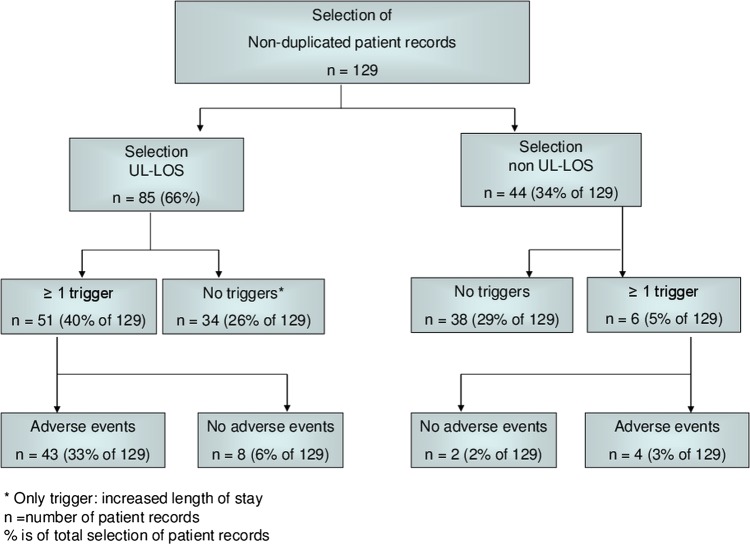
In the records of patients with colorectal cancer who had a UL-LOS, 51% of the records contained one or more AEs compared with 9% in the reference group of non-UL-LOS patients. By reviewing only the UL-LOS group with at least one trigger, we found in 84% (43 out of 51) of these records at least one adverse event.
A priori selection of patient records using the UL-LOS indicator appears to be a powerful selection method which could be an effective way for healthcare professionals to identify opportunities to improve patient safety in their day-to-day work.
研究使用意外住院时间延长(UL-LOS)对患者病历进行预先选择是否比非 UL-LOS 患者病历更能发现更多的不良事件(AE)。
为了研究 UL-LOS 的机会,我们在所有结直肠癌患者的病历中寻找 AE。在该组中,我们比较了 UL-LOS 患者病历中发现的 AE 数量与没有 UL-LOS 患者病历中发现的 AE 数量。
我们的研究在荷兰的一家综合医院进行。该医院规模中等,每年约有 30000 名患者入院。医院在两个不同的城市设有两个主要院区,提供初级和二级保健服务。
对 191 名结直肠癌患者的病历进行了回顾。
触发因素和不良事件的数量是主要的结局测量。
在 UL-LOS 患者的病历中,51%的病历包含一个或多个 AE,而在非 UL-LOS 患者的参考组中,这一比例为 9%。通过仅审查至少有一个触发因素的 UL-LOS 组,我们在这些病历中的 84%(51 例中的 43 例)中发现了至少一个不良事件。
使用 UL-LOS 指标对患者病历进行预先选择似乎是一种强大的选择方法,这可能是医疗保健专业人员在日常工作中识别提高患者安全机会的有效方法。