Department of Cognitive Neuroscience, Graduate School of Medicine, The University of Tokyo Tokyo, Japan ; Department of Experimental Psychology, University of Oxford Oxford, UK.
Front Hum Neurosci. 2013 Jul 15;7:365. doi: 10.3389/fnhum.2013.00365. eCollection 2013.
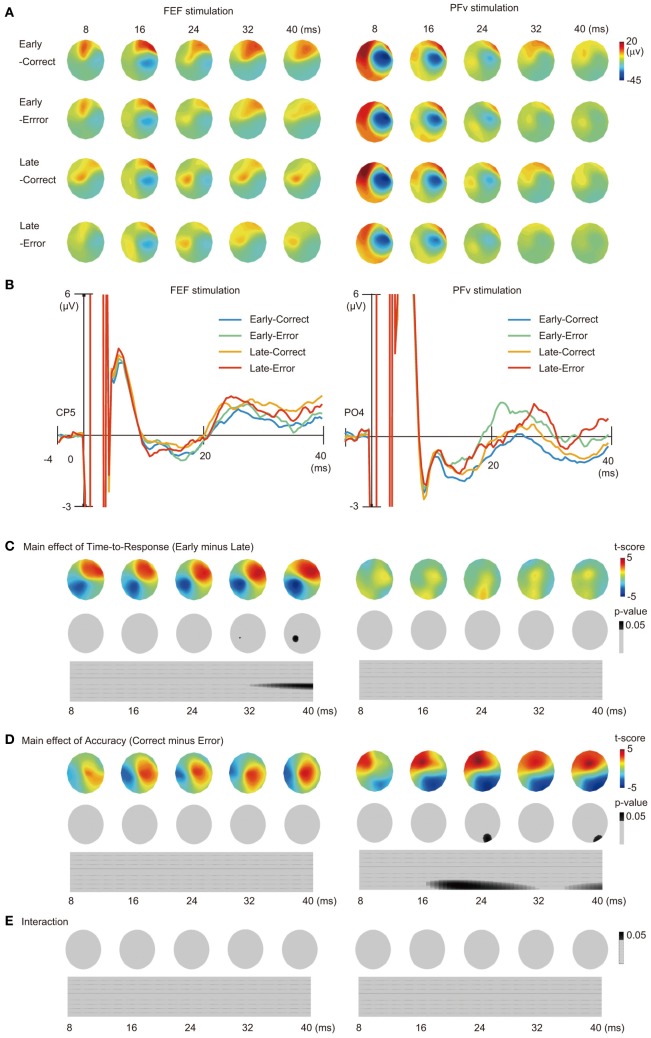
The dorsal and ventral parts of the lateral prefrontal cortex have been thought to play distinct roles in decision making. Although its dorsal part such as the frontal eye field (FEF) is shown to play roles in accumulation of sensory information during perceptual decision making, the role of the ventral prefrontal cortex (PFv) is not well-documented. Previous studies have suggested that the PFv is involved in selective attention to the task-relevant information and is associated with accuracy of the behavioral performance. It is unknown, however, whether the accumulation and selection processes are anatomically dissociated between the FEF and PFv. Here we show that, by using concurrent TMS and EEG recording, the short-latency (20-40 ms) TMS-evoked potentials after stimulation of the FEF change as a function of the time to behavioral response, whereas those after stimulation of the PFv change depending on whether the response is correct or not. The potentials after stimulation of either region did not show significant interaction between time to response and performance accuracy, suggesting dissociation between the processes subserved by the FEF and PFv networks. The results are consistent with the idea that the network involving the FEF plays a role in information accumulation, whereas the network involving the PFv plays a role in selecting task relevant information. In addition, stimulation of the FEF and PFv induced activation in common regions in the dorsolateral and medial frontal cortices, suggesting convergence of information processed in the two regions. Taken together, the results suggest dissociation between the FEF and PFv networks for their computational roles in perceptual decision making. The study also highlights the advantage of TMS-EEG technique in investigating the computational processes subserved by the neural network in the human brain with a high temporal resolution.
外侧前额叶皮质的背侧和腹侧部分被认为在决策中发挥着不同的作用。虽然其背侧部分,如额眼区(FEF),在感知决策中被证明在积累感觉信息方面发挥作用,但腹侧前额叶皮质(PFv)的作用尚未得到很好的记录。先前的研究表明,PFv 参与了对任务相关信息的选择性注意,并且与行为表现的准确性相关。然而,尚不清楚在 FEF 和 PFv 之间,积累和选择过程是否在解剖上是分离的。在这里,我们通过使用同时 TMS 和 EEG 记录表明,FEF 刺激后的短潜伏期(20-40ms)TMS 诱发电位随行为反应时间而变化,而 PFv 刺激后的 TMS 诱发电位则取决于反应是否正确。来自两个区域的刺激后的电位在反应时间和表现准确性之间没有表现出显著的相互作用,这表明由 FEF 和 PFv 网络提供的过程的分离。这些结果与以下观点一致,即涉及 FEF 的网络在信息积累中起作用,而涉及 PFv 的网络在选择任务相关信息中起作用。此外,FEF 和 PFv 的刺激在背外侧和内侧前额皮质的共同区域引起激活,表明这两个区域处理的信息的收敛。总之,结果表明 FEF 和 PFv 网络在感知决策中的计算作用是分离的。该研究还强调了 TMS-EEG 技术在以高时间分辨率研究人类大脑中神经网络所支持的计算过程方面的优势。