Department of Biological Sciences, University of Calgary, Calgary, Alberta, Canada.
PLoS One. 2013 Jul 10;8(7):e67182. doi: 10.1371/journal.pone.0067182. Print 2013.
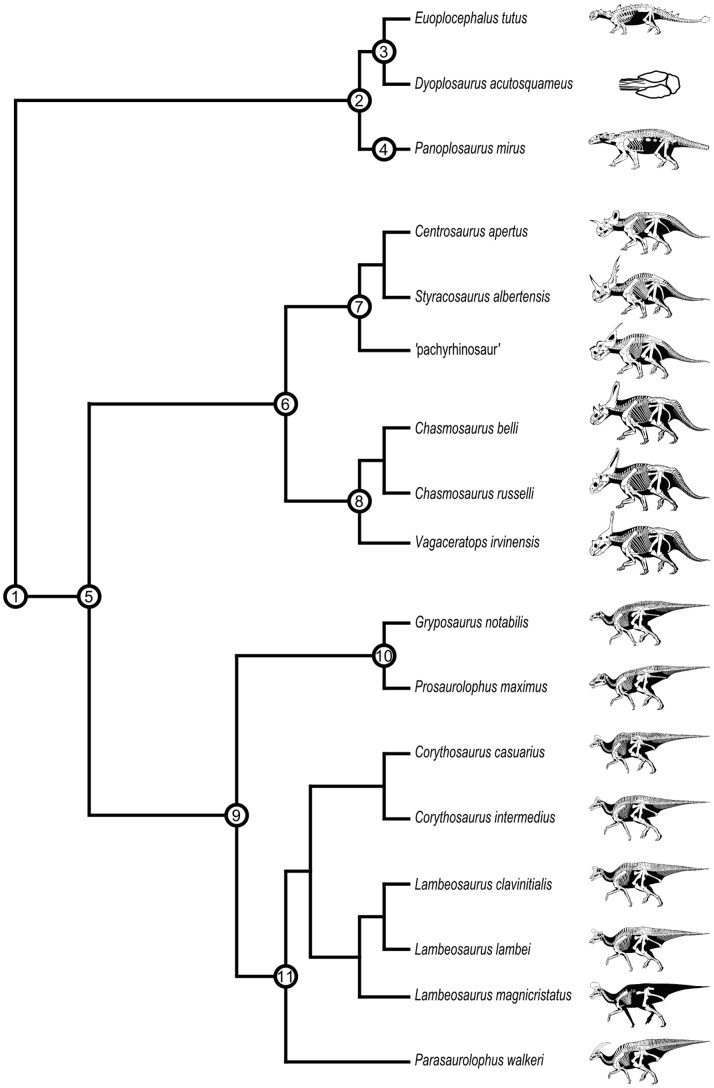
Megaherbivorous dinosaur coexistence on the Late Cretaceous island continent of Laramidia has long puzzled researchers, owing to the mystery of how so many large herbivores (6-8 sympatric species, in many instances) could coexist on such a small (4-7 million km(2)) landmass. Various explanations have been put forth, one of which-dietary niche partitioning-forms the focus of this study. Here, we apply traditional morphometric methods to the skulls of megaherbivorous dinosaurs from the Dinosaur Park Formation (upper Campanian) of Alberta to infer the ecomorphology of these animals and to test the niche partitioning hypothesis. We find evidence for niche partitioning not only among contemporaneous ankylosaurs, ceratopsids, and hadrosaurids, but also within these clades at the family and subfamily levels. Consubfamilial ceratopsids and hadrosaurids differ insignificantly in their inferred ecomorphologies, which may explain why they rarely overlap stratigraphically: interspecific competition prevented their coexistence.
巨型草食性恐龙在晚白垩世拉腊米迪亚大陆岛屿上的共存一直令研究人员感到困惑,因为有一个谜一直没有解开,即在如此小的(400 万至 700 万平方公里)陆地上,怎么会有如此多的大型草食动物(在许多情况下,有 6 到 8 个同域物种共存)。为此提出了各种解释,其中之一——生态位分化——是本研究的重点。在这里,我们应用传统的形态计量学方法来研究来自艾伯塔省恐龙公园组(坎潘阶上部)的巨型草食性恐龙的头骨,以推断这些动物的生态形态,并检验生态位分化假说。我们发现,不仅在同时代的甲龙类、角龙类和鸭嘴龙类之间存在生态位分化,而且在这些类群的科和亚科水平上也存在生态位分化。同亚科的角龙类和鸭嘴龙类在其推断的生态形态上差异不显著,这可能解释了为什么它们在地质记录中很少重叠:种间竞争阻止了它们的共存。