Division of Gynecologic Oncology, Department of Obstetrics and Gynecology, Northwestern University Feinberg School of Medicine, Robert H Lurie Comprehensive Cancer Center, Chicago, IL, USA.
J Gynecol Oncol. 2013 Jul;24(3):258-64. doi: 10.3802/jgo.2013.24.3.258. Epub 2013 Jul 4.
To determine the efficacy, progression-free survival (PFS) and overall survival (OS) for the combination of intravenous bevacizumab and oral cyclophosphamide in heavily pretreated patients with recurrent ovarian carcinoma.
A retrospective review was performed for all patients with recurrent ovarian carcinoma treated with intravenous bevacizumab 10 mg/kg every 14 days and oral cyclophosphamide 50 mg daily between January 2006 and December 2010. Response to treatment was determined by Response Evaluation Criteria in Solid Tumors criteria and/or CA-125 levels.
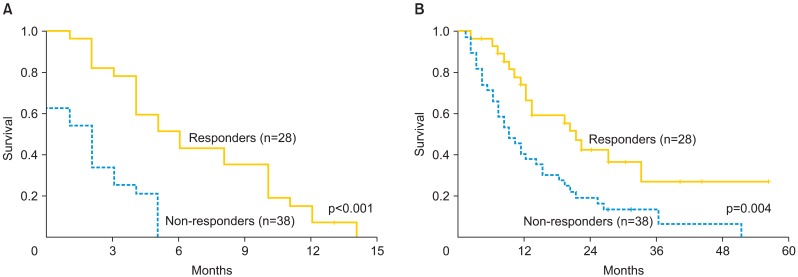
Sixty-six eligible patients were identified. Median age was 53 years. Fifty-five patients (83%) had undergone optimal cytoreduction. All patients were primarily or secondarily platinum resistant at the time of administration of bevacizumab and cyclophosphamide. The median number of prior chemotherapy treatments was 6.5 (range, 3 to 16). Eight patients (12.1%) had side effects which required discontinuation of bevacizumab and cyclophosphamide. There was one bowel perforation (1.5%). Overall response rate was 42.4%, including, complete response in 7 patients (10.6%), and partial response in 21 patients (31.8%), while 15 patients (22.7%) had stable disease and 23 patients (34.8%) had disease progression. Median PFS for responders was 5 months (range, 2 to 14 months). Median OS from initiation of bevacizumab and cyclophosphamide was 20 months (range, 2 to 56 months) for responders and 9 months (range, 2 to 51 months) for non-responders (p=0.004).
Bevacizumab and cyclophosphamide is an effective, well-tolerated chemotherapy regimen in heavily pretreated patients with recurrent ovarian carcinoma. This combination significantly improved PFS and OS in responders. Response rates were similar and favorable to the rates reported for similar patients receiving other commonly used second-line chemotherapeutic agents.
确定在经过大量预处理的复发性卵巢癌患者中,静脉注射贝伐珠单抗联合口服环磷酰胺的疗效、无进展生存期(PFS)和总生存期(OS)。
对 2006 年 1 月至 2010 年 12 月期间接受静脉注射贝伐珠单抗 10mg/kg 每 14 天和口服环磷酰胺 50mg 每天治疗的所有复发性卵巢癌患者进行回顾性分析。通过实体瘤反应评价标准和/或 CA-125 水平来确定治疗反应。
共确定 66 例符合条件的患者。中位年龄为 53 岁。55 例患者(83%)接受了最佳减瘤术。所有患者在接受贝伐珠单抗和环磷酰胺治疗时均为原发性或继发性铂类耐药。中位化疗次数为 6.5 次(范围 3 至 16 次)。8 例(12.1%)出现需要停止使用贝伐珠单抗和环磷酰胺的副作用。有 1 例肠穿孔(1.5%)。总缓解率为 42.4%,包括 7 例完全缓解(10.6%)和 21 例部分缓解(31.8%),15 例患者(22.7%)病情稳定,23 例(34.8%)病情进展。缓解者的中位 PFS 为 5 个月(范围 2 至 14 个月)。从开始使用贝伐珠单抗和环磷酰胺到缓解者的中位 OS 为 20 个月(范围 2 至 56 个月),而非缓解者为 9 个月(范围 2 至 51 个月)(p=0.004)。
贝伐珠单抗联合环磷酰胺是一种在大量预处理的复发性卵巢癌患者中有效且耐受性良好的化疗方案。该联合方案在缓解者中显著改善了 PFS 和 OS。缓解率与接受其他常用二线化疗药物的相似患者相似且有利。