Singh Niraj K, Meshram Chetan D, Sonwane Arvind A, Dahiya Shyam S, Pawar Sachin S, Chaturvedi V K, Saini Mohini, Singh R P, Gupta Praveen K
Division of Veterinary Biotechnology, Indian Veterinary Research Institute, Izatnagar, 243122, India.
Mol Biotechnol. 2014 Feb;56(2):91-101. doi: 10.1007/s12033-013-9685-1.
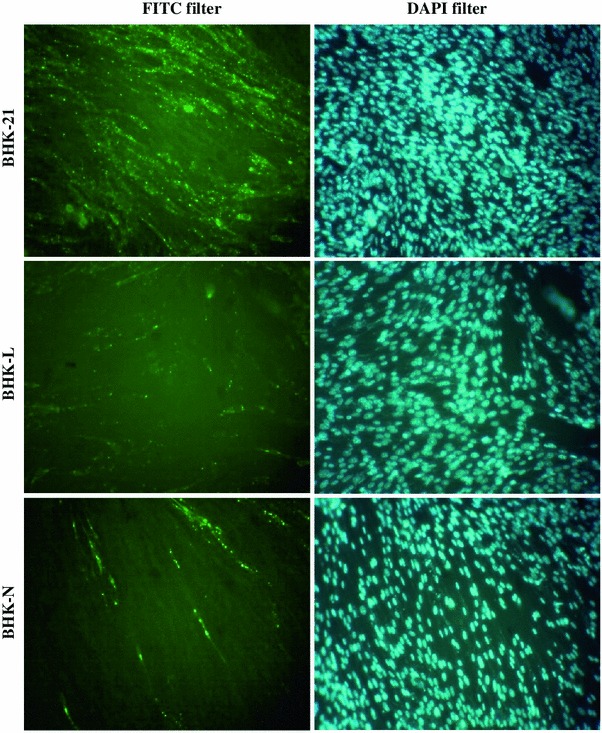
The antiviral potential of small interfering RNAs (siRNAs) targeting rabies virus (RV) polymerase (L) and nucleoprotein (N) genes delivered through lentiviral vector was investigated. For in vitro evaluation, siRNAs expressing BHK-21 cell lines (BHK-L and BHK-N) were developed using transduction with Lenti-L and Lenti-N lentiviruses encoding siRNAs against RV-L and N genes, respectively. When these cell lines were challenged in vitro with RV Pasteur virus-11 (PV-11) strain, there was reduction in number of RV-specific foci and target gene transcripts indicating inhibitory effect on RV multiplication. For in vivo evaluation, mice were treated intracerebrally with lentiviruses and challenged with 20 LD50 of RV challenge virus standard-11 (CVS-11) strain by intramuscular route in masseter muscle. Five out of eight mice treated with Lenti-N survived indicating 62.5 % protection. The control and Lenti-L-treated mice died within 7-10 days indicating lethal nature of challenge virus and no protection. These results demonstrated that siRNA targeting RV-N could not only inhibit RV multiplication, but also conferred protection in mice against lethal RV challenge. These findings have implication on therapeutic use of siRNA targeting RV-N against RV infection.
研究了通过慢病毒载体递送的靶向狂犬病病毒(RV)聚合酶(L)和核蛋白(N)基因的小干扰RNA(siRNA)的抗病毒潜力。为了进行体外评估,分别使用编码针对RV-L和N基因的siRNA的Lenti-L和Lenti-N慢病毒进行转导,构建了表达siRNA的BHK-21细胞系(BHK-L和BHK-N)。当用RV巴斯德病毒-11(PV-11)株在体外攻击这些细胞系时,RV特异性病灶数量和靶基因转录本减少,表明对RV增殖有抑制作用。为了进行体内评估,小鼠经脑内注射慢病毒,然后通过咬肌肌肉内途径用20个半数致死剂量的RV攻击病毒标准-11(CVS-11)株进行攻击。用Lenti-N处理的八只小鼠中有五只存活,表明保护率为62.5%。对照组和用Lenti-L处理的小鼠在7-10天内死亡,表明攻击病毒具有致死性且无保护作用。这些结果表明,靶向RV-N的siRNA不仅可以抑制RV增殖,还可以在小鼠中对致死性RV攻击提供保护。这些发现对于靶向RV-N的siRNA在治疗RV感染中的应用具有重要意义。