Division of Musculoskeletal Sciences, Department of Orthopaedics and Rehabilitation, Penn State College of Medicine, 500 University Drive, Hershey, PA 17033, USA.
Bone. 2013 Nov;57(1):76-83. doi: 10.1016/j.bone.2013.07.022. Epub 2013 Jul 24.
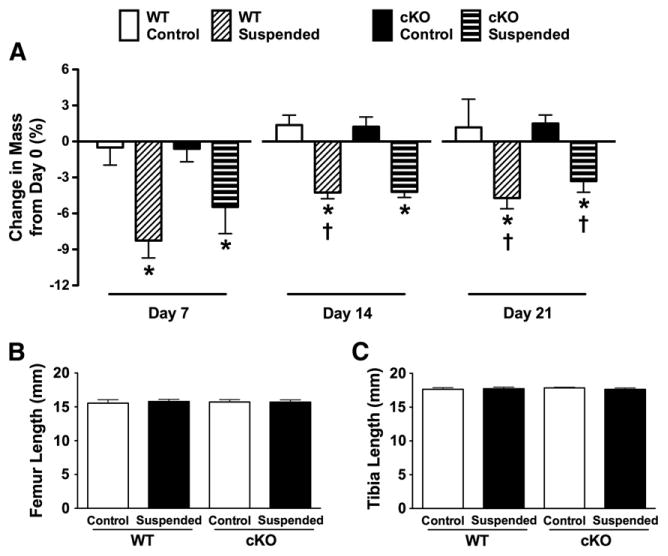
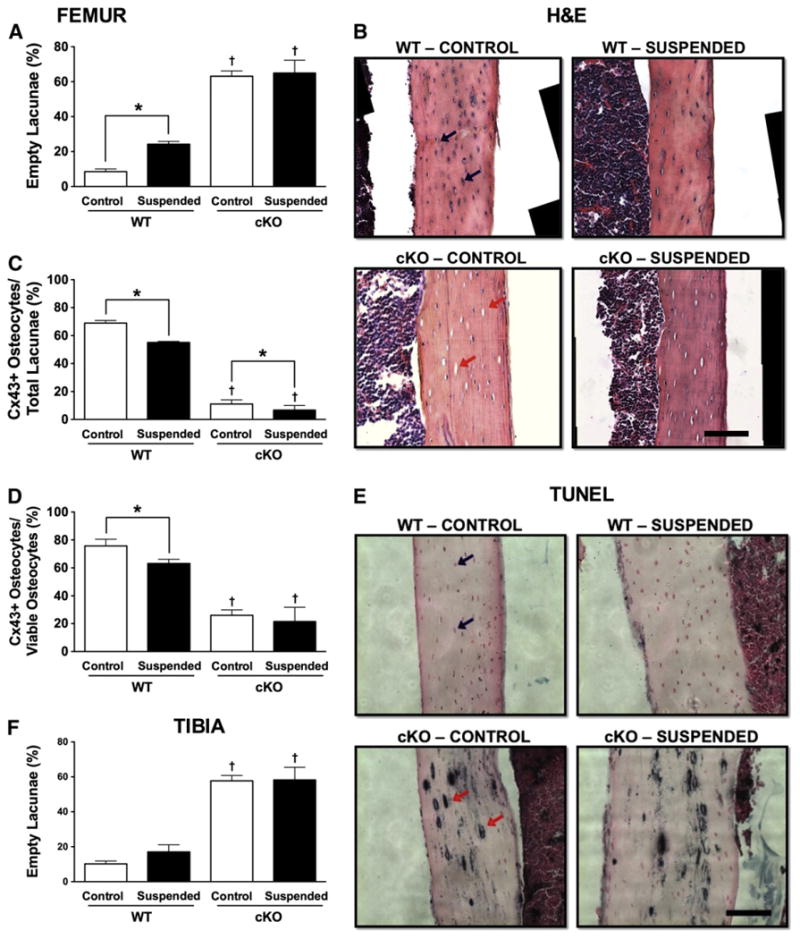
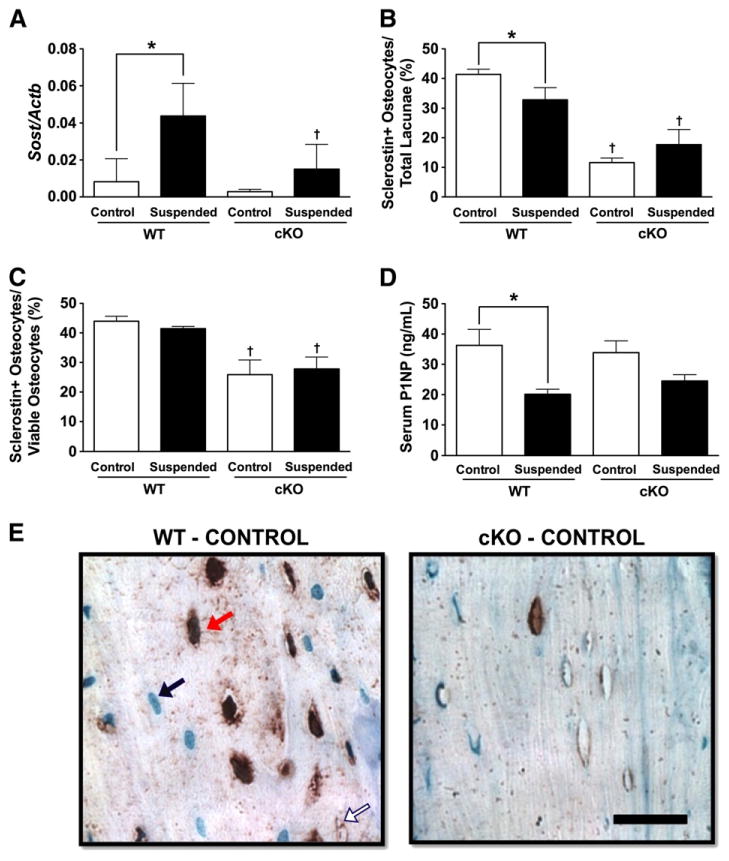
Connexin 43 (Cx43) is a gap junction protein that plays an integral role in the skeletal response to mechanical loading and unloading. In a previous study, we demonstrated preservation of trabecular bone mass and cortical bone formation rate in mice with an osteoblast/osteocyte-selective deficiency of Cx43 (cKO) following mechanical unloading via hindlimb suspension (HLS). In the present study, we sought to define the potential mechanisms underlying this response. Following three weeks of HLS, mRNA levels of Sost were significantly greater in wild-type (WT)-Suspended mice vs. WT-Control, while there was no difference between cKO control and cKO-Suspended. Unloading-induced decreases in P1NP, a serum marker of bone formation, were also attenuated in cKO-Suspended. The proportion of sclerostin-positive osteocytes was significantly lower in cKO-Control vs. WT-Control (-72%, p<0.05), a difference accounted for by the presence of numerous empty lacunae in the cortical bone of cKO vs. WT. Abundant TUNEL staining was present throughout the cortical bone of the tibia and femur, suggesting an apoptotic process. There was no difference in empty lacunae in the trabecular bone of the tibia or femur. Trabecular and cortical osteoclast indices were lower in cKO-Suspended vs. WT-Suspended; however, mRNA levels of the gene encoding RANKL increased similarly in both genotypes. Connexin 43 deficient mice experience attenuated sclerostin-mediated suppression of cortical bone formation and lower cortical osteoclast activity during unloading. Preservation of trabecular bone mass and attenuated osteoclast activity during unloading, despite an apparent lack of effect on osteocyte viability at this site, suggests that an additional mechanism independent of osteocyte apoptosis may also be important. These findings indicate that Cx43 is able to modulate both arms of bone remodeling during unloading.
间隙连接蛋白 43(Cx43)是一种间隙连接蛋白,在骨骼对机械加载和卸载的反应中起着重要作用。在之前的研究中,我们证明了在通过后肢悬吊(HLS)进行机械卸载后,成骨细胞/成骨细胞选择性缺乏 Cx43(cKO)的小鼠中,小梁骨量和皮质骨形成率得以保留。在本研究中,我们试图确定这种反应的潜在机制。在 HLS 三周后,与 WT 对照相比,WT 悬吊小鼠的 Sost mRNA 水平显著增加,而 cKO 对照与 cKO 悬吊之间没有差异。骨形成的血清标志物 P1NP 的下降也在 cKO 悬吊中减弱。与 WT 对照相比,cKO 对照中的骨硬化蛋白阳性成骨细胞比例显著降低(-72%,p<0.05),这一差异归因于 cKO 皮质骨中存在大量空骨陷窝。在胫骨和股骨的皮质骨中存在大量的 TUNEL 染色,表明存在凋亡过程。胫骨和股骨的小梁骨中没有空骨陷窝的差异。cKO 悬吊组的皮质骨破骨细胞指数和破骨细胞指数均低于 WT 悬吊组;然而,两种基因型的 RANKL 基因编码的 mRNA 水平增加相似。在卸载过程中,Cx43 缺乏的小鼠经历了骨硬化蛋白介导的皮质骨形成抑制的减弱和皮质骨破骨细胞活性的降低。尽管在该部位骨细胞活力似乎没有影响,但在卸载过程中保留小梁骨量和减弱破骨细胞活性表明,一种独立于骨细胞凋亡的额外机制也可能很重要。这些发现表明,Cx43 能够在卸载过程中调节骨重塑的两个分支。