National Institute on Drug Dependence, Peking University, Beijing, China.
PLoS One. 2013 Jul 24;8(7):e68791. doi: 10.1371/journal.pone.0068791. Print 2013.
The majority of drug abusers are incapable of sustaining abstinence over any length of time. Accumulating evidence has linked intense and involuntary craving, Impulsive decision-making and mood disturbances to risk for relapse. However, little is known about temporal changes of these neuropsychological functions in methamphetamine (METH)-dependent individuals.
To investigate the effect of length of abstinence on decision-making, craving (baseline and cue-induced), and emotional state in METH-addicted individuals.
In this cross-sectional study, 183 adult METH-dependent patients at an addiction rehabilitation center who were abstinent for 6 days (n = 37), 14 days (n = 33), 1 month (n = 31), 3 months (n = 30), 6 months (n = 26), or 1 year (n = 30) and 39 healthy subjects were administered the Iowa Gambling Task (IGT) to assess decision-making performance. Depression, anxiety, and impulsivity were also examined. One hundred thirty-nine METH abusers who were abstinent for the aforementioned times then underwent a cue session, and subjective and physiological measures were assessed.
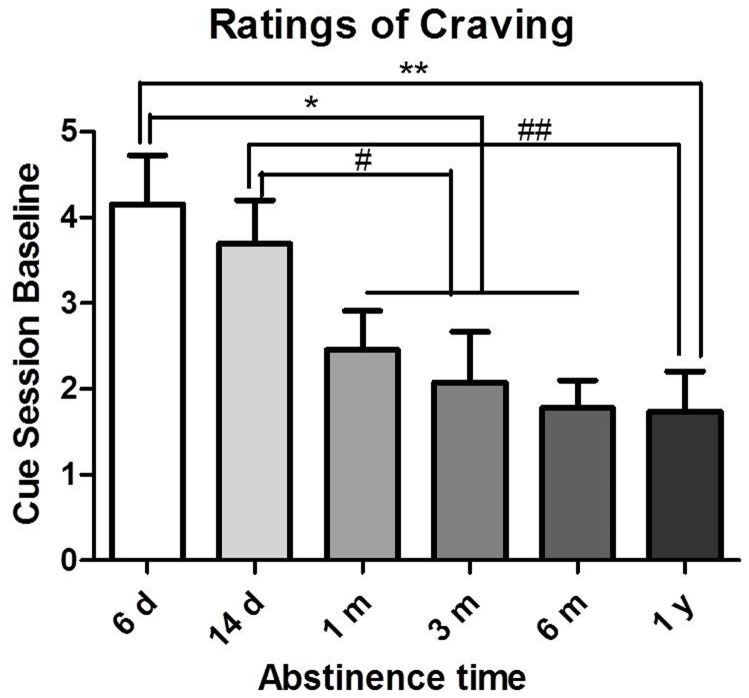
METH dependent individuals who were abstinent for longer periods of time exhibited better decision-making than those who were abstinent for shorter periods of time. And self-reported emotional symptoms improved with abstinence. METH abusers' ratings of craving decreased with the duration of abstinence, while cue-induced craving increased until 3 months of abstinence and decreased at 6 months and 1 year of abstinence.
We present time-dependent alterations in decision-making, emotional state, and the incubation of cue-induced craving in METH-dependent individuals, which might have significant clinical implications for the prevention of relapse.
大多数药物滥用者都无法长时间保持戒断状态。越来越多的证据表明,强烈的、不由自主的渴求、冲动决策和情绪紊乱与复发风险有关。然而,关于甲基苯丙胺(METH)依赖个体这些神经心理功能的时间变化知之甚少。
研究戒断时间对METH 依赖个体决策、渴求(基线和线索诱导)和情绪状态的影响。
在这项横断面研究中,我们招募了 183 名在成瘾康复中心的成年 METH 依赖患者,他们的戒断时间分别为 6 天(n=37)、14 天(n=33)、1 个月(n=31)、3 个月(n=30)、6 个月(n=26)或 1 年(n=30),同时还招募了 39 名健康受试者。通过 Iowa 赌博任务(IGT)评估决策表现。还检查了抑郁、焦虑和冲动。139 名 METH 滥用者在上述时间点戒断后进行了线索处理,评估了主观和生理指标。
与戒断时间较短的个体相比,戒断时间较长的 METH 依赖个体表现出更好的决策能力。随着戒断时间的延长,自我报告的情绪症状也有所改善。METH 滥用者的渴求评分随着戒断时间的延长而降低,而线索诱导的渴求则在 3 个月的戒断时增加,然后在 6 个月和 1 年的戒断时降低。
我们提出了 METH 依赖个体在决策、情绪状态和线索诱导渴求潜伏期方面的时间依赖性变化,这可能对预防复发具有重要的临床意义。