Department of Cardiology, the First Affiliated Hospital of Fujian Medical University, Fuzhou, China.
PLoS One. 2013 Jul 24;8(7):e70834. doi: 10.1371/journal.pone.0070834. Print 2013.
Considerable efforts have been devoted to evaluating the association of the receptor for advanced glycation end-products (gene AGER and protein: RAGE) genetic variants to coronary artery disease (CAD); the results, however, are often irreproducible. To generate more information, we sought to explore four common polymorphisms of AGER and its circulating forms associated with the risk of CAD via a meta-analysis.
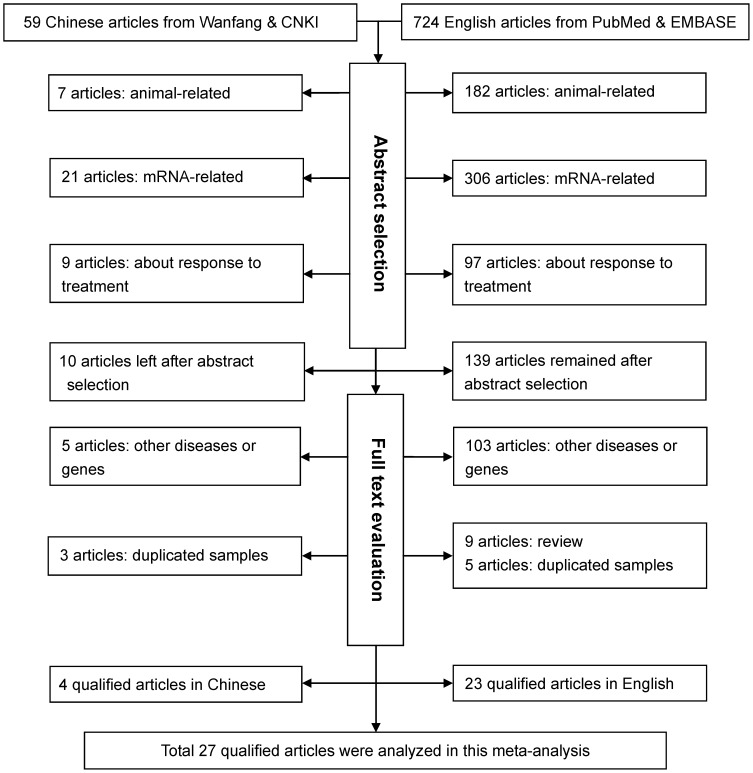
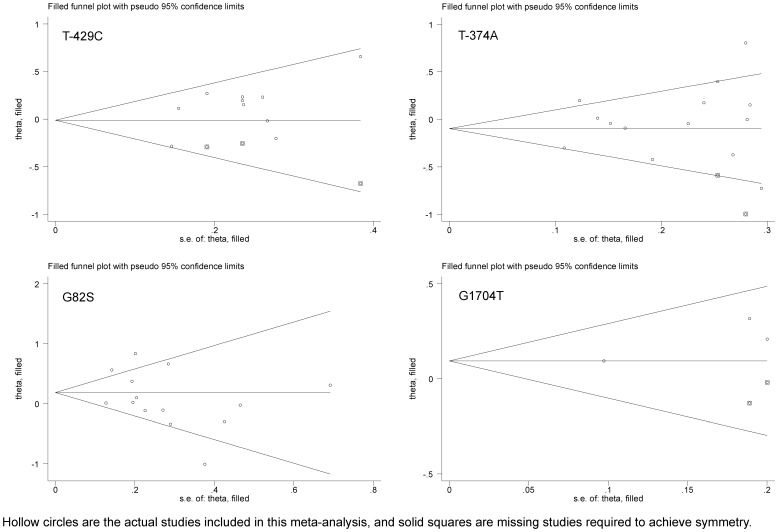
METHODOLOGY/PRINCIPAL FINDINGS: Articles were identified by searching PubMed, EMBASE, Wanfang and CNKI databases before March 2013. Qualified articles had case-control designs and investigated AGER four polymorphisms (T-429C, T-374A, Gly82Ser, G1704A) or circulating soluble RAGE (sRAGE) or endogenous secretory RAGE (esRAGE) levels associated with CAD. Twenty-seven articles involving 39 independent groups fulfilled the predefined criteria. Overall, no significance was observed for all examined polymorphisms under allelic and dominant models. When restricting groups to CAD patients with diabetes mellitus or renal disease, deviations of risk estimates from the unity were stronger than overall estimates for all polymorphisms except for G1704A due to limited available studies. For example, under dominant model, having -429C allele increased the odds of developing CAD in diabetic patients by 1.22-fold (95% confidence interval (95% CI) 0.99-1.51; P = 0.06; I (2) = 6.7%) compared with that of overall estimate of 1.15-fold (95% CI: 0.97-1.36; P = 0.111; I (2) = 18.0%). Circulating sRAGE levels were non-significantly lower in CAD patients than in controls, whereas this reduction was totally and significantly reversed in CAD patients with diabetes mellitus (weighted mean difference: 185.71 pg/ml; 95% CI: 106.82 to 264.61 pg/ml). Circulating esRAGE levels were remarkably lower in CAD patients, as well as in subgroups with or without diabetes mellitus and without renal disease.
Our findings demonstrated that association of AGER genetic polymorphisms with CAD was potentiated in patients with diabetes mellitus or renal disease. Practically, circulating esRAGE might be a powerful negative predictor for the development of CAD.
人们投入了大量精力来评估晚期糖基化终产物受体(AGER 基因和蛋白:RAGE)遗传变异与冠状动脉疾病(CAD)之间的关联,然而,结果往往不可重复。为了提供更多信息,我们试图通过荟萃分析来探讨与 CAD 风险相关的AGER 及其循环形式的四个常见多态性。
方法/主要发现:通过检索 PubMed、EMBASE、万方和中国知网数据库,在 2013 年 3 月之前确定了相关文章。合格的文章采用病例对照设计,调查了与 CAD 相关的AGER 四个多态性(T-429C、T-374A、Gly82Ser、G1704A)或循环可溶性 RAGE(sRAGE)或内源性分泌型 RAGE(esRAGE)水平。27 篇文章涉及 39 个独立组符合预先设定的标准。总体而言,在等位基因和显性模型下,所有检查的多态性均无显著性。当将组限制为患有糖尿病或肾脏疾病的 CAD 患者时,由于可用研究有限,除了 G1704A 之外,所有多态性的风险估计值偏离单位的程度均强于总体估计值。例如,在显性模型下,与总体估计的 1.15 倍(95%置信区间(95%CI)0.97-1.36;P=0.111;I²=18.0%)相比,糖尿病患者中 -429C 等位基因增加了患 CAD 的几率 1.22 倍(95%CI:0.99-1.51;P=0.06;I²=6.7%)。与对照组相比,CAD 患者的循环 sRAGE 水平无显著降低,但在糖尿病合并 CAD 患者中,这种降低完全且显著逆转(加权平均差异:185.71pg/ml;95%CI:106.82 至 264.61pg/ml)。循环 esRAGE 水平在 CAD 患者中显著降低,在伴有或不伴有糖尿病和无肾脏疾病的亚组中也显著降低。
我们的研究结果表明,AGER 遗传多态性与 CAD 的关联在患有糖尿病或肾脏疾病的患者中增强。实际上,循环 esRAGE 可能是 CAD 发展的有力负预测因子。