Huang Jun, Tabata Sho, Kakiuchi Soji, The Van Trung, Goto Hisatsugu, Hanibuchi Masaki, Nishioka Yasuhiko
Department of Respiratory Medicine and Rheumatology, Institute of Health Biosciences, The University of Tokushima Graduate School, Tokushima, Japan.
Oncotarget. 2013 Aug;4(8):1172-84. doi: 10.18632/oncotarget.1126.
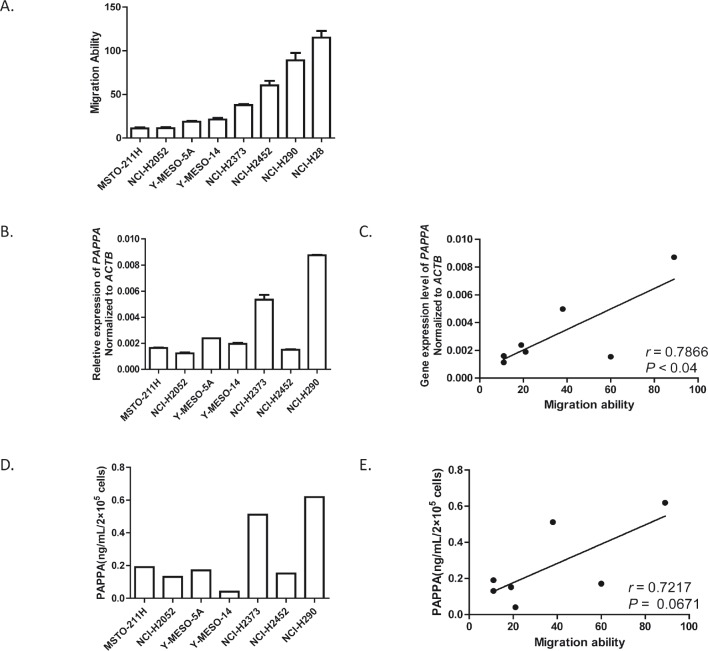
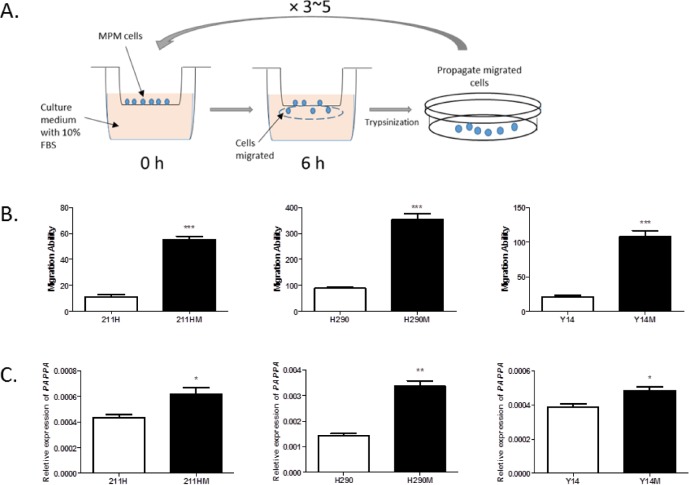
Despite recent advances in treatment, malignant pleural mesothelioma (MPM) remains a deadly disease. Targeted therapy generated broad interests and is highly expected for the treatment of MPM, yet promising preclinical results have not been translated into substantial clinical benefits for the patients. In this study, we tried to identify the genes which play functional roles in cell migration as well as to test whether they can be used as novel targets for molecular targeted therapy for MPM in preclinical model. In our study, pregnancy-associated plasma protein A (PAPPA) was identified as a gene whose expression level is correlated with MPM cell migration by correlation analysis combining MPM cell migration ability and their gene expression profiles. Highly migratory cells were selected from MPM cell lines, MSTO-211H, NCI-H290 and EHMES-1 in vitro and up-regulation of PAPPA in these cells were confirmed. In vitro, PAPPA was demonstrated to stimulate the MPM cell migration via cleavage of insulin-like growth factor-binding protein-4 and subsequent release of IGF-1. Gene silencing of PAPPA in MPM cells led to reduced migration, invasion and proliferation. Furthermore, PAPPA shRNA transfected NCI-H290 when orthotopically inoculated into pleural cavity of severe combined immunodeficiency recipient mice, failed to develop tumors and produce bloody pleural effusion as control shRNA transfected cells did. Our study suggests that PAPPA plays a functional role in promoting MPM cell migration and it might serve as a potential therapeutic target for the treatment of MPM.
尽管近期在治疗方面取得了进展,但恶性胸膜间皮瘤(MPM)仍然是一种致命疾病。靶向治疗引起了广泛关注,并被寄予厚望用于MPM的治疗,然而有前景的临床前研究结果尚未转化为对患者的实质性临床益处。在本研究中,我们试图鉴定在细胞迁移中发挥功能作用的基因,并测试它们是否可作为MPM分子靶向治疗临床前模型中的新靶点。在我们的研究中,通过结合MPM细胞迁移能力及其基因表达谱的相关性分析,妊娠相关血浆蛋白A(PAPPA)被鉴定为一种其表达水平与MPM细胞迁移相关的基因。从MPM细胞系MSTO-211H、NCI-H290和EHMES-1中体外筛选出高迁移性细胞,并证实这些细胞中PAPPA上调。在体外,PAPPA被证明可通过切割胰岛素样生长因子结合蛋白-4并随后释放IGF-1来刺激MPM细胞迁移。MPM细胞中PAPPA的基因沉默导致迁移、侵袭和增殖减少。此外,当将PAPPA shRNA转染的NCI-H290原位接种到严重联合免疫缺陷受体小鼠的胸腔中时,与转染对照shRNA的细胞不同,它未能形成肿瘤并产生血性胸腔积液。我们的研究表明,PAPPA在促进MPM细胞迁移中发挥功能作用,它可能作为治疗MPM潜在的治疗靶点。