Department of Psychiatry, Academic Medical Center, University of Amsterdam, Amsterdam, The Netherlands.
Transl Psychiatry. 2013 Jul 30;3(7):e288. doi: 10.1038/tp.2013.60.
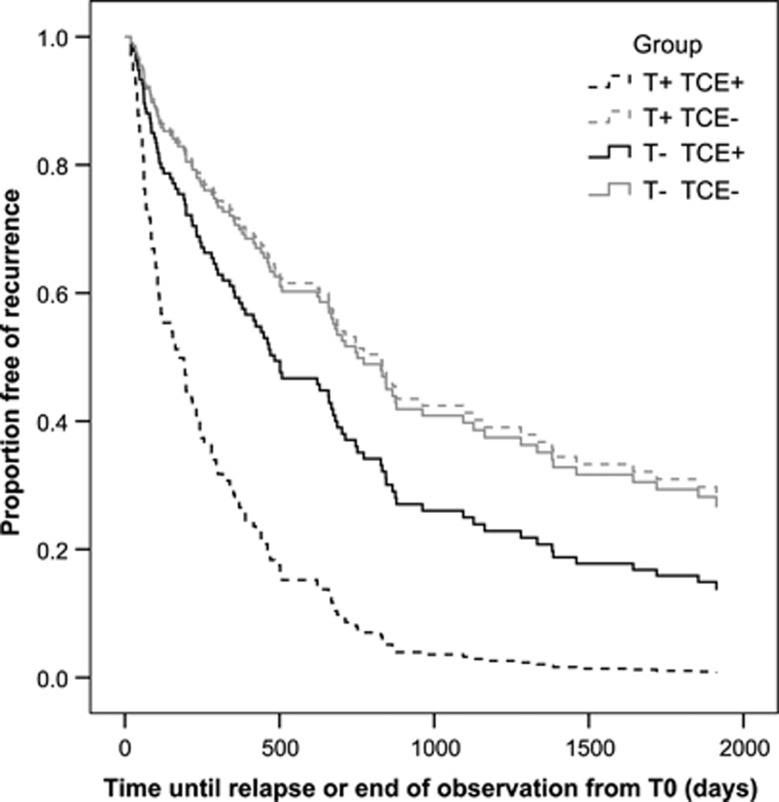
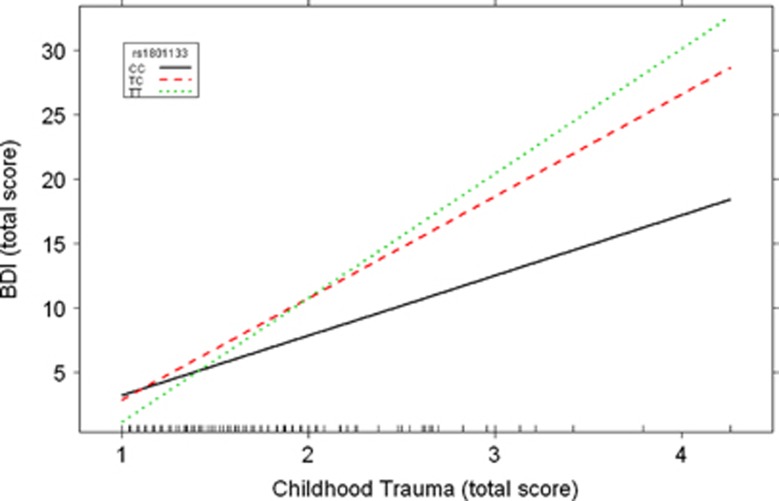
Childhood trauma is associated with the onset and recurrence of major depressive disorder (MDD). The thermolabile T variant of the methylenetetrahydrofolate reductase (MTHFR) C677T polymorphism (rs1801133) is associated with a limited (oxidative) stress defense. Therefore, C677T MTHFR could be a potential predictor for depressive symptomatology and MDD recurrence in the context of traumatic stress during early life. We investigated the interaction between the C677T MTHFR variant and exposure to traumatic childhood events (TCEs) on MDD recurrence during a 5.5-year follow-up in a discovery sample of 124 patients with recurrent MDD and, in an independent replication sample, on depressive symptomatology in 665 healthy individuals from the general population. In the discovery sample, Cox regression analysis revealed a significant interaction between MTHFR genotype and TCEs on MDD recurrence (P=0.017). Over the 5.5-year follow-up period, median time to recurrence was 191 days for T-allele carrying patients who experienced TCEs (T+ and TCE+); 461 days for T- and TCE+ patients; 773 days for T+ and TCE- patients and 866 days for T- and TCE- patients. In the replication sample, a significant interaction was present between the MTHFR genotype and TCEs on depressive symptomatology (P=0.002). Our results show that the effects of TCEs on the prospectively assessed recurrence of MDD and self-reported depressive symptoms in the general population depend on the MTHFR genotype. In conclusion, T-allele carriers may be at an increased risk for depressive symptoms or MDD recurrence after exposure to childhood trauma.
儿童期创伤与重性抑郁障碍(MDD)的发病和复发有关。亚甲基四氢叶酸还原酶(MTHFR)C677T 多态性(rs1801133)的热不稳定 T 变体与有限的(氧化)应激防御有关。因此,C677T MTHFR 可能是创伤性应激儿童时期发生的抑郁症状和 MDD 复发的潜在预测因子。我们研究了 C677T MTHFR 变体与暴露于创伤性童年事件(TCEs)之间的相互作用,以在一个包含 124 名复发性 MDD 患者的发现样本中对 MDD 在 5.5 年的随访期间的复发进行预测,并在一个独立的复制样本中对来自普通人群的 665 名健康个体的抑郁症状进行预测。在发现样本中,Cox 回归分析显示 MTHFR 基因型与 TCEs 对 MDD 复发之间存在显著的相互作用(P=0.017)。在 5.5 年的随访期间,携带 T 等位基因且经历 TCEs(T+和 TCE+)的患者复发的中位时间为 191 天;T-和 TCE+患者为 461 天;T+和 TCE-患者为 773 天;T-和 TCE-患者为 866 天。在复制样本中,MTHFR 基因型与 TCEs 之间存在显著的相互作用,对抑郁症状的影响(P=0.002)。我们的研究结果表明,TCEs 对一般人群中前瞻性评估的 MDD 复发和自我报告的抑郁症状的影响取决于 MTHFR 基因型。总之,暴露于儿童期创伤后,T 等位基因携带者可能面临更高的抑郁症状或 MDD 复发风险。