Gerges Noha, Fontebasso Adam M, Albrecht Steffen, Faury Damien, Jabado Nada
Departments of Pediatrics and Human Genetics, McGill University and McGill University Health Centre, Montreal, Quebec, Canada, H3Z2Z3.
Division of Experimental Medicine, McGill University and McGill University Health Centre, Montreal, Quebec, Canada, H3Z2Z3.
Genome Med. 2013 Jul 30;5(7):66. doi: 10.1186/gm470. eCollection 2013.
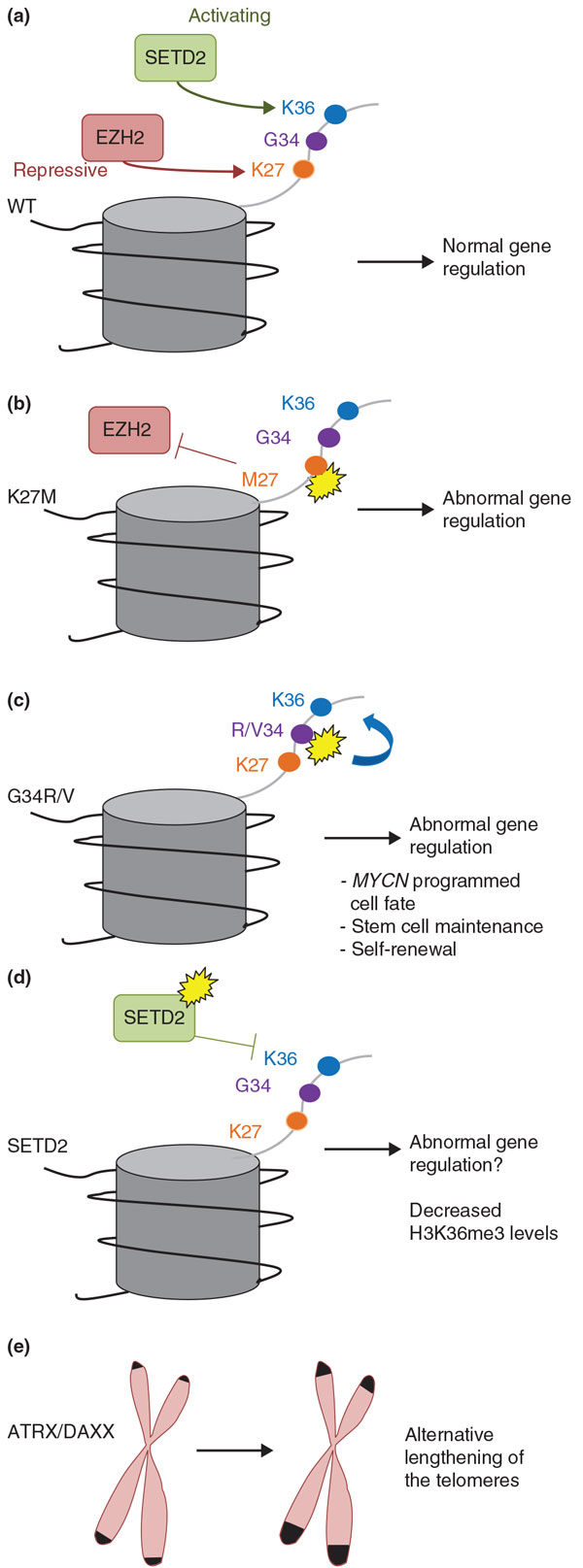
Brain tumors are the leading cause of cancer-related death in children. High-grade astrocytomas (HGAs), in particular, are lethal in children across all ages. Integrative genome-wide analyses of the tumor's genome, transcriptome and epigenome, using next-generation sequencing technologies and genome-wide DNA methylation arrays, have provided valuable breakthroughs in our understanding of the pathogenesis of HGAs across all ages. Recent profiling studies have provided insight into the epigenetic nature of gliomas in young adults and HGAs in children, particularly with the identification of recurrent gain-of-function driver mutations in the isocitrate dehydrogenase 1 and 2 genes (IDH1/2) and the epigenetic influence of their oncometabolite 2-hydroxyglutarate, as well as mutations in the histone 3 variant 3 gene (H3F3A) and loss-of-function mutations in the histone 3 lysine 36 trimethyltransferase gene (SETD2). Mutations in H3F3A result in amino acid substitutions at residues thought to directly (K27M) or indirectly (G34R/V) affect histone post-translational modifications, suggesting they have the capacity to affect the epigenome in a profound manner. Here, we review recent genomic studies, and discuss evidence supporting the molecular characterization of pediatric HGAs to complement traditional approaches, such as histology of resected tumors. We also describe newly identified molecular mechanisms and discuss putative therapeutic approaches for HGAs specific to pediatrics, highlighting the necessity for the evolution of HGA disease management approaches.
脑肿瘤是儿童癌症相关死亡的主要原因。特别是高级别星形细胞瘤(HGAs),对各年龄段的儿童都是致命的。利用下一代测序技术和全基因组DNA甲基化阵列对肿瘤的基因组、转录组和表观基因组进行综合全基因组分析,在我们对各年龄段HGAs发病机制的理解上取得了有价值的突破。最近的分析研究深入了解了年轻成人胶质瘤和儿童HGAs的表观遗传性质,特别是通过鉴定异柠檬酸脱氢酶1和2基因(IDH1/2)中反复出现的功能获得性驱动突变及其致癌代谢物2-羟基戊二酸的表观遗传影响,以及组蛋白3变体3基因(H3F3A)的突变和组蛋白3赖氨酸36三甲基转移酶基因(SETD2)的功能丧失突变。H3F3A中的突变导致被认为直接(K27M)或间接(G34R/V)影响组蛋白翻译后修饰的残基处的氨基酸替换,表明它们有能力以深远的方式影响表观基因组。在这里,我们回顾了最近的基因组研究,并讨论了支持对儿童HGAs进行分子特征分析以补充传统方法(如切除肿瘤的组织学检查)的证据。我们还描述了新发现的分子机制,并讨论了针对儿科特定HGAs的推定治疗方法,强调了HGAs疾病管理方法演变的必要性。