Seoul National University College of Medicine, 103 Daehak-ro, Jongro-gu, Seoul, Republic of Korea 110-460.
BMC Infect Dis. 2013 Aug 2;13:365. doi: 10.1186/1471-2334-13-365.
The need for mandatory confirmation of negative conversion in Klebsiella pneumoniae bacteremia (KpB) has not been adequately addressed. We conducted a retrospective case-control study of adult patients with KpB over a 5-year period in two tertiary-care hospitals to determine the risk factors for persistent bacteremia and to reevaluate the necessity of follow-up blood culture in KpB.
Persistent KpB is defined as the finding of K. pneumoniae in more than two separate blood-culture samples for longer than a two-day period in a single episode. The case- and control-groups were patients with persistent and non-persistent KpB, respectively, and they were matched 1-to-3 according to age and gender.
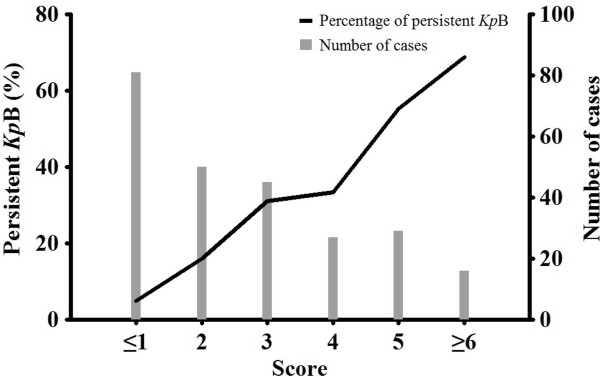
Among 1068 KpB episodes analyzed after excluding polymicrobial infection and repeated KpB, follow-up blood cultures were performed in 862 cases (80.7%), 62 of which (7.2%) were persistent. Independent risk factors for persistence were intra-abdominal infection, higher Charlson's comorbidity weighted index score, prior solid organ transplantation, and unfavorable treatment response, which was defined as positivity for at least two parameters among fever, leukocytosis, and no decrease of C-reactive protein on the second day after initial culture. A proposed scoring system using four variables, namely, intra-abdominal infection, nosocomial KpB, fever and lack of C-reactive protein decrease, the last two being assessed on the second day after the initial blood culture, showed that only 4.9% of the patients with no risk factors or with only intra-abdominal infection had persistent KpB.
Though persistent KpB is uncommon, follow-up blood culture was performed in as many as 80% of the cases in this study. A more careful clinical assessment is warranted to reduce the cost and patient inconvenience involved in follow-up blood culture.
对于肺炎克雷伯菌血症(KpB),需要强制性确认阴性转换,但这一需求尚未得到充分满足。我们对两家三级医院的 5 年间成人 KpB 患者进行了回顾性病例对照研究,以确定持续性菌血症的危险因素,并重新评估 KpB 随访血培养的必要性。
持续性 KpB 定义为在单次感染中,2 天以上时间内从超过 2 份单独的血培养样本中发现肺炎克雷伯菌。病例组和对照组分别为持续性和非持续性 KpB 患者,按照年龄和性别 1:3 匹配。
在排除混合感染和重复 KpB 后,对 1068 例 KpB 发作进行了分析,其中 862 例(80.7%)进行了随访血培养,其中 62 例(7.2%)为持续性。持续性的独立危险因素为腹腔内感染、较高的 Charlson 合并症加权指数评分、既往实体器官移植和治疗反应不佳,其定义为在初始培养后的第二天至少有 2 个参数呈阳性,即发热、白细胞增多和 C 反应蛋白无下降。使用 4 个变量(即腹腔内感染、医院获得性 KpB、发热和缺乏 C 反应蛋白下降,后两者在初始血培养后第二天评估)提出的评分系统表明,无危险因素或仅腹腔内感染的患者中,只有 4.9%出现持续性 KpB。
尽管持续性 KpB 并不常见,但在本研究中,多达 80%的病例进行了随访血培养。需要更仔细的临床评估,以减少随访血培养的成本和给患者带来的不便。