Kitaya Shiori, Kanamori Hajime, Baba Hiroaki, Oshima Kengo, Takei Kentarou, Seike Issei, Katsumi Makoto, Katori Yukio, Tokuda Koichi
Department of Infectious Diseases, Internal Medicine, Tohoku University Graduate School of Medicine, Sendai 980-8574, Japan.
Department of Otolaryngology, Head and Neck Surgery, Tohoku University Graduate School of Medicine, Sendai 980-8574, Japan.
Pathogens. 2023 Jan 29;12(2):212. doi: 10.3390/pathogens12020212.
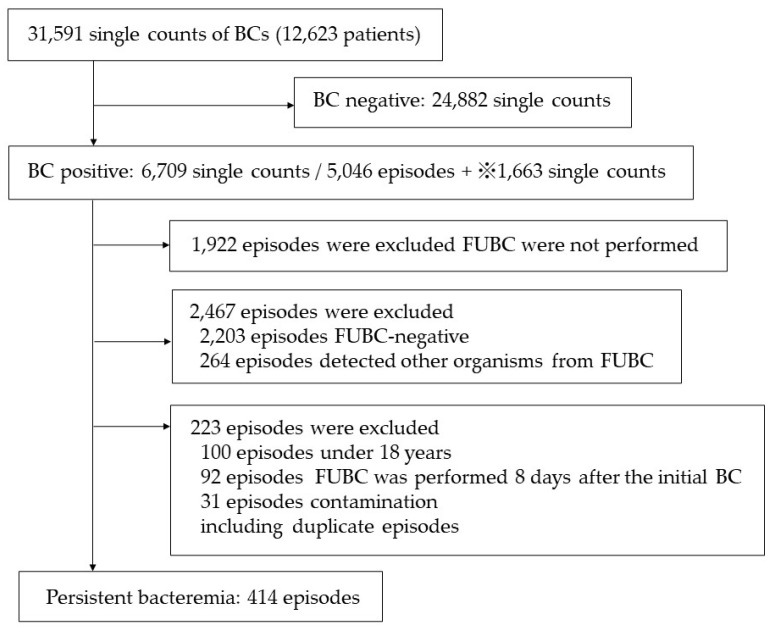
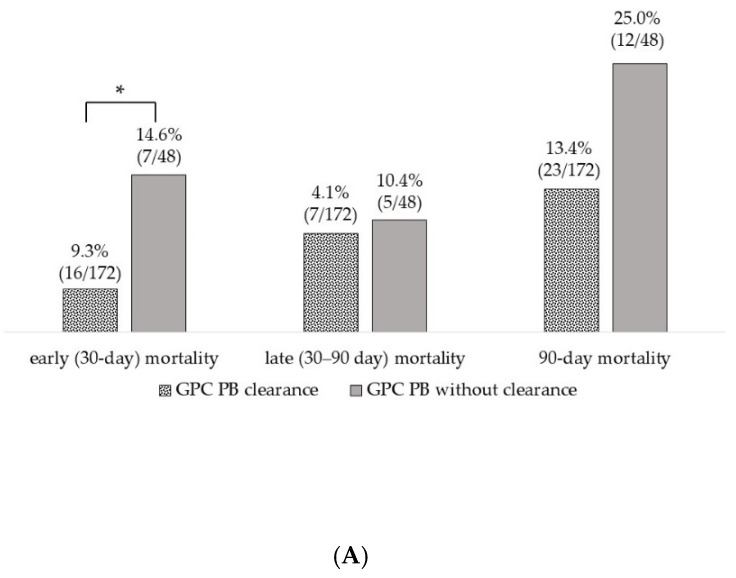
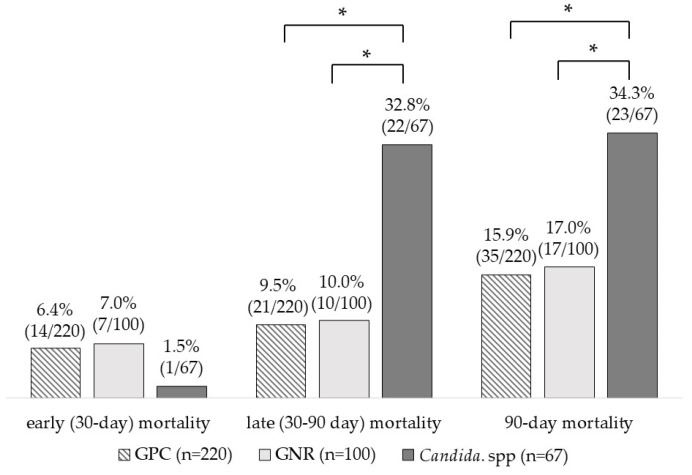
: Bloodstream infections (BSIs), including persistent bacteremia (PB), are a leading source of morbidity and mortality globally. PB has a higher mortality rate than non- PB, but the clinical aspects of PB in terms of the causative pathogens and the presence of clearance of PB are not well elucidated. Therefore, this study aimed to describe the clinical and epidemiological characteristics of PB in a real-world clinical setting. : We performed a retrospective observational survey of patients who underwent blood culture between January 2012 and December 2021 at Tohoku University Hospital. Cases of PB were divided into three groups depending on the causative pathogen: gram-positive cocci (GPC), gram-negative rods (GNRs), and spp. For each group, we examined the clinical and epidemiological characteristics of PB, including differences in clinical features depending on the clearance of PB. The main outcome variable was mortality, assessed as early (30-day), late (30-90 day), and 90-day mortality. : Overall, we identified 31,591 cases of single bacteremia; in 6709 (21.2%) cases, the first blood culture was positive, and in 3124 (46.6%) cases, a follow-up blood culture (FUBC) was performed. Of the cases with FUBCs, 414 (13.2%) were confirmed to be PB. The proportion of PB cases caused by spp. was significantly higher (29.6%, 67/226 episodes) than that for GPC (11.1%, 220/1974 episodes, < 0.001) and GNRs (12.1%, 100/824 episodes, < 0.001). The spp. group also had the highest late (30-90 day) and 90-day mortality rates. In all three pathogen groups, the subgroup without the clearance of PB tended to have a higher mortality rate than the subgroup with clearance. : Patients with PB due to spp. have a higher late (30-90 day) and 90-day mortality rate than patients with PB due to GPC or GNRs. In patients with PB, FUBCs and confirming the clearance of PB are useful to improve the survival rate.
血流感染(BSIs),包括持续性菌血症(PB),是全球发病和死亡的主要原因。PB的死亡率高于非PB,但PB在致病病原体和PB清除方面的临床情况尚未得到充分阐明。因此,本研究旨在描述真实临床环境中PB的临床和流行病学特征。我们对2012年1月至2021年12月在东北大学医院接受血培养的患者进行了一项回顾性观察调查。PB病例根据致病病原体分为三组:革兰氏阳性球菌(GPC)、革兰氏阴性杆菌(GNRs)和[具体菌种]。对于每组,我们研究了PB的临床和流行病学特征,包括根据PB清除情况的临床特征差异。主要结局变量是死亡率,评估为早期(30天)、晚期(30 - 90天)和90天死亡率。总体而言,我们确定了31591例单菌血症病例;在6709例(21.2%)病例中,首次血培养呈阳性,在3124例(46.6%)病例中进行了随访血培养(FUBC)。在进行FUBC的病例中,414例(13.2%)被确认为PB。由[具体菌种]引起的PB病例比例(29.6%,67/226次发作)显著高于GPC(11.1%,220/1974次发作,P < 0.001)和GNRs(12.1%,100/824次发作,P < 0.001)。[具体菌种]组的晚期(30 - 90天)和90天死亡率也最高。在所有三个病原体组中,未清除PB的亚组死亡率往往高于清除PB的亚组。由[具体菌种]引起PB的患者的晚期(30 - 90天)和90天死亡率高于由GPC或GNRs引起PB的患者。在PB患者中,FUBC和确认PB清除有助于提高生存率。