Health Services Research and Development, VA Health System, Durham, NC, USA.
BMC Fam Pract. 2013 Aug 6;14:111. doi: 10.1186/1471-2296-14-111.
Family health history (FHH) is the single strongest predictor of disease risk and yet is significantly underutilized in primary care. We developed a patient facing FHH collection tool, MeTree, that uses risk stratification to generate clinical decision support for breast cancer, colorectal cancer, ovarian cancer, hereditary cancer syndromes, and thrombosis. Here we present data on the experience of patients and providers after integration of MeTree into 2 primary care practices.
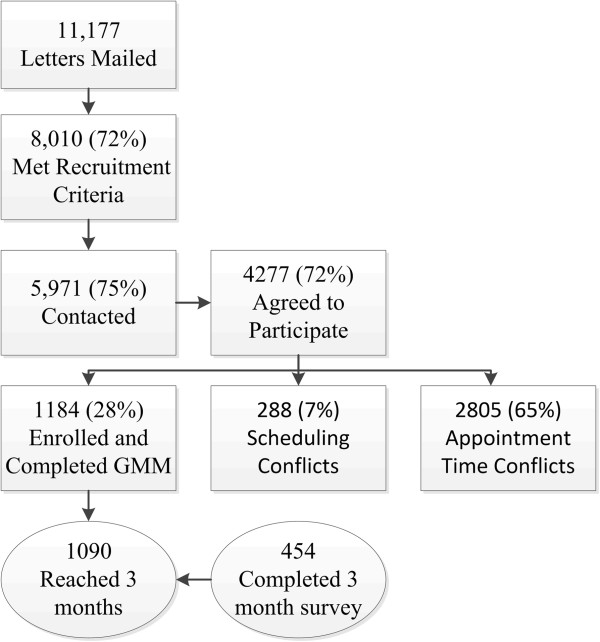
This was a Type 2 hybrid controlled implementation-effectiveness study in 3 community-based primary care clinics in Greensboro, NC. All non-adopted adult English speaking patients with upcoming routine appointments were invited. Patients were recruited from December 2009 to the present and followed for one year. Ease of integration of MeTree into clinical practice at the two intervention clinics was evaluated through patient surveys after their appointment and at 3 months post-visit, and physician surveys 3 months after tool integration.
Total enrollment =1,184. Average time to complete MeTree = 27 minutes. Patients found MeTree: easy to use (93%), easy to understand (97%), useful (98%), raised awareness of disease risk (85%), and changed how they think about their health (86%). Of the 26% (N = 311) asking for assistance to complete the tool, age (65 sd 9.4 vs. 57 sd 11.8, p-value < 0.00) and large pedigree size (24.4 sd 9.81 vs. 22.2 sd 8.30, p-value < 0.00) were the only significant factors; 77% of those requiring assistance were over the age of 60. Providers (N = 14) found MeTree: improved their practice (86%), improved their understanding of FHH (64%), made practice easier (79%), and worthy of recommending to their peers (93%).
Our study shows that MeTree has broad acceptance and support from both patients and providers and can be implemented without disruption to workflow.
家族健康史(FHH)是疾病风险的最强预测因素,但在初级保健中却未得到充分利用。我们开发了一种面向患者的 FHH 收集工具,MeTree,它使用风险分层为乳腺癌、结直肠癌、卵巢癌、遗传性癌症综合征和血栓形成提供临床决策支持。这里我们介绍了将 MeTree 整合到 2 个初级保健实践中的患者和提供者的经验数据。
这是北卡罗来纳州格林斯伯勒的 3 个社区初级保健诊所的 2 型混合控制实施效果研究。所有即将进行常规预约的非采用成年英语患者均被邀请参加。从 2009 年 12 月开始招募患者,并随访一年。通过患者在预约后的随访和就诊后 3 个月以及医生在工具整合后 3 个月进行的调查,评估 MeTree 在两个干预诊所的临床实践中的整合难易程度。
总入组人数=1184。完成 MeTree 的平均时间为 27 分钟。患者发现 MeTree:易于使用(93%)、易于理解(97%)、有用(98%)、提高了对疾病风险的认识(85%)、并改变了他们对健康的看法(86%)。在要求协助完成工具的 26%(N=311)的患者中,年龄(65 岁标准差 9.4 岁与 57 岁标准差 11.8 岁,p 值<0.00)和大系谱大小(24.4 岁标准差 9.81 岁与 22.2 岁标准差 8.30 岁,p 值<0.00)是唯一的显著因素;需要协助的患者中 77%的年龄超过 60 岁。提供者(N=14)发现 MeTree:改善了他们的实践(86%)、改善了他们对 FHH 的理解(64%)、使实践更容易(79%)、并值得向他们的同行推荐(93%)。
我们的研究表明,MeTree 得到了患者和提供者的广泛认可和支持,并且可以在不中断工作流程的情况下实施。