Institute of Anatomy and Cell Biology, National Yang-Ming University, Taipei11221, Taiwan.
J Biomed Sci. 2013 Aug 2;20(1):54. doi: 10.1186/1423-0127-20-54.
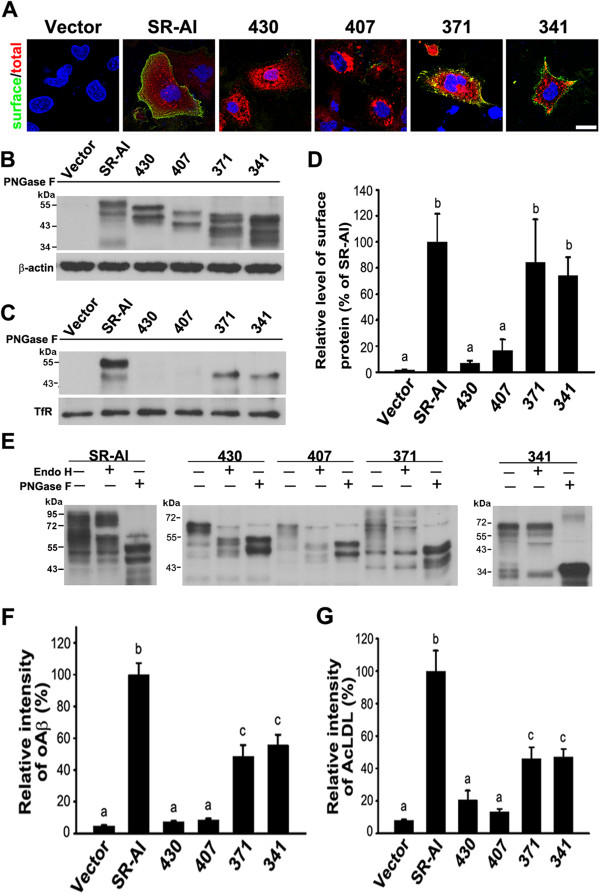
Insufficient clearance of soluble oligomeric amyloid-β peptide (oAβ) in the central nervous system leads to the synaptic and memory deficits in Alzheimer's disease (AD). Previously we have identified scavenger receptor class A (SR-A) of microglia mediates oligomeric amyloid-β peptide (oAβ) internalization by siRNA approach. SR-A is a member of cysteine-rich domain (SRCR) superfamily which contains proteins actively modulating the innate immunity and host defense, however the functions of the SRCR domain remain unclear. Whether the SRCR domain of SR-AI modulates the receptor surface targeting and ligand internalization was investigated by expressing truncated SR-A variants in COS-7 cells. Surface targeting of SR-A variants was examined by live immunostaining and surface biotinylation assays. Transfected COS-7 cells were incubated with fluorescent oAβ and acetylated LDL (AcLDL) to assess their ligand-internalization capabilities.
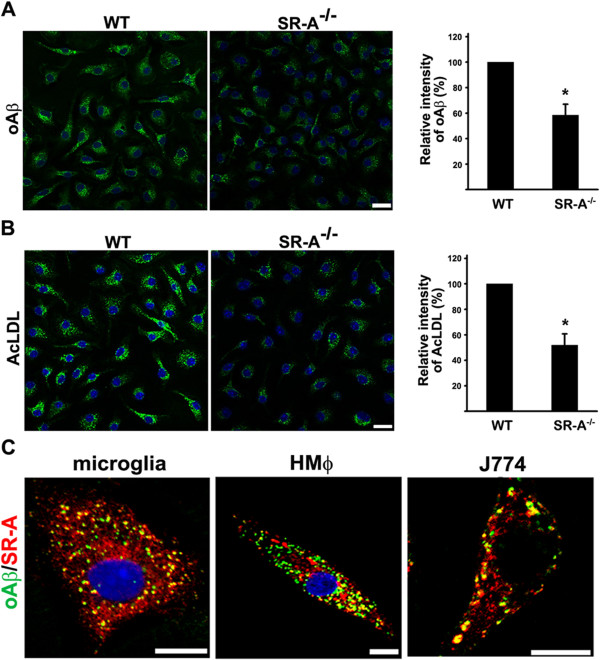
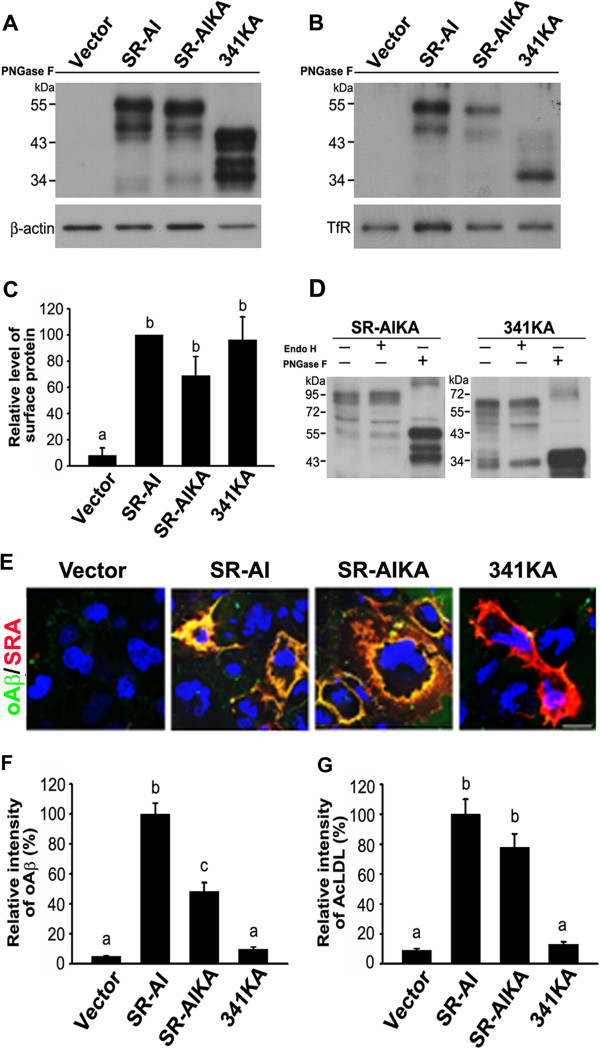
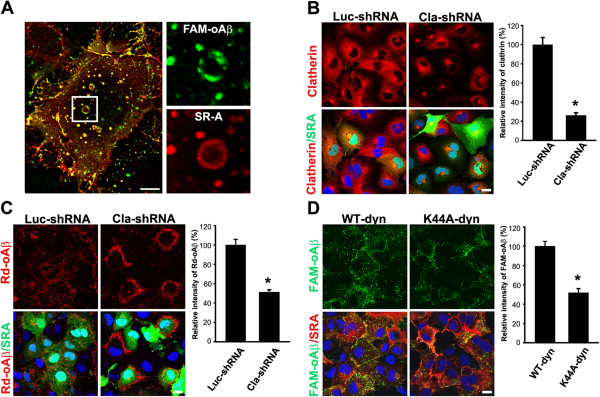
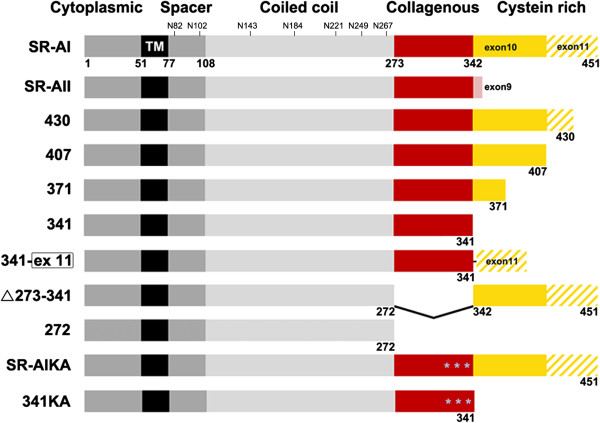
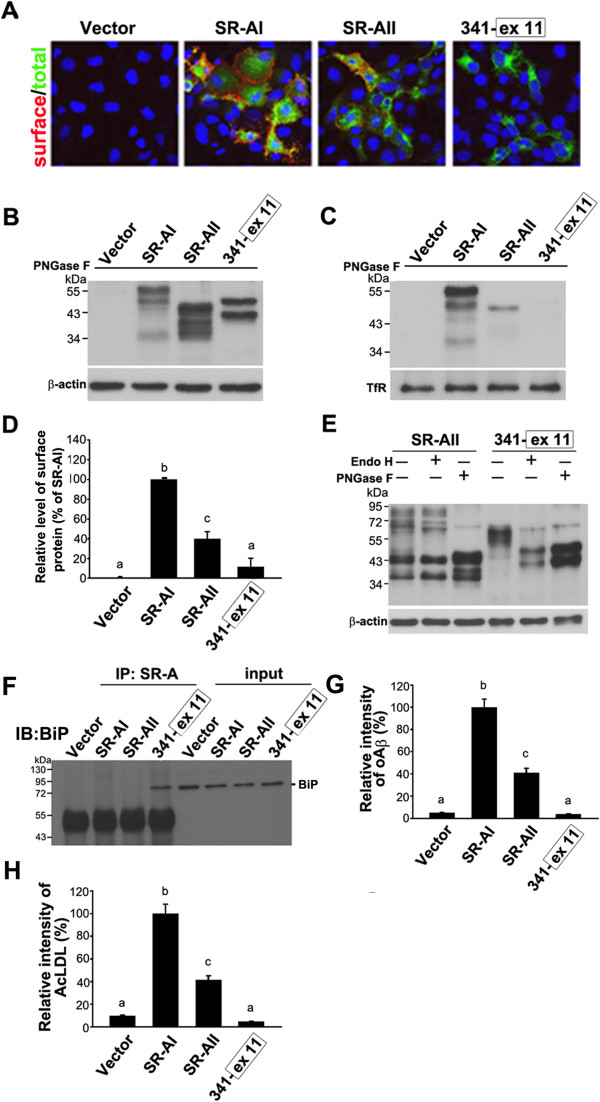
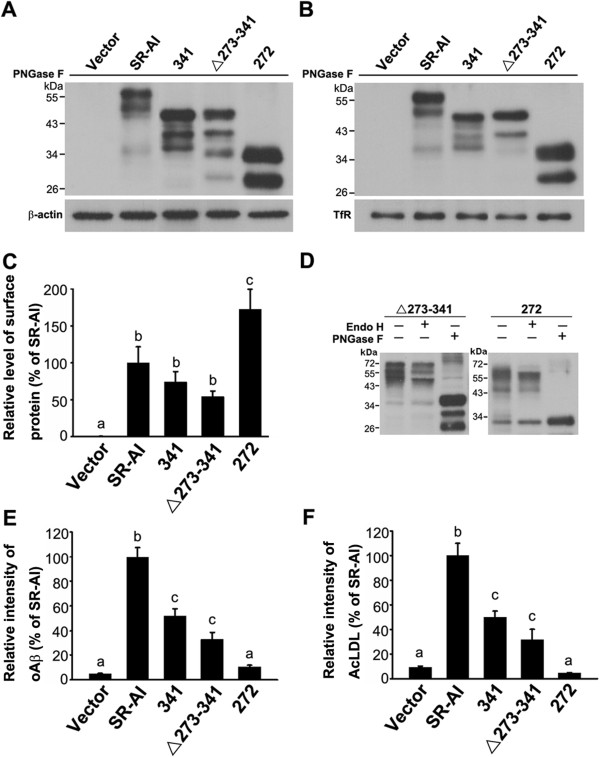
Genetic ablation of SR-A attenuated the internalization of oAβ and AcLDL by microglia. Half of oAβ-containing endocytic vesicles was SR-A positive in both microglia and macrophages. Clathrin and dynamin in SR-AI-mediated oAβ internalization were involved. The SRCR domain of SR-AI is encoded by exons 10 and 11. SR-A variants with truncated exon 11 were intracellularly retained, whereas SR-A variants with further truncations into exon 10 were surface-targeted. The fusion of exon 11 to the surface-targeted SR-A variant lacking the SRCR domain resulted in the intracellular retention and the co-immunoprecipitation of Bip chaperon of the endoplasmic reticulum. Surface-targeted variants were N-glycosylated, whereas intracellularly-retained variants retained in high-mannose states. In addition to the collagenous domain, the SRCR domain is a functional binding domain for oAβ and AcLDL. Our data suggest that inefficient folding of SR-AI variants with truncated SRCR domain was recognized by the endoplasmic reticulum associated degradation which leads to the immature N- glycosylation and intracellular retention.
The novel functions of the SRCR domain on regulating the efficacy of receptor trafficking and ligand binding may lead to possible approaches on modulating the innate immunity in Alzheimer's disease and atherosclerosis.
中枢神经系统中可溶性寡聚淀粉样β肽(oAβ)的清除不足导致阿尔茨海默病(AD)的突触和记忆缺陷。以前我们已经确定小胶质细胞的清道夫受体 A(SR-A)通过 siRNA 方法介导寡聚淀粉样β肽(oAβ)的内化。SR-A 是富含半胱氨酸结构域(SRCR)超家族的成员,该家族包含积极调节先天免疫和宿主防御的蛋白质,但 SRCR 结构域的功能仍不清楚。是否通过在 COS-7 细胞中表达截断的 SR-A 变体来调节 SR-AI 的 SRCR 结构域的受体表面靶向和配体内化。通过活免疫染色和表面生物素化测定来检查 SR-A 变体的表面靶向。用荧光 oAβ和乙酰化 LDL(AcLDL)孵育转染的 COS-7 细胞,以评估其配体内化能力。
SR-A 的遗传缺失减弱了小胶质细胞对 oAβ和 AcLDL 的内化。在小胶质细胞和巨噬细胞中,一半含有 oAβ的内吞小泡呈 SR-A 阳性。网格蛋白和动力蛋白参与了 SR-AI 介导的 oAβ内化。SR-AI 的 SRCR 结构域由外显子 10 和 11 编码。截短外显子 11 的 SR-A 变体被保留在细胞内,而进一步截短到外显子 10 的 SR-A 变体则靶向表面。将外显子 11 融合到缺乏 SRCR 结构域的靶向表面的 SR-A 变体上,导致内质网伴侣 Bip 的细胞内保留和共免疫沉淀。靶向表面的变体被 N-糖基化,而保留在细胞内的变体则以高甘露糖状态保留。除了胶原结构域外,SRCR 结构域还是 oAβ和 AcLDL 的功能结合域。我们的数据表明,具有截断 SRCR 结构域的 SR-AI 变体的低效折叠被内质网相关降解所识别,这导致不成熟的 N-糖基化和细胞内保留。
SRCR 结构域在调节受体运输和配体结合效率方面的新功能可能为调节阿尔茨海默病和动脉粥样硬化中的先天免疫提供可能的方法。