Cancer Research UK, Paterson Institute for Cancer Research, University of Manchester, Wilmslow Road, Manchester M20 4BX, UK.
Nat Commun. 2013;4:2164. doi: 10.1038/ncomms3164.
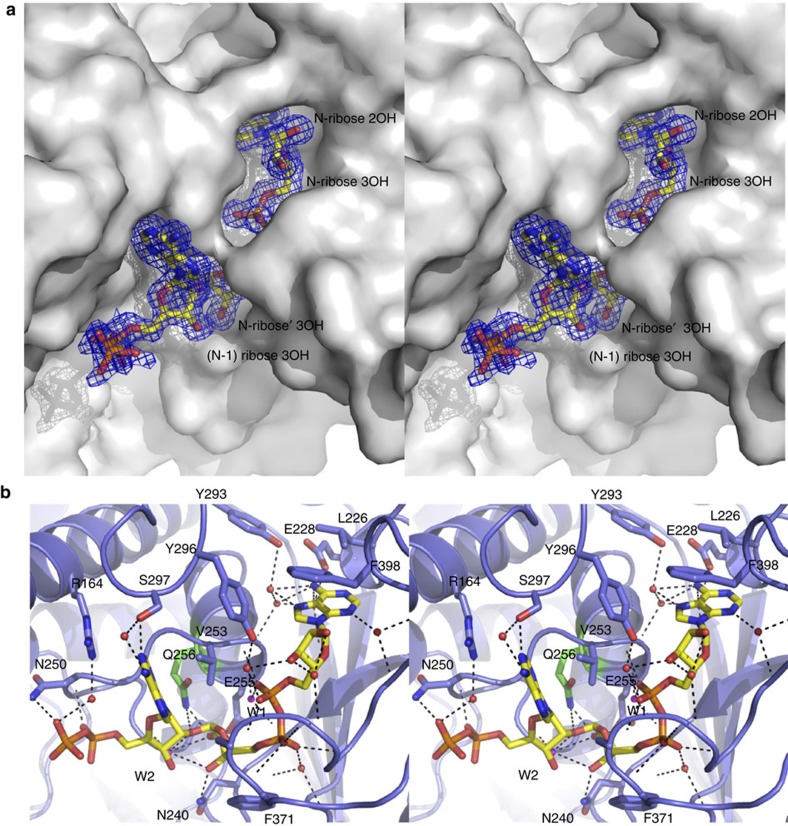
Poly-ADP-ribosylation is a post-translational modification that regulates processes involved in genome stability. Breakdown of the poly(ADP-ribose) (PAR) polymer is catalysed by poly(ADP-ribose) glycohydrolase (PARG), whose endo-glycohydrolase activity generates PAR fragments. Here we present the crystal structure of PARG incorporating the PAR substrate. The two terminal ADP-ribose units of the polymeric substrate are bound in exo-mode. Biochemical and modelling studies reveal that PARG acts predominantly as an exo-glycohydrolase. This preference is linked to Phe902 (human numbering), which is responsible for low-affinity binding of the substrate in endo-mode. Our data reveal the mechanism of poly-ADP-ribosylation reversal, with ADP-ribose as the dominant product, and suggest that the release of apoptotic PAR fragments occurs at unusual PAR/PARG ratios.
聚 ADP-核糖基化是一种翻译后修饰,可调节涉及基因组稳定性的过程。多聚 ADP-核糖 (PAR) 聚合物的分解由多聚 ADP-核糖糖水解酶 (PARG) 催化,其内切糖水解酶活性产生 PAR 片段。在此,我们呈现了包含 PAR 底物的 PARG 的晶体结构。聚合物底物的两个末端 ADP-核糖单位以外切模式结合。生化和建模研究表明,PARG 主要作为外切糖水解酶起作用。这种偏好与 Phe902(人编号)有关,它负责底物在内切模式下的低亲和力结合。我们的数据揭示了聚 ADP-核糖基化逆转的机制,以 ADP-核糖为主要产物,并表明凋亡 PAR 片段的释放发生在异常的 PAR/PARG 比。