Chair for Healthcare Telematics and Medical Engineering, Otto-von-Guericke University, Magdeburg, Germany,
Int J Comput Assist Radiol Surg. 2014 Mar;9(2):323-32. doi: 10.1007/s11548-013-0925-4. Epub 2013 Aug 6.
Electromagnetic tracking systems, frequently used in minimally invasive surgery, are affected by conductive distorters. The influence of conductive distorters on electromagnetic tracking system accuracy can be reduced through magnetic field modifications. This approach was developed and tested.
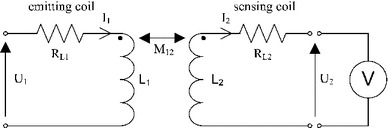
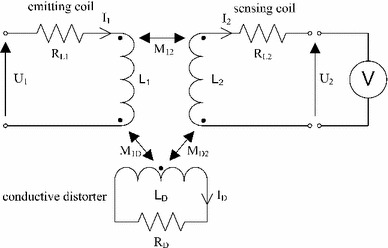
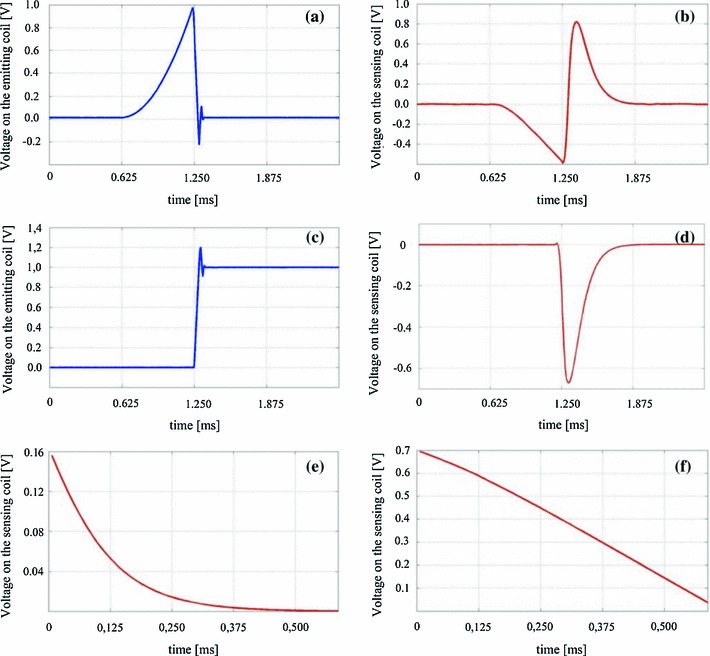
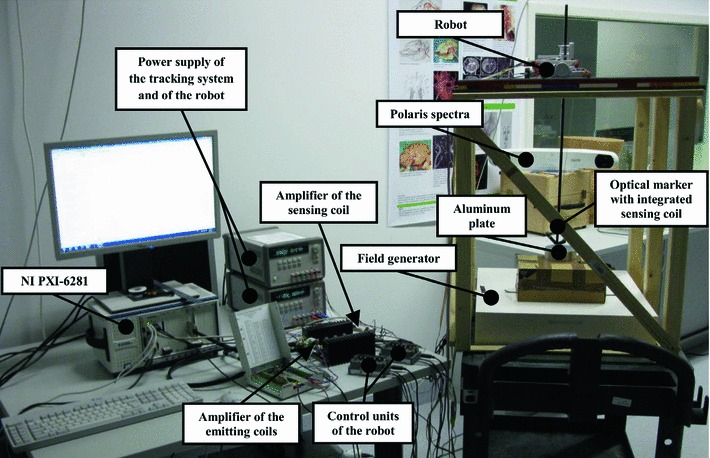
The voltage induced directly by the emitting coil in the sensing coil without additional influence by the conductive distorter depends on the first derivative of the voltage on the emitting coil. The voltage which is induced indirectly by the emitting coil across the conductive distorter in the sensing coil, however, depends on the second derivative of the voltage on the emitting coil. The electromagnetic tracking system takes advantage of this difference by supplying the emitting coil with a quadratic excitation voltage. The method is adaptive relative to the amount of distortion cause by the conductive distorters. This approach is evaluated with an experimental setup of the electromagnetic tracking system.
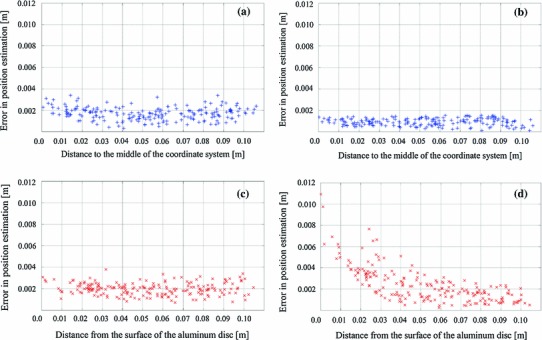
In vitro testing showed that the maximal error decreased from 10.9 to 3.8 mm when the quadratic voltage was used to excite the emitting coil instead of the sinusoidal voltage. Furthermore, the root mean square error in the proximity of the aluminum disk used as a conductive distorter was reduced from 3.5 to 1.6 mm when the electromagnetic tracking system used the quadratic instead of sinusoidal excitation.
Electromagnetic tracking with quadratic excitation is immune to the effects of a conductive distorter, especially compared with sinusoidal excitation of the emitting coil. Quadratic excitation of electromagnetic tracking for computer-assisted surgery is promising for clinical applications.
电磁跟踪系统常用于微创手术,但其会受到导体干扰器的影响。通过改变磁场,可降低导体干扰器对电磁跟踪系统精度的影响。本研究旨在开发并测试这一方法。
在没有导体干扰器额外影响的情况下,发射线圈在感应线圈中产生的感应电压直接取决于发射线圈上的电压一阶导数。然而,发射线圈通过导体干扰器在感应线圈中产生的感应电压间接取决于发射线圈上的电压二阶导数。电磁跟踪系统利用这一差异,为发射线圈提供二次激励电压。该方法对导体干扰器造成的失真量具有自适应能力。通过电磁跟踪系统的实验装置对该方法进行了评估。
体外测试表明,与使用正弦电压激励发射线圈相比,使用二次电压激励时,最大误差从 10.9 毫米降低到 3.8 毫米。此外,当电磁跟踪系统使用二次激励而不是正弦波激励时,在靠近用作导体干扰器的铝盘的位置,均方根误差从 3.5 毫米降低到 1.6 毫米。
与正弦波激励的发射线圈相比,二次激励的电磁跟踪具有抗导体干扰器的能力,尤其是在这种情况下。用于计算机辅助手术的电磁跟踪的二次激励具有很大的临床应用潜力。