Department of Pharmacology and Pharmacy, Centre for Safe Medication Practice and Research, Li Ka Shing Faculty of Medicine, University of Hong Kong, 2/F Laboratory Block, 21 Sassoon Road, Hong Kong SAR, China,
CNS Drugs. 2013 Oct;27(10):817-27. doi: 10.1007/s40263-013-0091-9.
Perampanel is a first-in-class antiepileptic drug approved for adjunctive treatment of partial-onset seizure in patients aged 12 years or older. Published randomised controlled trials (RCTs) had small sample sizes, and meta-analyses have included too few studies to draw conclusive results for the assessment of tolerability, efficacy and safety of perampanel. There is a need to conduct a meta-analysis with a larger dataset and an appropriate study design.
The aim of this study was to systematically review the efficacy and safety of perampanel in the treatment of partial-onset epilepsy.
Electronic and clinical trials databases were searched for RCTs of perampanel published up to March 2013. Outcomes of interest were 50 % responder rates, seizure freedom, treatment-emergent adverse events (TEAEs) and incidence of withdrawal. Meta-analysis was performed to investigate the outcomes of interest.
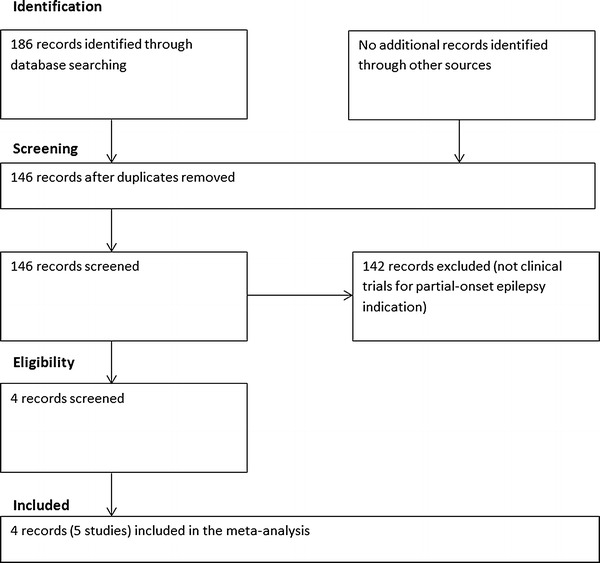
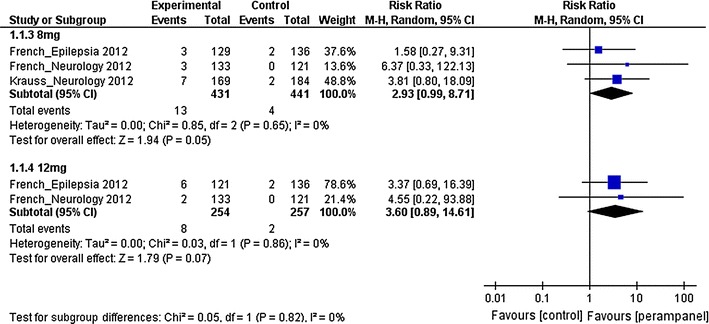
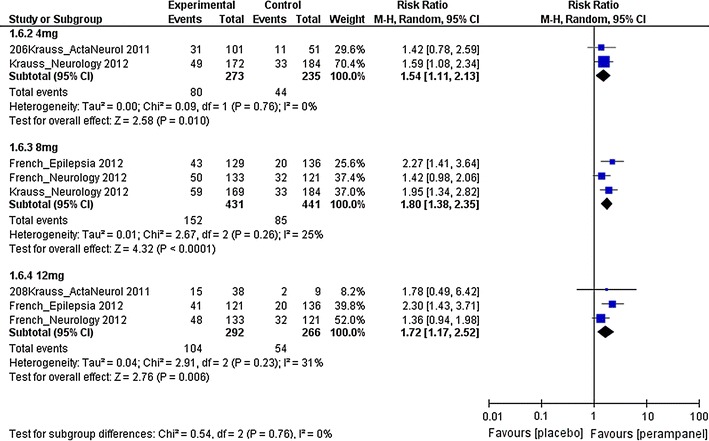
Five RCTs with a total of 1,678 subjects were included. The 50 % responder rates were significantly greater in patients receiving 4, 8 and 12 mg perampanel versus placebo, with risk ratios of 1.54 (95 % CI 1.11-2.13), 1.80 (95 % CI 1.38-2.35) and 1.72 (95 % CI 1.17-2.52), respectively. There was no statistical evidence of a difference in seizure freedom between 8 or 12 mg perampanel and placebo. Of the five commonly reported TEAEs included, both dizziness and somnolence were statistically associated with 8 mg perampanel, whilst dizziness was statistically associated with 12 mg perampanel. Incidences of withdrawal due to adverse events were significantly higher in the 8 mg and 12 mg perampanel groups versus placebo.
The use of perampanel resulted in a statistically significant reduction of seizure frequency with respect to the 50 % responder rate in patients with partial-onset epilepsy. Perampanel is well tolerated at 4 mg and reasonably tolerated at 8 and 12 mg. Further clinical and pharmacovigilance studies are required to investigate the long-term efficacy and safety of perampanel in the management of other types of epilepsy.
吡仑帕奈是一种新型抗癫痫药物,适用于 12 岁及以上部分发作性癫痫患者的辅助治疗。已发表的随机对照试验(RCT)样本量较小,且荟萃分析纳入的研究太少,无法得出吡仑帕奈耐受性、疗效和安全性评估的结论。因此,有必要进行一项具有更大数据集和适当研究设计的荟萃分析。
本研究旨在系统评价吡仑帕奈治疗部分性癫痫的疗效和安全性。
检索截至 2013 年 3 月发表的吡仑帕奈 RCTs 的电子和临床试验数据库。主要观察终点为 50%应答率、无癫痫发作、治疗中出现的不良事件(TEAEs)和停药率。采用荟萃分析对各观察终点进行分析。
共纳入 5 项 RCT,共 1678 例患者。与安慰剂相比,接受 4、8 和 12 mg 吡仑帕奈治疗的患者的 50%应答率显著更高,风险比分别为 1.54(95%CI 1.11-2.13)、1.80(95%CI 1.38-2.35)和 1.72(95%CI 1.17-2.52)。8 或 12 mg 吡仑帕奈与安慰剂之间无统计学证据表明无癫痫发作存在差异。5 项常见的报告 TEAEs 中,头晕和嗜睡均与 8 mg 吡仑帕奈显著相关,而头晕与 12 mg 吡仑帕奈显著相关。因不良事件导致停药的发生率在 8 mg 和 12 mg 吡仑帕奈组明显高于安慰剂组。
在部分性癫痫患者中,与 50%应答率相比,吡仑帕奈治疗可显著降低癫痫发作频率。吡仑帕奈 4 mg 时具有良好的耐受性,8 mg 和 12 mg 时具有合理的耐受性。需要进一步的临床和药物警戒研究来调查吡仑帕奈在其他类型癫痫治疗中的长期疗效和安全性。